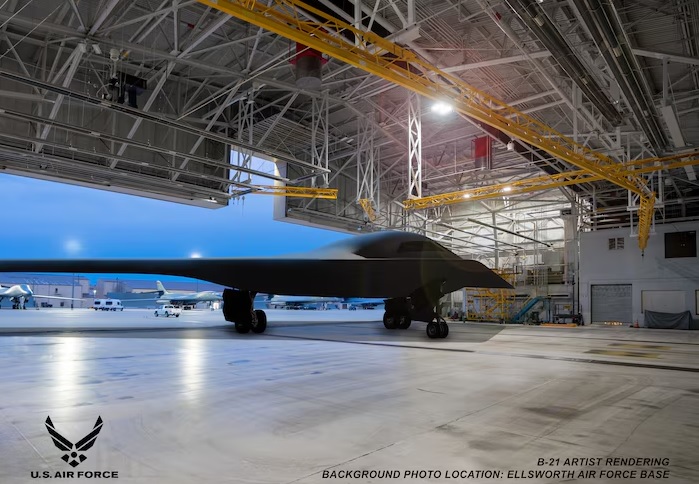
ELLSWORTH AIR FORCE BASE, S.D. — The U.S. Air Force has taken another step toward introducing the B-21 Raider into operational service after formally accepting the first two facilities built specifically for the next-generation stealth bomber at Ellsworth Air Force Base during a visit by Secretary of the Air Force Troy Meink on June 30 and July 1, 2026.
During the visit, Meink reviewed the 28th Bomb Wing's ongoing B-1B Lancer operations and inspected progress on the base's transition to the B-21 Raider. Ellsworth has been selected as the Air Force's first main operating base and formal training unit for the new bomber and is undergoing an infrastructure modernization program valued at approximately $2 billion while continuing to support active B-1B missions.
A key milestone during the visit was the official acceptance of the first completed B-21 support facilities: the $161 million Low Observable Restoration Facility and the $81 million Wash Rack and General Maintenance Hangar. These are the first completed projects in the larger construction effort designed to support future B-21 operations.
"Taking ownership of these facilities is a step toward fielding advanced capabilities at scale," Meink said. "The infrastructure completed today is truly innovative, allowing us to preserve the technological edge and deliver the long-range deterrence our nation depends on."
The Low Observable Restoration Facility has been designed to maintain the B-21 Raider's stealth characteristics. The climate-controlled building allows maintenance personnel to inspect, clean and repair the aircraft's radar-absorbent materials in a controlled indoor environment, helping reduce maintenance downtime while preserving its low-observable capabilities.
The adjacent Wash Rack and General Maintenance Hangar will support routine inspections, aircraft washing, servicing and general maintenance required to keep the bomber ready for operations.
Following the formal handover, teams from the 28th Bomb Wing began fitting out both facilities by installing secure information technology systems, communications equipment, furnishings and mission support equipment needed before the arrival of the first production B-21 aircraft.
While preparing for the new bomber, Ellsworth continues to operate its fleet of B-1B Lancer aircraft. During the visit, Meink received updates on current B-1B operations and the challenges of maintaining today's long-range strike missions while building the infrastructure for the Air Force's future bomber force.
Col. Jonathan Keller, commander of the 28th Bomb Wing, said the base is managing both missions simultaneously.
"The base is actively flying the B-1 globally while simultaneously building the infrastructure for the next generation of airpower," Keller said. "Accepting the keys to our first B-21 facilities is exciting for our Airmen, our civil engineer teams and the community partners who support our long-range strike mission."
Continuing B-1B operations during the transition is part of the Air Force's effort to avoid any gap in long-range strike capability as the B-21's infrastructure, training and sustainment systems are established.
Developed by Northrop Grumman under the Long Range Strike Bomber program, the B-21 Raider is the Air Force's next-generation strategic stealth bomber. The engineering and manufacturing development contract, valued at $21.4 billion, was awarded in October 2015. The program uses digital engineering and advanced manufacturing techniques intended to reduce development risks and simplify future software and hardware upgrades.
The Air Force plans to acquire at least 100 B-21 Raiders, which will gradually replace the B-1B Lancer and B-2 Spirit fleets while operating alongside the modernized B-52J Stratofortress. The aircraft is designed to penetrate heavily defended airspace and features open mission systems architecture, secure network connectivity and the ability to integrate with other military platforms, including fifth-generation fighters, collaborative combat aircraft and space-based systems.
According to recent program updates, the first B-21 aircraft is expected to arrive at Ellsworth in 2027, with one of the test aircraft currently flying at Edwards Air Force Base planned to relocate there to support testing and early operational activities.
Ellsworth is the first installation in the Air Force's phased B-21 basing plan. After South Dakota, future main operating bases are planned at Whiteman Air Force Base, Missouri, and Dyess Air Force Base, Texas.
The completion of the first dedicated B-21 facilities marks an important stage in preparing Ellsworth for the aircraft's arrival while ensuring the Air Force can continue current B-1B operations during the transition to its next-generation strategic bomber fleet.
Source: af.mil
——— End of Article ———