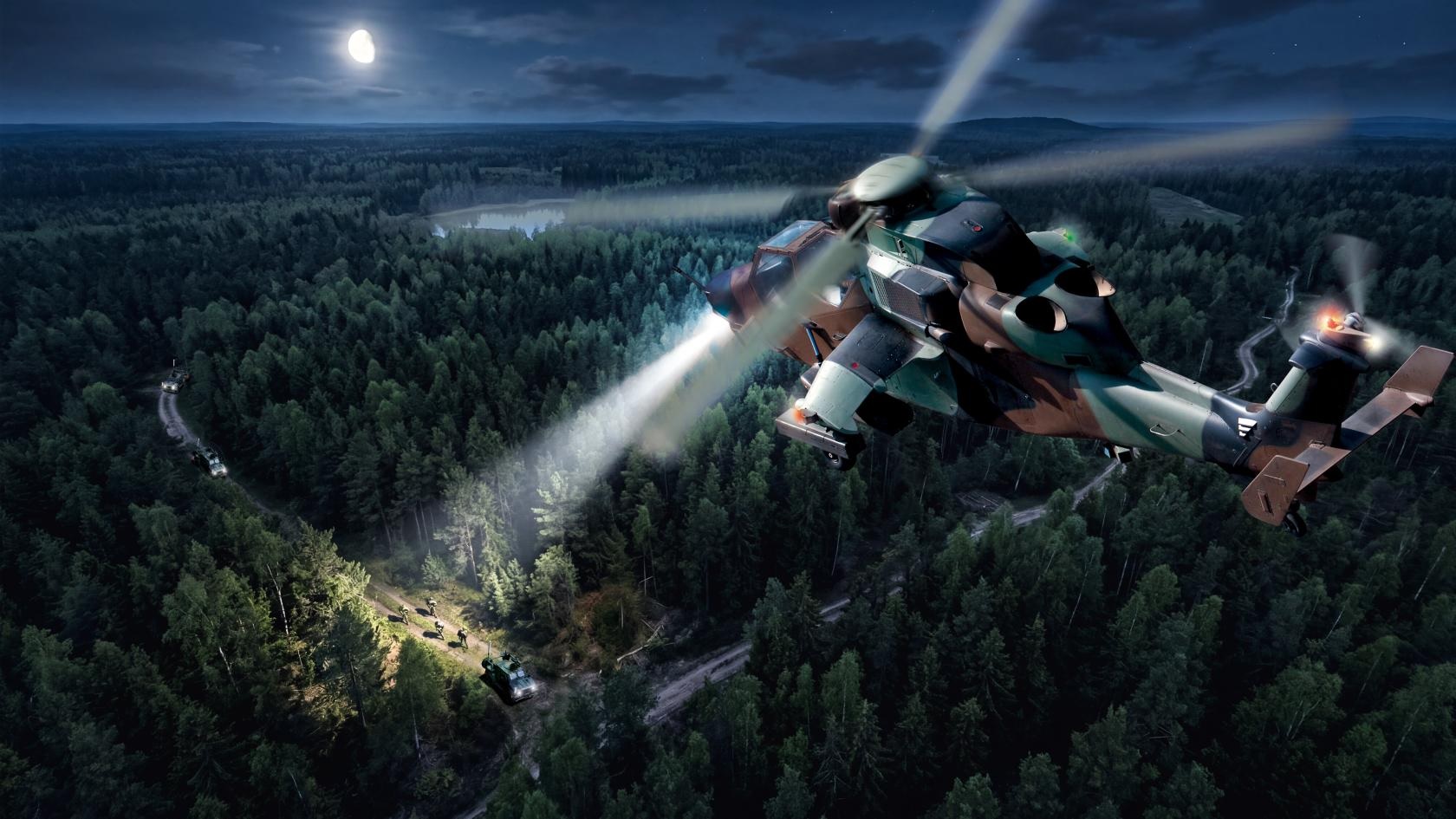
DOURDAN, France — Thales has introduced a new generation Search & Landing Light (SLL) for helicopters, designed to improve visibility and crew coordination during military, security, civil aviation, and search-and-rescue (SAR) operations.
The new onboard illumination system uses a high-power LED optical unit and provides continuous 360-degree swiveling coverage while maintaining a compact, flush-mounted design that minimizes aerodynamic drag. According to Thales, the design allows helicopter crews to maintain full illumination around the aircraft without creating blind spots.
The SLL features a software-defined, connected architecture that allows operators to configure the system for different mission requirements. It is designed to integrate with existing onboard avionics, including Forward-Looking Infrared (FLIR) sensors, multifunction displays, and helmet-mounted displays, helping improve situational awareness during complex operations.
The lighting system can be controlled by the pilot, co-pilot, or hoist operator, depending on the phase of the mission. This flexible control arrangement allows different crew members to manage the lighting as operational needs change.
For search-and-rescue (SAR) missions, particularly at night or in difficult terrain such as mountains, forests, or snow-covered areas, the SLL's 360-degree coverage allows crews to continuously illuminate survivors, rescue personnel, and landing zones without repeatedly repositioning the helicopter. This can help crews maintain visual contact throughout the rescue operation.
During hoist operations, including maritime recovery and medical evacuation missions, the system provides stable and focused lighting over the rescue area. The hoist operator can independently adjust the light in real time to follow the movement of personnel or equipment, supporting operations in degraded visual conditions.
For military night operations, including infiltration, exfiltration, and special operations, the SLL includes a dedicated covert mode. This operating mode is designed to reduce the helicopter's visual and infrared signature while still providing sufficient illumination for the crew to carry out the mission.
Thales said the system has been developed to support a broad range of helicopter platforms used by military, security, emergency response, and civil aviation operators. Its software-based architecture also allows operators to tailor system functions to specific mission profiles without requiring major hardware changes.
The company manages the complete development and production process for the SLL at its facility in Dourdan, France, including the design of the high-power LED optical unit, system integration, assembly, and final testing.
"Helicopter crews operate in some of the most demanding environments, often making critical decisions in seconds and under extremely challenging conditions. Our new Search & Landing Light was developed with those operators in mind, giving them greater flexibility, enhanced mission effectiveness and the ability to adapt to a wide range of operational scenarios from a single system. It illustrates our commitment to delivering solutions that evolve with our customers' missions." said Nicolas Bonleux, Vice President of Aerospace Communications at Thales.
According to Thales, the new Search & Landing Light (SLL) combines compact installation, full 360-degree illumination, integration with modern cockpit systems, and multiple operating modes in a single system intended to support demanding helicopter missions across military, emergency response, security, and civil aviation sectors.
Source: thalesgroup
——— End of Article ———