OKLAHOMA CITY — June 05, 2026 : The U.S. Air Force is seeking external storage pods for its new OA-1K Skyraider II aircraft to address a practical limitation that currently prevents crews from carrying mission equipment and personal gear during training deployments without additional ground transportation support.
The requirement was outlined in a sources sought notice issued by the 137th Special Operations Wing of the Oklahoma Air National Guard on behalf of the 17th Special Operations Squadron, the Air Force's formal training unit and currently the only squadron operating the OA-1K.
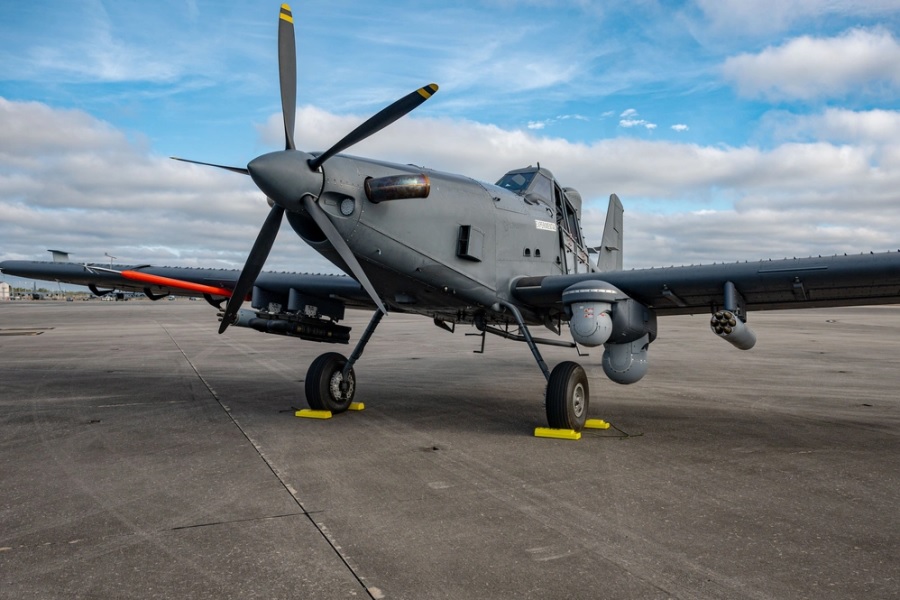
The OA-1K Skyraider II was developed under U.S. Special Operations Command's Armed Overwatch program and was formally designated by Air Force Special Operations Command (AFSOC) in February 2025. The aircraft replaces the U-28A Draco in the intelligence, surveillance, and reconnaissance (ISR) role while also providing precision strike capabilities.
Based on the Air Tractor AT-802 agricultural aircraft and militarized by L3Harris Technologies, the two-seat turboprop is designed to operate from austere locations, including dirt runways and unimproved airstrips. The aircraft can carry up to 6,000 pounds of munitions and stores across eight underwing pylons and can remain on station for up to six hours while operating approximately 200 miles from its target area.
The first missionized OA-1K was delivered to AFSOC at Hurlburt Field, Florida, in April 2025. Additional aircraft were later assigned to the 17th Special Operations Squadron at Will Rogers Air National Guard Base, Oklahoma, for pilot and aircrew training.
Storage Pod Requirement
According to the June 2026 notice, the Air Force is seeking a commercially available external carriage mobility pod that can be mounted directly to the aircraft's existing underwing pylons without requiring modifications to the aircraft or its support equipment.
The pod must be compatible with BRU-71/A ejector release units using 14-inch lug spacing and must not interfere with flight controls or landing gear operations.
The Air Force requires a pod measuring no more than 130 inches (330 cm) in length, 22.5 inches (57 cm) in width, and 28.8 inches (73 cm) in depth. It must provide at least 9 cubic feet (0.25 cubic meters) of usable storage volume and include a minimum internal length of 75 inches (190 cm) for mission equipment.
The structure must be made from corrosion-resistant materials, including composites, aluminum, or hybrid designs. Required features include adjustable tie-down straps, center-of-gravity markings, external handling handles, and a keyed locking mechanism.
The notice references proven commercial products such as the MXU-648 cargo pod and Kihomac ACE pod, indicating a preference for existing solutions rather than a new development program.
Procurement Plans
The selected contractor will be required to deliver three storage pods within 60 days of contract award and provide 12 months of maintenance and support.
The contract also requires a complete technical data package, including structural and aerodynamic analyses, ground vibration test results, and weight and balance data to support airworthiness certification.
Program Outlook
The OA-1K Skyraider II is expected to reach initial operational capability (IOC) in 2026, with full fleet deliveries planned by 2029.
Current budget plans have reduced the fleet from 75 aircraft to 53 aircraft, although AFSOC Commander Lt. Gen. Michael Conley has publicly supported acquiring the originally planned 75-aircraft fleet.
The planned acquisition of external storage pods is intended to improve the aircraft's operational flexibility by allowing crews to transport essential equipment without additional logistics support, supporting the Armed Overwatch program's goal of enabling small teams to operate independently in remote environments with a minimal logistical footprint.
——— End of Article ———