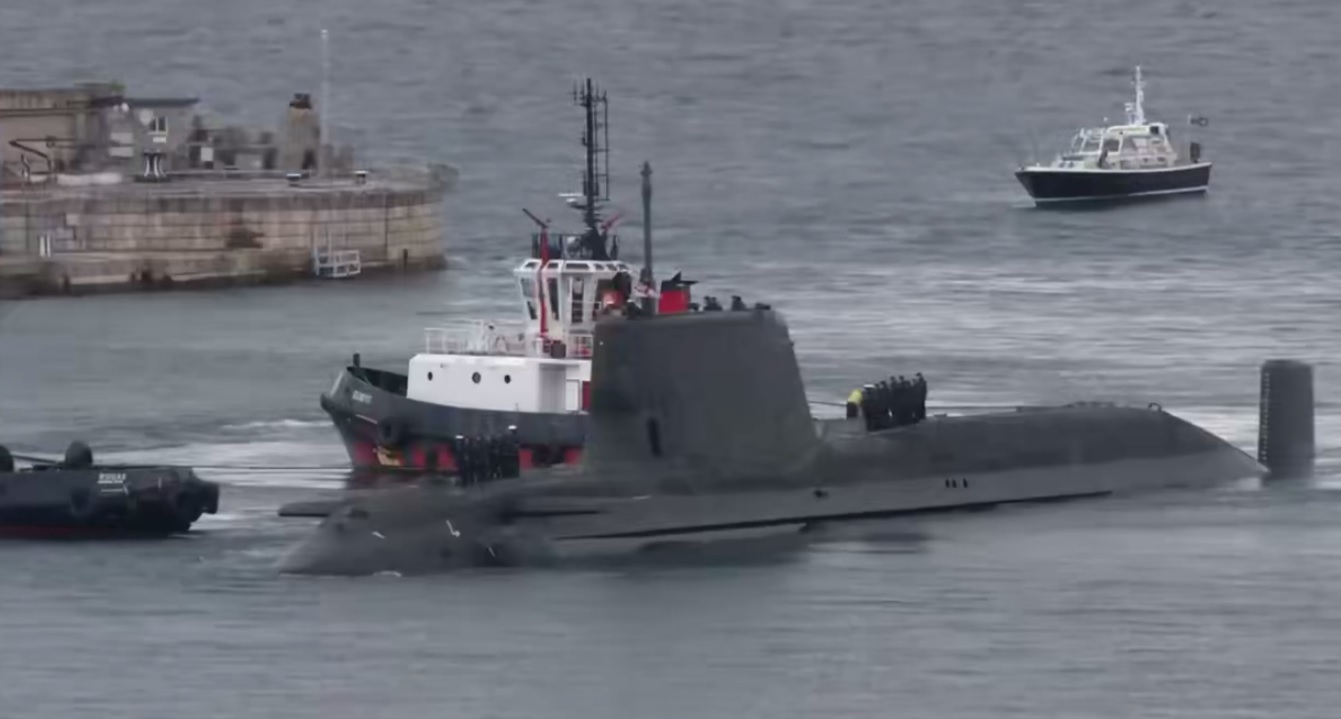
LONDON — March 22, 2026 : The United Kingdom has deployed a nuclear-powered Royal Navy submarine, HMS Anson, to the northern Arabian Sea, positioning British naval assets within operational range of Iran as regional tensions continue to evolve.
The deployment, first reported by the Daily Mail and supported by defence sources, provides the UK with the capability to conduct long-range precision strikes if required. The UK Ministry of Defence has not confirmed the submarine’s precise location, stating that operational deployments in the region are subject to continuous review.
Deployment and Transit Details
HMS Anson, an Astute-class submarine attack submarine, departed from Perth, Australia, on March 6 following its involvement in activities linked to the AUKUS security partnership.
The vessel travelled approximately 5,500 miles from the western coast of Australia to the northern Arabian Sea, where it is currently operating near key maritime routes, including areas in proximity to the Strait of Hormuz.
Capabilities and Armament
HMS Anson is equipped with Tomahawk Block IV land-attack cruise missiles, which have a reported range of approximately 1,600 kilometres (1,000 miles), enabling precision strikes against land-based targets at significant distances.
In addition to its strike capability, the submarine carries Spearfish heavyweight torpedoes designed for engagements against both surface vessels and other submarines.
Powered by a nuclear reactor, the submarine does not require refuelling over its estimated 25-year service life. The onboard systems are capable of generating breathable air and potable water independently, allowing for extended submerged operations. Operational endurance is practically limited by onboard provisions, typically supporting missions of up to three months for a crew of approximately 98 personnel.
The platform utilises advanced sensor systems and does not rely on a traditional periscope, instead employing digital imaging systems that project external views onto internal displays.
Command and Control Structure
To maintain covert operations, HMS Anson reportedly communicates with the UK’s Permanent Joint Headquarters in Northwood, London, at regular intervals, typically once every 24 hours.
Any decision to launch cruise missiles would require authorisation from UK Prime Minister Keir Starmer. Following approval, operational orders would be transmitted through the chain of command, including Nick Perry, before execution by the submarine.
Regional and Strategic Context
The deployment coincides with broader UK policy decisions related to the ongoing conflict involving Iran. The British government has authorised the United States to utilise UK-controlled facilities, including RAF Fairford and the joint UK-US facility at Diego Garcia, for operations targeting Iranian missile infrastructure linked to threats against commercial shipping in the Strait of Hormuz.
Recent Security Developments
The policy shift follows a recent Iranian missile launch directed toward Diego Garcia. According to defence reports, two ballistic missiles were fired toward the island, located approximately 4,000 kilometres from Iran.
One missile failed during flight, while the second was intercepted by a U.S. naval air defence system before impact. The incident highlighted an extended operational range of Iranian missile capabilities not previously demonstrated in combat conditions.
Iranian Response
Iranian Foreign Minister Seyyed Abbas Araghchi criticised the UK’s decision to allow U.S. forces to operate from British bases, stating that such actions constitute participation in ongoing hostilities. He added that Iran reserves the right to respond under the principle of self-defence.
Ongoing Monitoring
The UK Ministry of Defence has reiterated that it does not comment on specific submarine operations or deployments. Officials stated that the UK’s military posture in the region is under continuous assessment, in line with evolving security conditions.
The presence of HMS Anson reflects a broader effort by the United Kingdom to maintain operational readiness and support allied activities in a region experiencing sustained geopolitical tension.
——— End of Article ———