SEOUL — May 11, 2026 : South Korea’s Presidential Office on Monday condemned the attack on the cargo vessel HMM Namu in the Strait of Hormuz after a joint government investigation concluded that the ship was struck by two drones while anchored near the United Arab Emirates. Officials stated that Seoul is preparing a coordinated and “firm response” following the completion of forensic analysis conducted in Dubai.
National Security Adviser Wi Sung-lac said attacks on civilian commercial shipping are “intolerable” and cannot be justified under international law. The Presidential Office emphasized that the vessel had not violated any maritime regulations at the time of the incident.
Investigation Confirms Dual Drone Strike
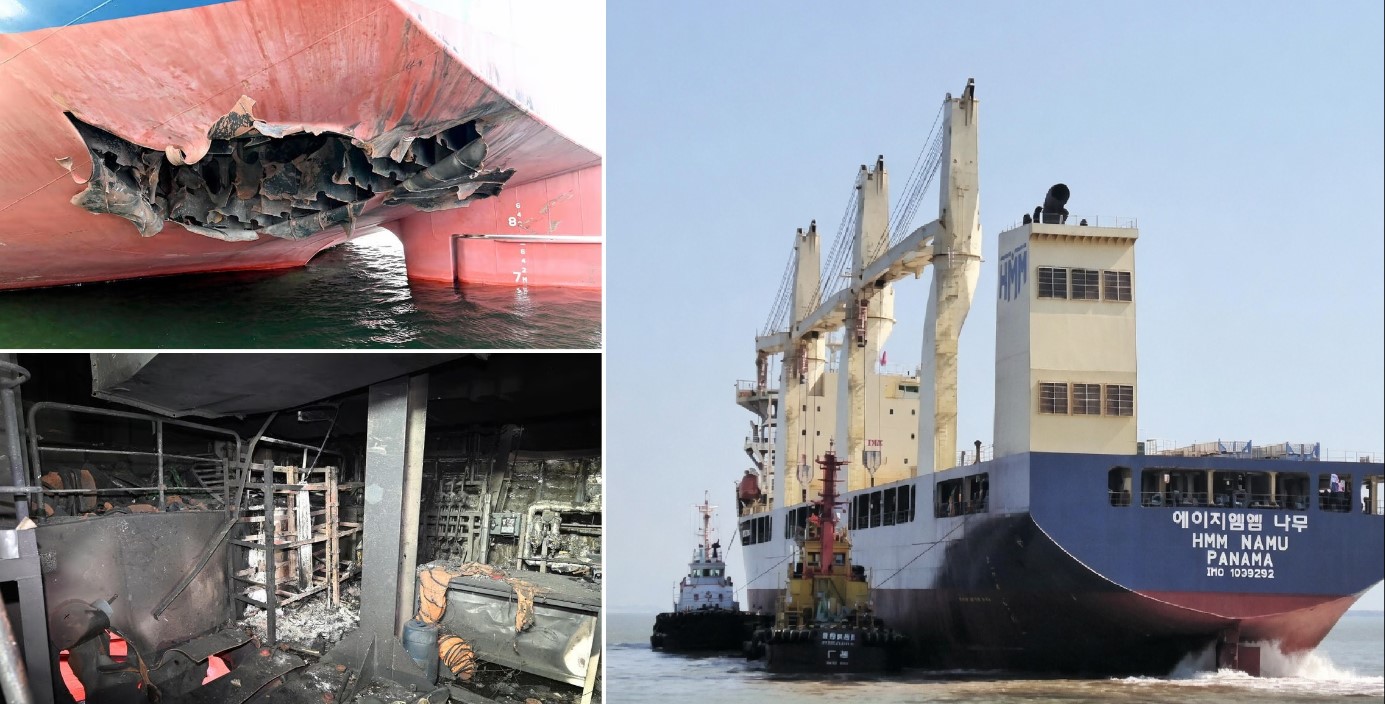
According to the findings released by South Korean authorities, the HMM Namu, a Panama-flagged general cargo vessel operated by HMM Co. Ltd., was anchored near Umm Al Quwain in the United Arab Emirates on May 4 when two aerial objects struck the vessel’s lower port stern approximately one minute apart.
The joint investigative team concluded that the ship had been hit by two Iranian drones based on forensic analysis, debris patterns, and damage assessment conducted after the vessel was towed to Dubai for inspection.
Officials stated that the first impact caused an explosion and ignited a fire inside the engine room. A second strike followed shortly afterward, spreading flames across the rear section of the vessel and causing additional structural damage.
Investigators confirmed that the attack created a breach measuring approximately 5 meters wide and up to 7 meters deep in the lower port stern. Authorities noted that the extent of the damage was not immediately visible because the impact area was located below the vessel’s rear port section.
Crew Rescued, Vessel Towed to Dubai
All 24 crew members aboard the HMM Namu, including six South Koreans, were rescued without injury. The fire was later extinguished, though the vessel was disabled and required tugboat assistance for extraction from the area.
The ship was transported to Drydocks World in Dubai, where it arrived around May 8 for repairs and a full forensic inspection.
The investigative team included inspectors from the Korea Maritime Safety Tribunal under the Ministry of Oceans and Fisheries and forensic specialists from the National Fire Agency. Officials examined CCTV footage, interviewed the captain and crew members, and collected debris from the impact site.
Authorities ruled out internal mechanical failure and sea mines as possible causes of the explosion.
“The damage was not immediately known because the strike occurred in the lower port stern,” Wi Sung-lac said during a media briefing. “However, forensic evidence collected in Dubai clarified the nature of the assault.”
Diplomatic Protest Lodged With Iran
Following the release of the investigation results, South Korea’s Foreign Ministry summoned the Iranian ambassador in Seoul on May 10 to formally protest the incident.
The Presidential Office stated that attacks against civilian commercial vessels operating in compliance with international regulations cannot be tolerated and that Seoul would continue coordinating with international partners on maritime security measures.
In response, the Iranian embassy in South Korea stated that it currently had no official position on the matter and would provide updates if information becomes available. Tehran has previously denied involvement in the incident.
South Korean authorities said additional forensic analysis of debris and damage patterns will continue as investigators work to determine the exact origin and technical characteristics of the drones involved in the strike.
Rising Tensions in the Strait of Hormuz
The attack occurred amid heightened tensions and maritime disruptions in the Strait of Hormuz, where regional shipping traffic has faced increasing security risks over the past two months.
Donald Trump stated after initial reports of the incident that Iran was responsible for the strike and urged South Korea to join a U.S.-led coalition aimed at securing commercial shipping routes in the region.
At the same time, commanders of the Islamic Revolutionary Guard Corps (IRGC) have warned that interference with Iranian shipping operations would result in retaliatory action against U.S. military assets and vessels considered hostile.
The United Kingdom has also announced the deployment of the destroyer HMS Dragon to the Middle East as part of a French-led maritime security mission focused on protecting commercial shipping.
Additional Maritime Incidents Reported
The strike on the HMM Namu followed several recent maritime security incidents in the region.
On Sunday, another cargo vessel arriving from Abu Dhabi was reportedly attacked by a drone near Qatar’s territorial waters. Separately, authorities in the United Arab Emirates announced that two Iranian drones had been intercepted.
Despite the tensions, some maritime transit operations have continued. A Qatari liquefied natural gas tanker was recently permitted by Tehran to transit regional waters toward Pakistan, marking the first such passage since the escalation of the current crisis in late February.
South Korean officials stated that the government will continue prioritizing the safety of its citizens, the protection of commercial shipping, and the security of international maritime trade routes while further assessments of the HMM Namu continue in Dubai.
——— End of Article ———