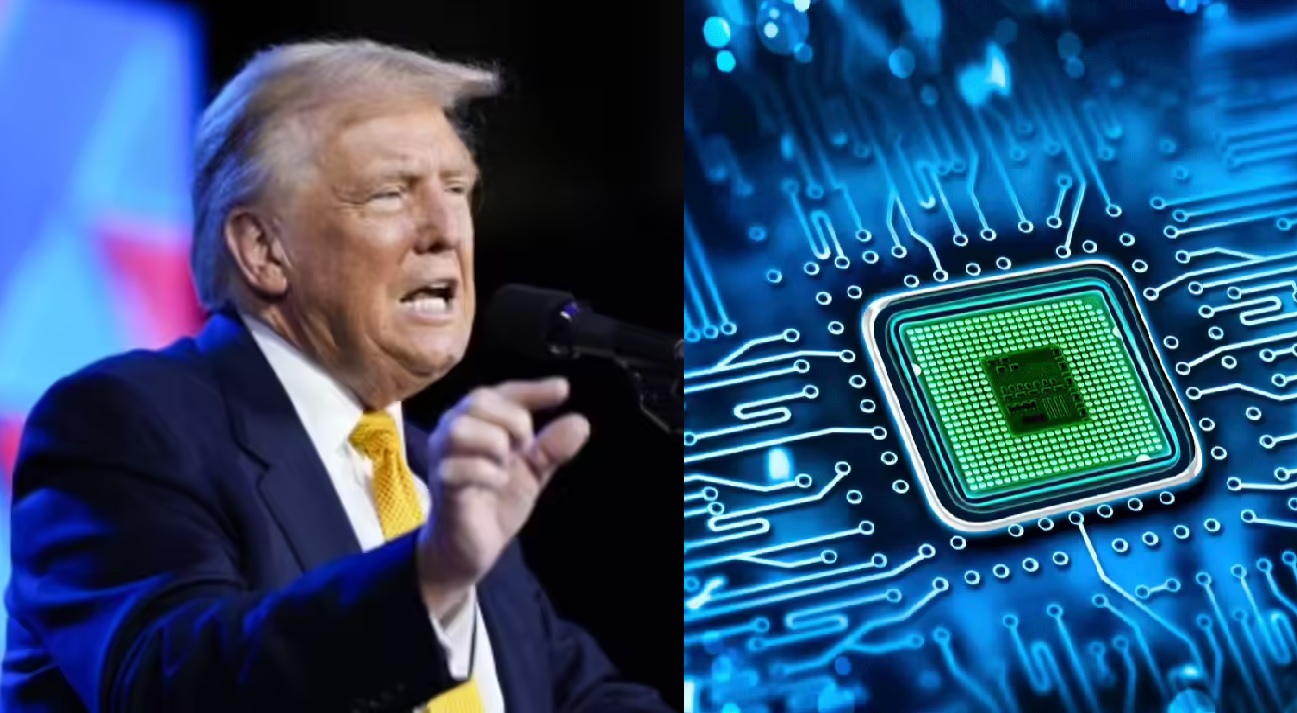
WASHINGTON, — May 18, 2026 : U.S. President Donald Trump has urged global semiconductor manufacturers, particularly companies based in Taiwan, to relocate more production capacity to the United States, citing growing concerns over Taiwan’s security and the risks posed to global supply chains if tensions with China escalate.
In an interview with Fox News, Trump said the United States must reduce its reliance on Taiwan for advanced semiconductor production and expand domestic manufacturing capacity as quickly as possible.
“I’d like to see everybody making chips over in Taiwan come into America,” Trump said, adding that relocating production to the U.S. would be “the greatest thing you can do” under current geopolitical conditions.
Trump stated that the administration wants the United States to account for 40% to 50% of the global semiconductor industry by the end of his term. He noted that some Taiwanese companies have already begun shifting part of their manufacturing operations to the United States and said further expansion should continue.
The comments come amid increasing concerns within Washington over the possibility that China could move against Taiwan within the coming years. Advisers close to the administration have reportedly warned that Chinese President Xi Jinping may attempt actions involving Taiwan within the next five years, raising fears of major disruptions to the global semiconductor industry.
Taiwan currently produces around 90% of the world’s most advanced semiconductors, including high-end chips used in artificial intelligence systems, consumer electronics, cloud computing infrastructure, and military technologies. Much of that production is controlled by Taiwan Semiconductor Manufacturing Company (TSMC), the world’s largest contract chipmaker.
U.S. officials and industry groups have warned that any blockade or disruption affecting Taiwan’s chip exports could trigger severe shortages across the global technology sector. Analysts have also cautioned that a prolonged interruption in semiconductor supplies would significantly affect manufacturing output, financial markets, and economic growth in the United States and other major economies before domestic production could fully compensate for lost supply.
Trump linked the push for domestic chip production directly to national security concerns. During the interview, he suggested the United States may not be able to guarantee Taiwan’s protection indefinitely if tensions escalate in the future.
“We’re not going to be able to protect it if something happens,” Trump said, referring to possible developments after his presidency.
The president’s remarks followed his recent summit with Xi in Beijing, where trade, tariffs, and regional security issues were discussed. Trump also addressed a potential U.S. arms package for Taiwan, describing it as “a very good negotiating chip” in broader discussions with Beijing.
He indicated that future decisions regarding the package would depend partly on China’s actions and wider U.S.-China negotiations. Trump also reiterated support for maintaining the current status quo across the Taiwan Strait and cautioned against formal Taiwanese independence, stating he was “not looking to have somebody go independent.”
The administration has continued using trade policy, tariff pressure, and industrial incentives to encourage companies to move advanced manufacturing operations into the United States. Semiconductor production has become a central element of U.S. economic and national security policy as Washington seeks to strengthen domestic supply chains for critical technologies.
Taiwanese semiconductor firms have already announced major investments in the United States. TSMC has committed more than $100 billion to semiconductor manufacturing projects in Arizona, where multiple fabrication facilities are currently under construction or planned.
However, industry experts and officials in Taipei have noted that relocating the broader semiconductor ecosystem remains difficult due to Taiwan’s established infrastructure, specialized workforce, and tightly integrated supplier network. Analysts have also pointed to significantly higher manufacturing and operational costs in the United States compared to Taiwan.
In response to recent U.S.-China discussions, Taiwan President Lai Ching-te said Taiwan’s sovereignty and security would not be compromised in geopolitical negotiations. He reaffirmed the island’s commitment to maintaining its defense capabilities and emphasized the importance of continued U.S. security support.
As tensions surrounding the Taiwan Strait remain a key focus in international relations, the United States continues expanding domestic semiconductor production capacity in an effort to reduce long-term dependence on overseas manufacturing and strengthen supply chain resilience for critical techn
——— End of Article ———