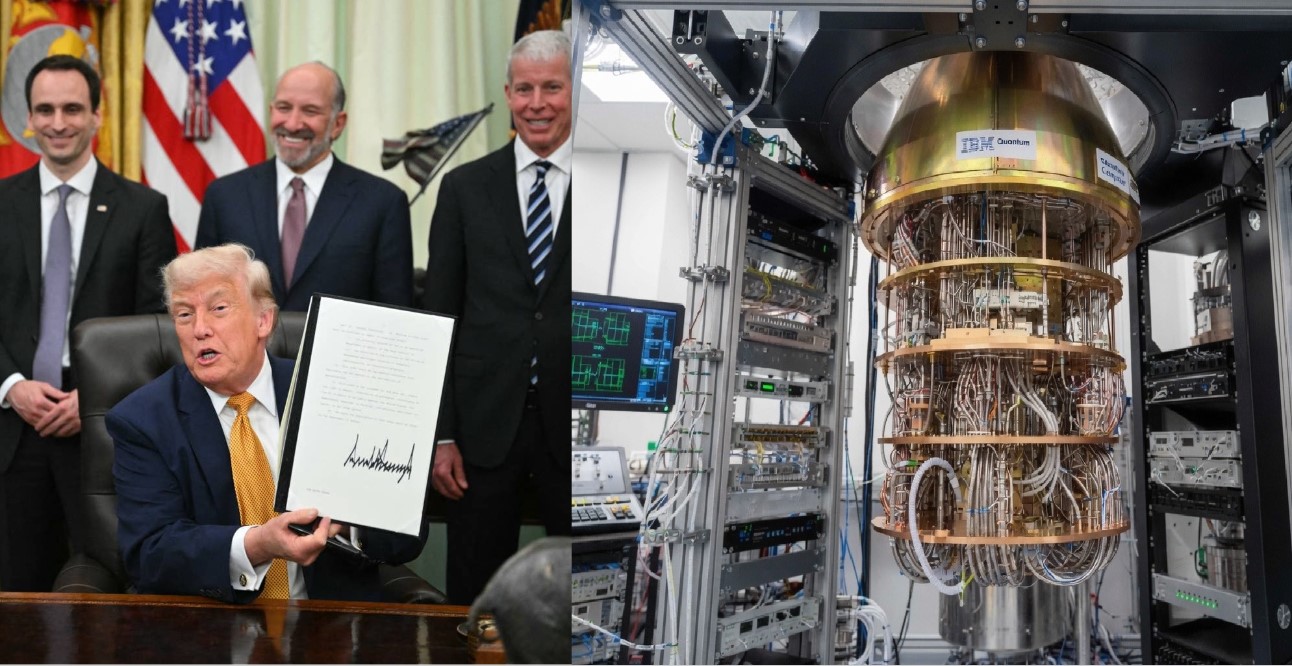
WASHINGTON, June 23, 2026 — President Donald Trump has signed two executive orders aimed at strengthening U.S. leadership in quantum technology and protecting federal digital infrastructure from future cyber threats posed by advanced quantum computing systems.
The directives establish a dual-track strategy focused on accelerating domestic quantum research and development while requiring federal agencies to transition more rapidly to post-quantum cryptography (PQC), a new generation of encryption designed to withstand attacks from future quantum computers.
National Initiative to Expand Quantum Computing Capabilities
The first executive order, EO 14411, launches a coordinated national effort to develop a large-scale quantum computer capable of performing complex scientific calculations and supporting advanced research applications.
The initiative, known as the Quantum Computer for Application Development and Discovery Science (QC-ADDS) program, seeks to establish a quantum computing system suitable for scientific research by 2028. The Department of Energy will host at least one such system as part of the program.
The order also directs the Departments of Commerce, War, and Energy, along with NASA, to deploy advanced quantum-enabled sensors and networking technologies within the next five years. These systems are expected to improve scientific research, sensing capabilities, and secure communications.
To support the effort, the Department of Energy has been instructed to define the technical requirements for the new quantum computing system within 90 days.
Workforce Development Measures
The executive order includes several workforce development initiatives intended to address the growing demand for skilled personnel in the quantum technology sector.
Under the directive, the Department of Labor and the National Science Foundation will align education and training programs with industry requirements, expand apprenticeship opportunities, and support the establishment of National Quantum Workforce Development Institutes.
Administration officials said these efforts are intended to strengthen the domestic talent pipeline and support long-term growth of the U.S. quantum industry.
Accelerated Transition to Post-Quantum Cryptography
The second executive order, EO 14409, focuses on protecting federal systems from future cryptographic threats by accelerating the adoption of post-quantum cryptography across government networks.
The order requires federal agencies to transition high-value assets and high-impact systems to quantum-resistant encryption standards on an accelerated timeline.
Under the new requirements:
- Federal agencies must complete migration to post-quantum cryptography for key establishment functions by December 31, 2030.
- Migration for digital signature systems must be completed by December 31, 2031.
- Each federal agency must designate a post-quantum cryptography migration lead within 30 days.
- Agencies must begin structured migration planning within 90 days.
- The Department of Commerce must launch a pilot migration project by the end of 2027 to demonstrate successful deployment methods and establish best practices for broader government adoption.
The revised deadlines move forward previous transition targets that extended to 2035 for some systems.
Addressing the “Harvest Now, Decrypt Later” Risk
A key objective of the cybersecurity order is addressing the growing threat known as “harvest now, decrypt later.”
Under this scenario, adversaries collect and store encrypted government and corporate data today, even though current computing technology cannot decrypt it. Once large-scale quantum computers become available, those stored files could potentially be decrypted, exposing sensitive information.
Officials warned that future quantum computers could break many of the encryption standards currently used to secure government networks, communications, intellectual property, and critical infrastructure systems.
The executive order states that the emergence of large-scale quantum computers, particularly if developed by adversarial nations, could pose a significant threat to widely used cryptographic security systems.
By establishing a 2031 compliance deadline, the administration aims to reduce the period during which sensitive data remains vulnerable to future decryption efforts.
Strategic Importance
The executive orders reflect growing international competition in quantum technologies and cybersecurity, particularly as countries invest heavily in quantum computing research and related infrastructure.
Quantum computing is expected to support advances in scientific research, materials science, optimization, artificial intelligence, and national security applications. At the same time, the technology presents challenges for existing cybersecurity frameworks because of its potential ability to break current encryption methods.
Administration officials said the measures are intended to strengthen U.S. technological leadership, support supply chain development, expand workforce training, encourage public-private collaboration, and promote commercialization of quantum technologies.
The orders build on previous federal initiatives, including the National Quantum Initiative, and establish a government-wide framework aimed at advancing quantum innovation while preparing federal systems for the security challenges of the quantum era.
——— End of Article ———