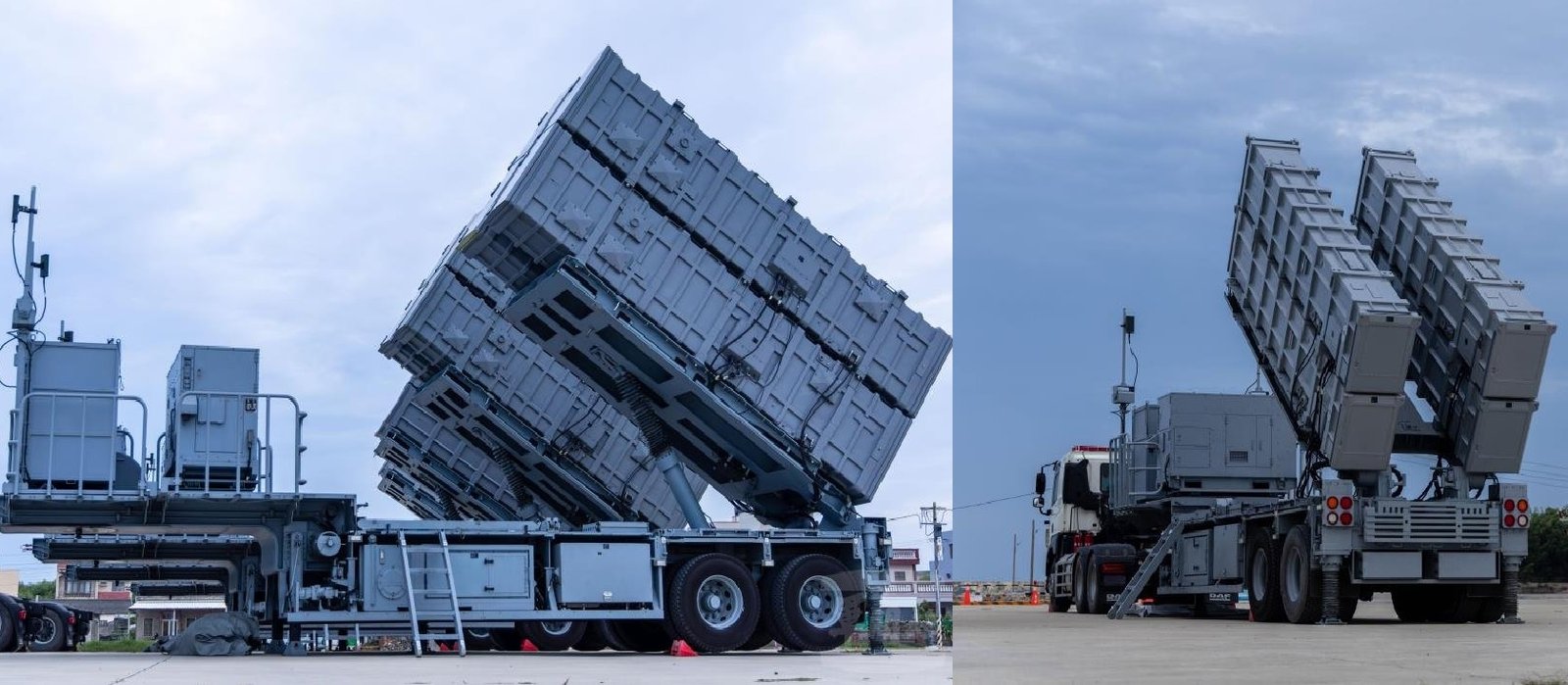
PENGHU, TAIWAN — Taiwan’s newly established Navy Littoral Operations Command deployed mobile launchers carrying Hsiung Feng II (HF-2) and Hsiung Feng III (HF-3) anti-ship missiles across the Penghu archipelago on August 9, 2026, during the ongoing Han Kuang military exercises.
After receiving simulated targeting information, missile crews rapidly moved the launchers from their bases to pre-designated tactical positions. The units then rehearsed coordinated fires against maritime targets, testing their ability to conduct mobile coastal-strike operations and control key waterways surrounding the Penghu islands.
The deployment was part of the fifth day of Taiwan’s 10-day Han Kuang exercise, which began earlier in the week and is scheduled to conclude on August 14. The annual exercise uses live troops, real terrain and military equipment to test combat readiness and the ability of Taiwan’s armed forces to respond to potential threats.
Hsiung Feng II and Hsiung Feng III
The Hsiung Feng II is a subsonic anti-ship missile developed by Taiwan’s National Chung-Shan Institute of Science and Technology (NCSIST). It has a reported range of about 160 km, while the Block II version has a range of up to 250 km. The missile has a top speed of about Mach 0.85 and carries a warhead of approximately 180 kg.
The Hsiung Feng III is a supersonic anti-ship missile with a reported range of more than 100–150 km, with some versions reaching around 250 km. Its speed is reported at Mach 2 to 3.5, and it carries a 225 kg warhead using self-forging fragments.
NCSIST describes the HF-III as using an integrated rocket-ramjet propulsion system. The missile uses inertial guidance during its mid-course flight and an active radar seeker during the terminal phase. Both the HF-II and HF-III can be deployed from land-based mobile launchers and are part of Taiwan’s domestically developed coastal-defense capabilities.
Taiwan’s 2025 National Defense Report lists the Hsiung Feng II, Hsiung Feng III and extended-range Hsiung Feng missiles among the country’s shore-based anti-ship missile systems.
Littoral Operations Command
The Littoral Operations Command began operations in July 2026 and is responsible for integrating Taiwan’s coastal-defense capabilities. Its forces include anti-ship missile units, coastal and mobile radar systems and unmanned systems.
The command places particular emphasis on mobile launchers, allowing missile units to relocate between positions and operate from different tactical locations. Its responsibilities include defending the waters surrounding Taiwan and its outlying islands, including Penghu.
The Penghu exercise tested this concept by requiring missile crews to rapidly move after receiving targeting information, establish firing positions and coordinate attacks against simulated maritime targets.
Exercise conducted during difficult weather
The missile deployment was conducted despite heavy rainfall and adverse weather conditions associated with Typhoon Dolphin. The operation provided an opportunity to test the movement and employment of the missile units under difficult weather conditions.
The exercise also comes amid continued Chinese military activity around Taiwan. Between Saturday and Sunday morning, Taiwan’s Ministry of National Defense reported tracking six Chinese naval vessels, nine official ships and four Chinese military aircraft operating around the island. Two of the aircraft crossed the median line of the Taiwan Strait, prompting Taiwan to deploy aircraft, naval vessels and coastal missile systems.
Photos of the Penghu deployment were released by Taiwan’s Military News Agency and credited to photographer Cai Fangyun.
Penghu is located in the Taiwan Strait and has strategic importance because of its position along maritime approaches to Taiwan. The Han Kuang exercises are continuing at multiple locations, including coastal and island-defense scenarios.
The Penghu drill demonstrated the Littoral Operations Command’s ability to move mobile Hsiung Feng missile units to designated positions and coordinate coastal-strike operations as part of Taiwan’s broader defense preparations.
——— End of Article ———