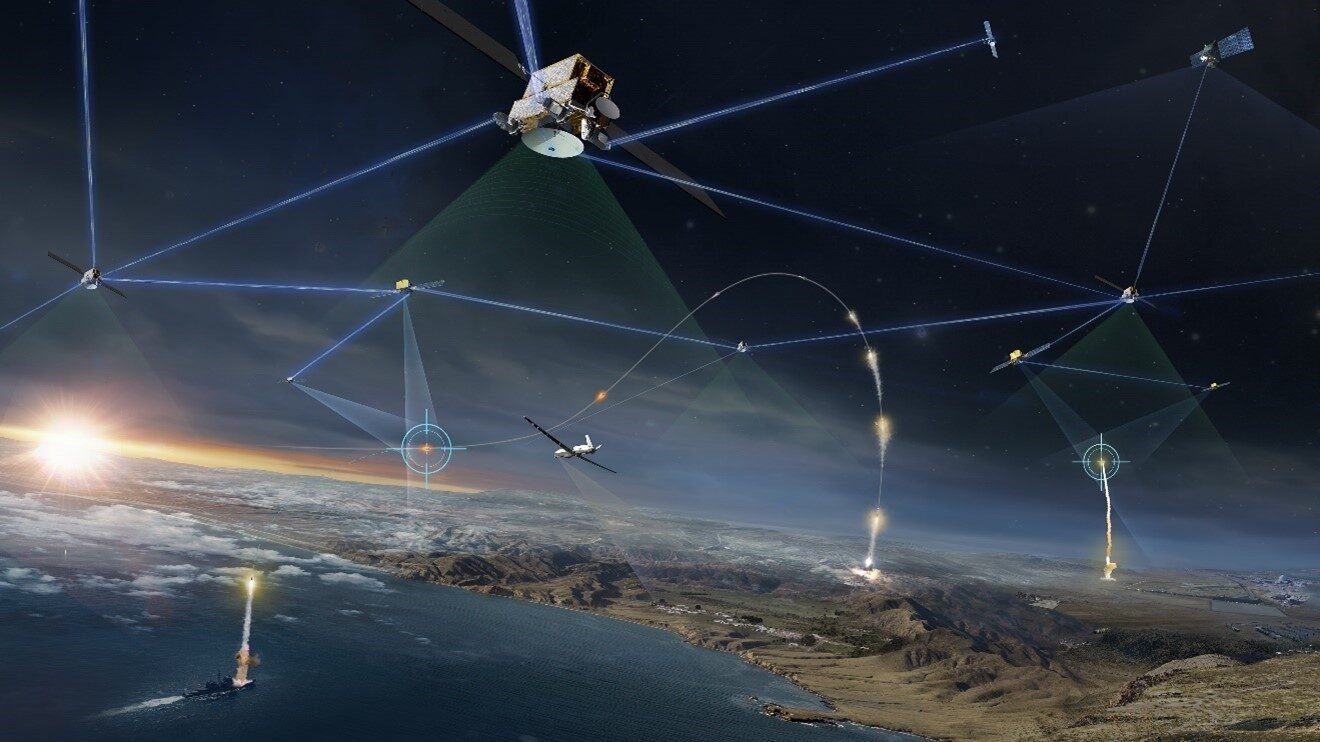
REDONDO BEACH, California — Northrop Grumman is developing an integrated missile defense architecture that connects space-based sensors, battle management systems and interceptors to detect, track and engage ballistic and hypersonic missile threats.
The architecture links capabilities across space, air, sea and land and combines existing systems with those under development. The objective is to create a continuous chain from initial missile detection and tracking to interceptor engagement.
At the center is the Integrated Battle Command System (IBCS), which connects sensors and weapons that were not originally designed to operate together. The system provides a common command-and-control network and uses software-based data integration. Artificial intelligence supports threat classification and interceptor selection, giving operators a shared view of the battlespace.
Rob Fleming, corporate vice president and president of Northrop Grumman Space Systems, said the company is combining next-generation sensors, advanced interceptors and AI-enabled decision-making to help warfighters detect and understand threats sooner, make faster decisions and adapt as threats evolve.
Space-based detection
The space layer includes Next-Generation Overhead Persistent Infrared (NG-OPIR) Polar satellites operating in highly elliptical orbits. Their infrared sensors are designed to detect missile heat signatures across the Northern Hemisphere. Northrop Grumman is under a $4.2 billion contract to build and launch two OPIR-Polar spacecraft for the U.S. Space Force.
Another component is the Ballistic Missile Defense System Overhead Persistent Infrared Architecture (BOA). It combines infrared data from multiple satellite constellations and processes the information into three-dimensional missile tracks for command-and-control systems. BOA is designed to support real-time threat detection, tracking and classification, including during high-volume missile attacks.
Northrop Grumman is also involved in the Hypersonic and Ballistic Tracking Space Sensor (HBTSS) program and the Space Development Agency's Proliferated Warfighter Space Architecture Tracking Layer, providing infrared missile warning and tracking capabilities from low-Earth orbit.
Glide Phase Interceptor
For hypersonic threats, the architecture includes the Glide Phase Interceptor (GPI), which is designed to engage hypersonic glide vehicles during their glide phase.
GPI is being developed for launch from Mk 41 Vertical Launch Systems on Aegis-equipped ships and Aegis Ashore sites. The U.S. Missile Defense Agency selected Northrop Grumman as the prime contractor.
In April 2026, the Missile Defense Agency awarded a $475 million contract modification, bringing the total agreement value to approximately $1.31 billion. Work under the current agreement is scheduled for completion by June 2028, with the preliminary design review targeted around that period.
The program is being developed with Japan under a 50-50 workshare arrangement. The United States is responsible for the first-stage booster, third-stage solid rocket motor and key kill-vehicle components, including the aeroshell, avionics and seeker. Japan is developing the second-stage solid rocket motor, third-stage attitude-control system and parts of the kill vehicle, including the rocket motor, fin actuators and fins.
The interceptor uses advanced seekers, dual aerodynamic and rocket-motor guidance, modular software and energy-flexible propulsion. Digital twins and modular open-system architecture are being used during development.
IBCS and missile defense integration
IBCS is a core part of the U.S. Army's integrated air and missile defense modernization. It connects different sensors and effectors and combines their information into an integrated air picture.
Northrop Grumman reports that IBCS has completed numerous successful flight tests, including its 34th consecutive successful missile flight test and 44th intercept as of mid-2026. The system has been demonstrated with capabilities including the Indirect Fire Protection Capability and Lower Tier Air and Missile Defense Sensor.
IBCS is in full-rate production and has achieved operational milestones with Poland's WISŁA medium-range air defense program. It has also been fielded with U.S. combatant commands in Europe and the Indo-Pacific.
Expanding rocket motor production
Northrop Grumman is expanding solid rocket motor production to support multiple missile programs. The company has produced more than 1.3 million solid rocket motors and increased annual production from about 13,000 motors in 2024, with a target of 25,000 annually by 2029.
The company has invested more than $1 billion in recent years to expand production facilities in West Virginia, Maryland and Utah. Propellant production is currently around 30 million pounds, with additional capacity planned. Multi-year agreements include production support for PAC-3 and THAAD motors.
Digital manufacturing and allied cooperation
Northrop Grumman is using additive manufacturing and digital engineering to support missile production. Some interceptor components are produced using 3D-printed titanium, reducing certain tooling requirements and shortening production lead times from months to weeks.
The company's Modular Avionics Control Hardware (MACH) provides a flexible architecture that can be configured for different launch-vehicle control systems. Digital twins and virtual testing are also being used to reduce development risks and schedules.
The company is extending its integrated approach to allies, including the United Kingdom, Japan, Australia and several NATO members. Cooperation includes GPI development with Japan, solid rocket motor activities with Australia and IBCS-related work with European partners.
The broader approach emphasizes shared procurement, interoperable data standards and open architectures. Northrop Grumman also plans forward-deployed ground stations in Europe and the Indo-Pacific to provide participating nations with real-time situational awareness.
The overall architecture is intended to connect space-based detection and tracking with command-and-control systems and interceptors, creating a multi-domain missile defense network for U.S. and allied forces against ballistic and hypersonic threats.
——— End of Article ———