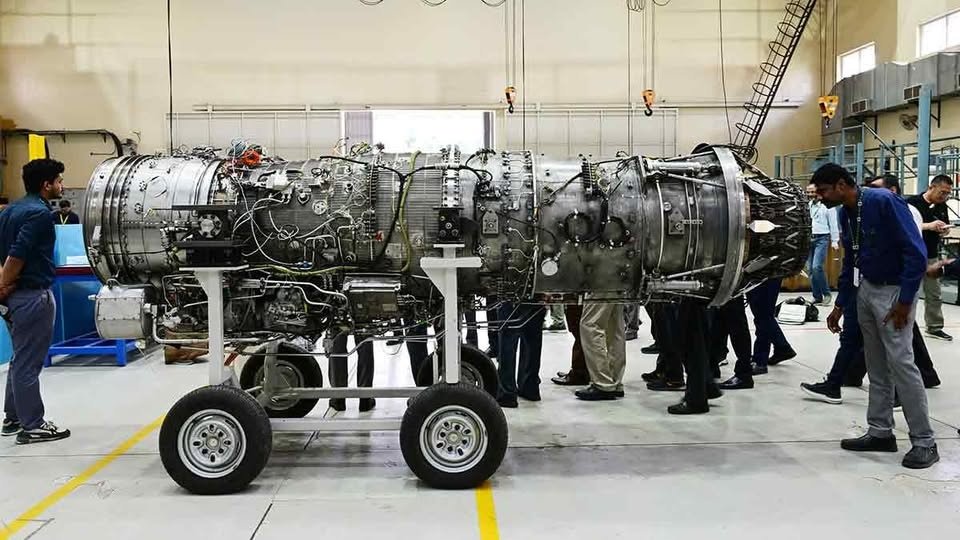
NEW DELHI — The Defence Research and Development Organisation’s (DRDO) Gas Turbine Research Establishment (GTRE) is pursuing a new Kaveri 2.0 engine programme centred on a redesigned core in the 90 kN thrust class. The effort is aimed at developing an indigenous engine option for the Tejas Mk1A, particularly for mid-life upgrades expected in the 2030s.
Kaveri 2.0 is being developed separately from the higher-thrust engine programme intended for the Advanced Medium Combat Aircraft (AMCA). The AMCA effort targets the 120–140 kN class, while Kaveri 2.0 is focused on medium-thrust requirements.
The new Kaveri design involves a major redesign rather than a simple upgrade of the existing core. GTRE is focusing on a new high-pressure compressor (HPC) to improve pressure ratios and fuel efficiency. The core is also planned to use single-piece blisks made from advanced titanium alloys to reduce weight and air leakage, along with single-crystal turbine blades designed to withstand higher operating temperatures.
The reported targets are 55–60 kN of dry thrust and 90–100 kN of thrust with afterburner. The earlier Kaveri Derivative Engine was in the roughly 49–52 kN thrust range. The new targets are intended to provide a power level suitable for a future Tejas Mk1A re-engining programme.
The programme builds on technology developed through the original Kaveri project, which was separated from the Tejas programme after the engine failed to meet the required thrust level. A dry derivative of the Kaveri has also been developed for unmanned applications.
For the Tejas Mk1A, the proposed Kaveri 2.0 would not be an immediate replacement for the GE F404. Instead, the plan is to develop and qualify the new engine so it could potentially be introduced during future mid-life upgrades, once the required testing, integration and certification are completed.
The programme is therefore intended to provide India with a future indigenous medium-thrust fighter engine option while reducing dependence on foreign powerplants.
——— End of Article ———