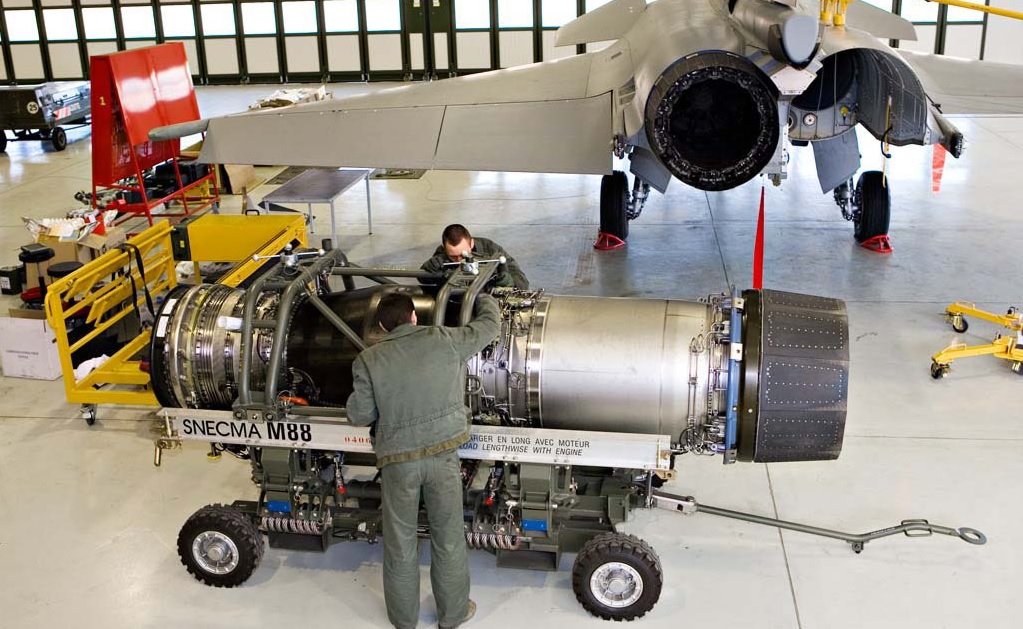
PARIS — Safran delivered 33 M88 fighter engines during the first half of 2026, more than three times the number delivered in the same period last year, as production of the Dassault Rafale continues to increase.
The M88 engine powers the Rafale fighter and is produced by Safran. The increase in deliveries was identified by Safran as one of the factors behind higher military-engine revenue during the first half of the year.
Safran reported that M88 deliveries reached 33 units in the first six months of 2026, compared with 10 during the first half of 2025. The company said the increase was linked to the planned increase in Rafale production.
Rafale production drives higher M88 deliveries
Safran Chief Financial Officer Pascal Bantegnie said during the company's first-half results discussion that Rafale production is being increased from two aircraft per month in 2025 toward four aircraft per month by 2029. The higher aircraft production rate is resulting in a corresponding increase in M88 engine deliveries.
The increase in M88 deliveries also contributed to stronger military-engine revenue within Safran's propulsion business. Safran said military-engine revenue increased year over year, driven by M88 deliveries, a favorable customer mix and a strong level of aftermarket activity. Missile propulsion revenue also benefited from increased deliveries.
Safran's propulsion division reported €9.2 billion in revenue during the first half of 2026, representing 27.7 percent organic growth compared with the same period of 2025. Recurring operating income for the division reached about €2.25 billion, while its recurring operating margin reached 24.5 percent.
Bantegnie said the company had benefited from strong performance in military engines, particularly the M88 programme.
Safran reports strong first-half results
The M88 increase came as part of a broader improvement in Safran's financial performance.
Safran reported adjusted first-half revenue of €17.571 billion, up 19 percent from the first half of 2025. Adjusted recurring operating income reached €3.237 billion, while free cash flow stood at €2.616 billion.
The company's civil-engine business also recorded strong growth. Safran delivered 1,030 LEAP engines during the first six months of 2026, an increase of 41 percent compared with the first half of 2025.
Based on its first-half performance, Safran raised its full-year 2026 outlook. The company now expects revenue growth in the mid-teens, recurring operating income of €6.4 billion to €6.5 billion and free cash flow of €4.7 billion to €4.9 billion.
Possible additional upside from India's 114-Rafale programme
Safran also has a potential additional source of business connected with India's planned acquisition of 114 Rafale fighters for the Indian Air Force.
India has moved forward with the proposed government-to-government procurement programme and has issued a Letter of Request to France. French and Indian sides are continuing the process before any final contract is signed. Recent reports said France was expected to respond to India's request by mid-August 2026.
Safran management said any advance payments received before the end of 2026 in connection with the discussions for the 114 Rafales have not been included in its current financial guidance.
Bantegnie said that such payments, if received before the end of the year, would therefore represent an additional upside to the company's existing outlook. Safran did not provide an amount for any potential advance payment or indicate that a final contract had already been concluded.
The proposed Indian programme is separate from Rafale aircraft already under contract. India's existing Rafale fleet includes aircraft acquired for the Indian Air Force, while the country has also placed an order for Rafale Marine aircraft for the Indian Navy.
Production requirements could increase if India signs the contract
A final agreement for 114 additional Rafale fighters would create a substantial additional requirement for aircraft production and, consequently, for M88 engines.
However, the Indian programme remains subject to the ongoing government-to-government procurement process and negotiations. The potential financial impact on Safran should therefore be distinguished from the company's confirmed 2026 results and current guidance.
For now, Safran's first-half figures show that M88 production has already increased significantly. The company delivered 33 M88 engines in the first six months of 2026, compared with 10 in the same period last year, while the planned increase in Rafale production is expected to support further engine deliveries in the coming years.
——— End of Article ———