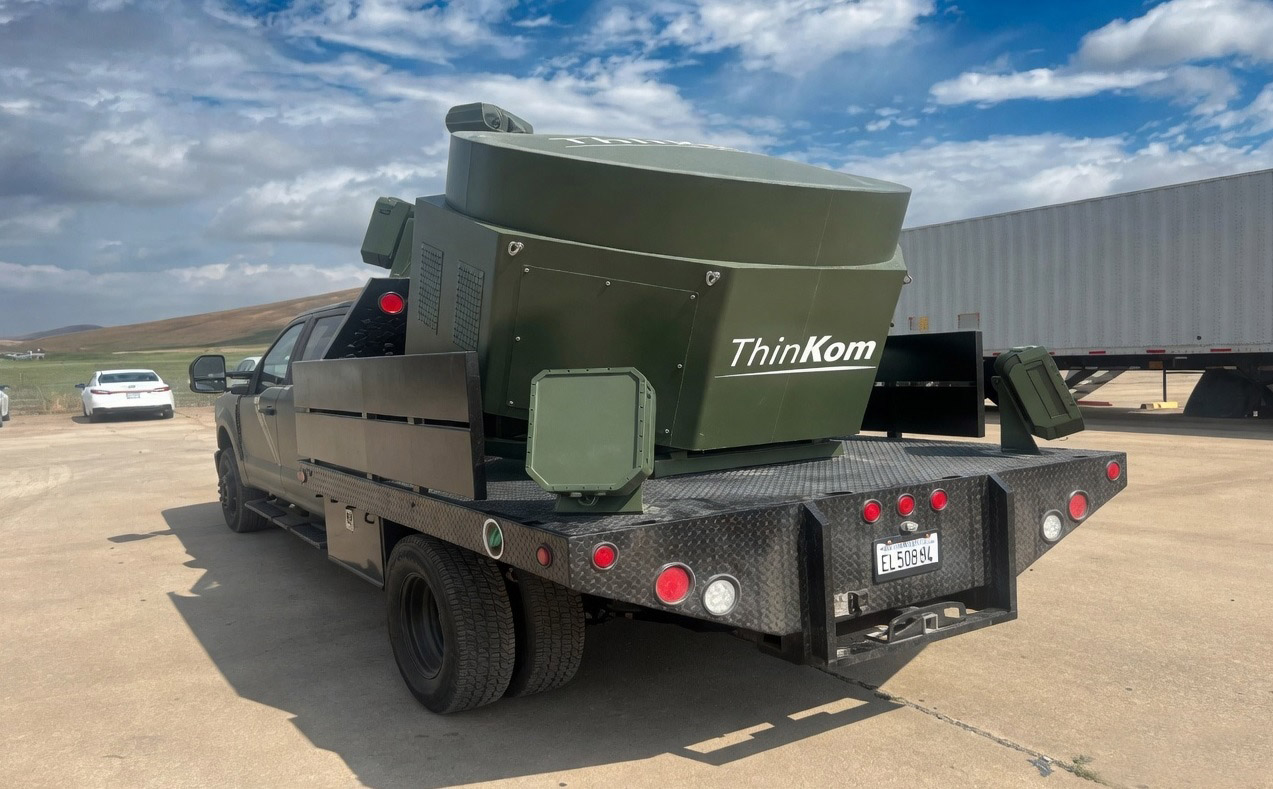
HAWTHORNE, Calif. — April 26, 2026: ThinKom Solutions, Inc. has demonstrated a mobile High Power Microwave (HPM) directed energy system mounted on a standard pickup truck during the Cross Domain Fires Concept Focused Warfighting Experiment, highlighting a compact counter-drone capability designed for multi-domain operations.
The demonstration took place during the U.S. Army exercise conducted from March 2 to 13, 2026, across multiple locations, including Fort Sill, Yuma Proving Ground, and White Sands Missile Range. The experiment evaluated emerging technologies for sensor-to-shooter integration, cross-domain fires, and operational performance in realistic battlefield conditions, with participation from soldiers of the 1st Armored Division and multiple industry partners.
System Demonstration and Integration
During the exercise, ThinKom’s HPM system—referred to as Alecto in company materials—was integrated with the EchoShield radar developed by Echodyne. The combined system demonstrated the ability to detect, track, and engage drone targets by directing concentrated microwave energy at their onboard electronics.
Radar data from EchoShield cued the HPM effector in real time, enabling the system to identify incoming threats and respond without delay. The vehicle-mounted platform maintained full operational capability while in motion, providing continuous 360-degree coverage without requiring the platform to halt.
High Power Microwave Engagement Mechanism
High Power Microwave systems function by emitting concentrated electromagnetic energy that couples into a target’s electronic components. This interaction can cause immediate and permanent damage to critical subsystems, including flight controllers, GPS receivers, and motor control circuits.
This mechanism constitutes a “hard-kill” effect, distinguishing it from radio-frequency jamming systems that only disrupt communication links and can be bypassed by autonomous drones. The HPM approach enables physical destruction of electronic systems at tactically relevant ranges without the use of kinetic projectiles.
The system’s design supports simultaneous engagement of multiple targets across a wide area, particularly against Group 1 and Group 2 drone threats, and provides near-instantaneous effects with no reliance on expendable munitions.
VICTS Technology and Power Architecture
The core of the Alecto system is ThinKom’s proprietary Variable Inclination Continuous Transverse Stub (VICTS) antenna technology. Originally developed for satellite communications, VICTS is a mechanically steered phased-array system.
Unlike electronically scanned arrays, which steer beams through electronic phase shifting, VICTS uses mechanical steering. This architecture allows the antenna to handle gigawatt-level peak power inputs while maintaining precision beam control, rapid agility, and a low-profile conformal structure.
The antenna is paired with high-efficiency vacuum electronics to generate the required microwave energy, achieving high power density within a compact footprint. ThinKom reports that internal development and testing since 2025 have validated the system’s ability to operate at these power levels.
Mobility and SWaP Characteristics
A key aspect of the demonstration was the system’s size, weight, and power (SWaP) optimization. The Alecto unit was mounted directly on the flatbed of a standard pickup truck finished in military olive drab, without the need for a large trailer or dedicated external generator.
This configuration reflects a shift from traditional HPM systems, which have historically required large platforms and significant support infrastructure. The reduced SWaP footprint enables deployment on light tactical vehicles and supports mobile operations such as convoy protection and maneuvering unit defense.
The system’s ability to operate while the vehicle is moving addresses a critical operational requirement, allowing forces to maintain mobility while retaining active air defense against drone threats.
Role in Counter-UAS and Air Defense
ThinKom positions the HPM system for both mobile and fixed-site applications, including Counter-Unmanned Aircraft Systems (C-UAS) and Integrated Air and Missile Defense (IAMD).
Within the counter-UAS domain, the system offers an alternative to kinetic interceptors, which are constrained by ammunition supply and cost per engagement, and to RF jamming systems, which face limitations against autonomous drones. By delivering a hard-kill effect with a deep magazine and rapid re-engagement capability, HPM systems address gaps in existing defensive approaches.
Corporate Development and Strategy
ThinKom, headquartered in Hawthorne, California, entered the High Power Microwave directed energy weapons market on August 26, 2025, expanding from its established role in phased-array antenna systems for satellite communications.
According to Bill Milroy, the company’s Chief Technology Officer and co-founder, the transition builds on existing technical capabilities. He stated during the 2025 announcement that ThinKom’s antenna designs are inherently suited for handling extremely high power levels, supporting the development of HPM systems for military applications.
The company continues to supply satellite communication antennas for commercial, government, and defense customers while advancing its directed energy portfolio.
Exercise Outcomes and Future Work
No specific performance metrics—such as engagement range or power output—were disclosed from the CDF CFWE demonstration. However, the exercise validated system integration, mobility, and operational concepts under realistic conditions.
ThinKom has indicated that further testing and demonstrations are planned throughout 2025 and 2026, with ongoing development focused on refining system performance and expanding deployment configurations.
The pickup truck–mounted demonstration represents an early operational example of the company’s approach to mobile directed energy systems, emphasizing scalability, integration, and field deployment flexibility.
——— End of Article ———