WASHINGTON — Teledyne FLIR Defense, a division of Teledyne Technologies Incorporated, has received an order from AeroVironment (AV) to supply its Argus XL counter-drone detection platform for the U.S. Air Force's Titan Multi-Sensor (Titan MS) system. The company announced the award on July 29, 2026.
The order supports the Pentagon's Domestic Shield Program, which is focused on protecting U.S. military installations and critical infrastructure from the growing threat posed by small unmanned aircraft systems (sUAS) operating within the United States.
Part of $500 Million Pentagon Counter-Drone Contract
The Argus XL order is part of a broader three-year, $500 million Indefinite Delivery/Indefinite Quantity (IDIQ) sole-source contract awarded by the Pentagon to AeroVironment. The contract supports the Joint Interagency Task Force 401 (JIATF-401) Domestic Shield Program, which is accelerating the deployment of counter-drone capabilities across the U.S. military.
Earlier in July 2026, JIATF-401 issued an $80.5 million task order to AeroVironment under the larger contract for the delivery of the Titan Multi-Sensor (Titan MS) system. The initial deployment will strengthen layered air defense for Air Force Global Strike Command, the organization responsible for the nation's bomber fleet and land-based nuclear missile force.
JIATF-401 Expanding Counter-Drone Capabilities
JIATF-401 was established by the Pentagon to address the increasing threat posed by small, low-cost drones targeting military bases and critical infrastructure. According to the Department of War, the task force had committed more than $600 million by April 2026 to rapidly field counter-drone systems in support of both the Domestic Shield Program and Operation Epic Fury.
Brig. Gen. Matt Ross, director of JIATF-401, has previously said the task force's primary objective is to rapidly deliver counter-drone capabilities to military forces operating both within the United States and overseas.
Col. Jason Idleman, chief of the Multi-Domain Operations Division at JIATF-401, said the task force continues working to strengthen the military services' ability to protect personnel and installations from evolving drone threats.
Titan MS Combines AI and Multiple Sensors
The Titan Multi-Sensor (Titan MS) system serves as the central command and sensor-fusion platform within the defense architecture. It combines data from radar, electro-optical cameras, infrared sensors, and radio-frequency detectors into a single operational picture.
Using artificial intelligence and machine learning, the system is designed to detect, identify, classify, track and support the defeat of both remotely piloted and fully autonomous unmanned aircraft systems, reducing the need for operators to monitor multiple independent sensor feeds.
Argus XL Provides Frontline Drone Detection
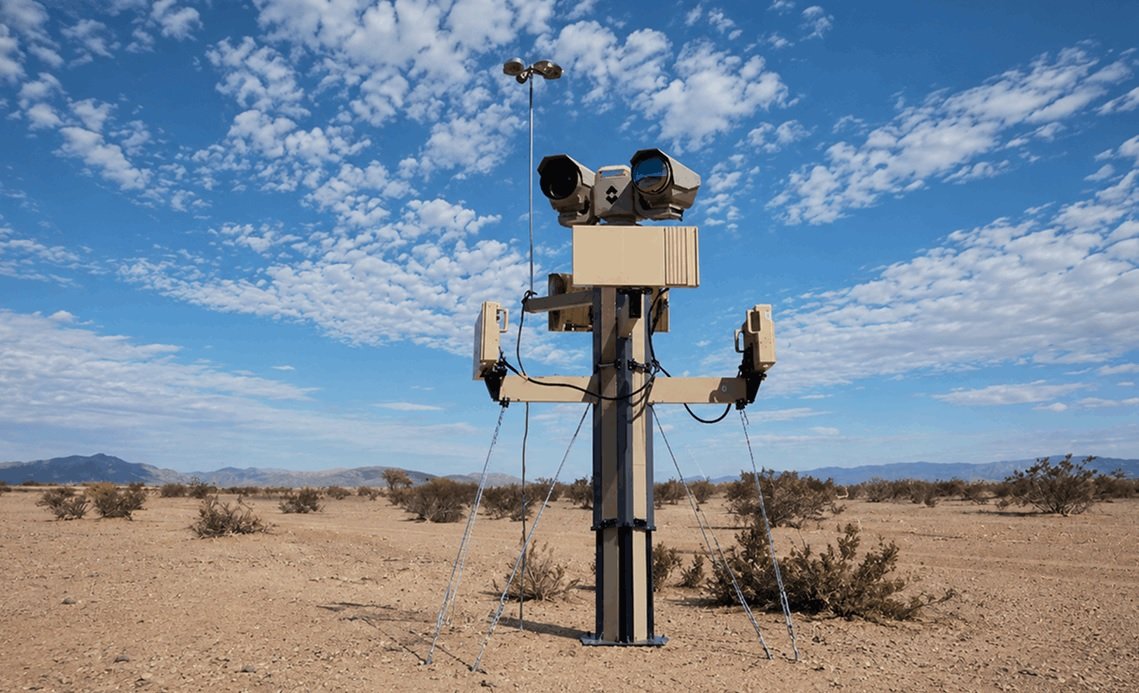
Teledyne FLIR Defense's Argus XL will serve as the primary detection component within the Titan MS system.
The fixed-site, multi-sensor platform combines radar, electro-optical cameras and infrared imaging to detect and track multiple aerial threats during both day and night, including in poor weather conditions. Its thermal imaging capability enables operators to identify drones by their heat signatures in darkness or through heavy cloud cover.
The system also integrates with third-party radio-frequency sensors and counter-drone defeat systems capable of jamming, disabling or destroying confirmed threats. According to Teledyne FLIR Defense, Argus XL provides near-hemispherical coverage over protected locations and can detect and track small and micro drones that older radar systems may struggle to distinguish from birds and other airborne objects.
Company Executives Highlight Importance of Early Detection
Dr. JihFen Lei, President of Teledyne Defense and Aerospace Group and Senior Vice President of Teledyne Technologies, said the company is pleased to support AeroVironment on the program.
"We are proud to collaborate with AV to deliver advanced counter-drone technology that enables the U.S. military to detect, classify, track, and respond to increasingly complex unmanned aerial threats," Lei said.
He added that Argus XL, Cerberus XL and other Teledyne FLIR Defense counter-UAS systems provide proven, mission-ready capabilities that are integrated into the Titan MS solution.
Lei also emphasized the importance of detection in counter-drone operations, stating:
"When countering drone threats, operators can't defeat what they can't find."
Domestic Shield Focuses on Protecting Military Bases and Critical Infrastructure
AeroVironment Chairman, President and Chief Executive Officer Wahid Nawabi said the broader $500 million Domestic Shield program is intended to protect Americans and the critical infrastructure that supports the country's economy and national security.
With Teledyne FLIR Defense supplying the Argus XL detection platform and AeroVironment integrating the Titan MS system, the deployment supports the Pentagon's ongoing effort to strengthen layered counter-drone defenses for Air Force Global Strike Command installations and other critical sites under the Domestic Shield Program.
——— End of Article ———