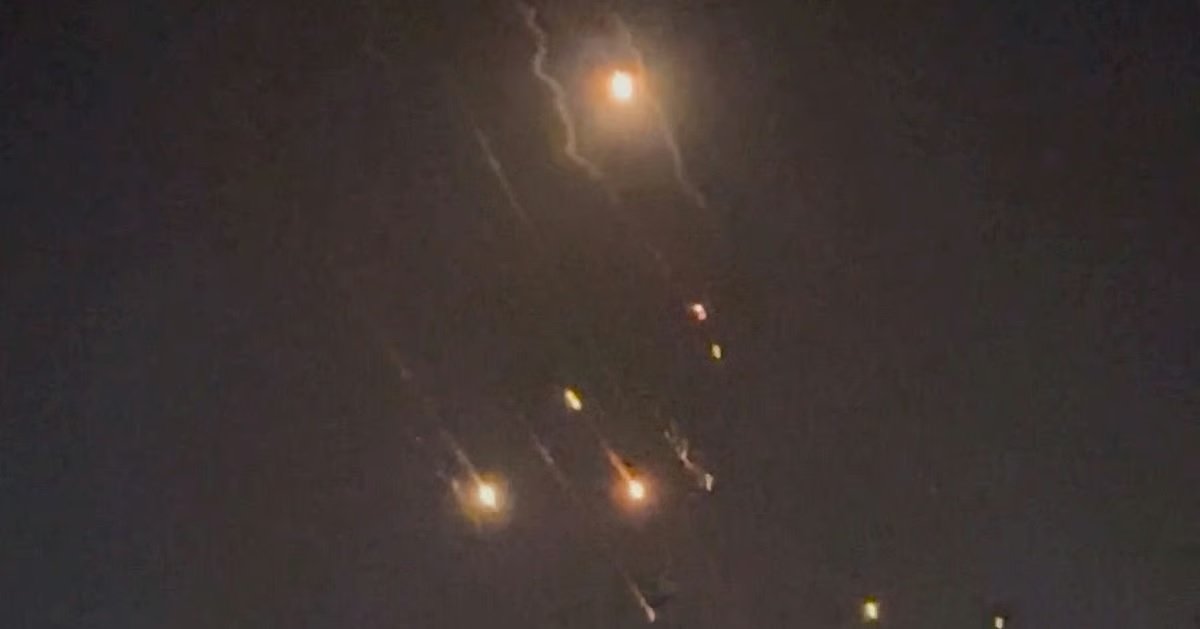
WASHINGTON — U.S. and partner forces intercepted multiple ballistic missiles launched by Iran's Islamic Revolutionary Guard Corps (IRGC) toward U.S. military positions in the Middle East on the evening of July 28, according to U.S. Central Command (CENTCOM).
CENTCOM said the missiles were launched from Iran at approximately 5:45 p.m. Eastern Time (ET) in what it described as an "attempted surprise attack." The command confirmed that all incoming missiles were successfully intercepted and that no casualties or damage were reported.
"U.S. forces remain vigilant and at a high state of readiness," CENTCOM said in a statement following the interceptions.
The command did not identify the specific military installation that was targeted.
At 5:45 p.m. ET today, Islamic Revolutionary Guard Corps forces launched multiple ballistic missiles from Iran in an attempted surprise attack on U.S. forces based in the Middle East. All Iranian missiles were successfully intercepted. U.S. forces remain vigilant and at a high…
— U.S. Central Command (@CENTCOM) July 28, 2026
Jordan Reports Missile Interceptions
Jordanian military officials said the country's air defense systems intercepted and destroyed five missiles launched from Iran. Local reports said the interceptions took place over Jordan during the early hours of July 29 local time.
Iranian state media, citing the IRGC, reported that the missiles were aimed at Muwaffaq Salti Air Base in Jordan and a U.S. Central Command facility located there. CENTCOM has not confirmed the intended target.
The reported target matches the location of an earlier Iranian attack. On July 17, 2026, Iranian ballistic missiles and drones struck the same base. During that attack, two U.S. service members were killed while responding to the strike, one additional service member was listed as missing in action, and four others were evacuated to hospitals in Jordan, according to CENTCOM.
End of a Brief Pause in Fighting
The July 28 missile launch followed a short period without publicly announced large-scale exchanges between the United States and Iran.
Earlier, President Donald Trump had paused a U.S. bombing campaign against Iranian-linked targets after nearly two weeks of military operations. The latest missile attack marks a renewed exchange of hostilities after that temporary lull.
CENTCOM said U.S. military personnel worked alongside partner forces to provide air defense during the latest attack but did not disclose the number of missiles fired or additional operational details.
Air Defense Response
The United States continues to maintain air defense systems across the region to protect military bases and partner facilities. These include systems such as the MIM-104 Patriot and SM-3, although CENTCOM did not identify which interceptor systems were used during the July 28 engagement.
The command also did not release information on the missiles' flight paths or other operational details beyond confirming that all incoming ballistic missiles were intercepted successfully.
Operation Epic Fury Casualty Figures
The latest interception occurred during the wider conflict between the United States and Iran, which began in late February 2026 under Operation Epic Fury.
According to the U.S. military's casualty accounting released as of July 16, 2026, 14 U.S. service members had died during Operation Epic Fury. Of those, seven were killed during combat operations, while seven died from non-combat causes or remained under review at the time of that report.
The U.S. Army accounted for eight of the deaths, while the U.S. Air Force accounted for six. No casualties were reported for the Navy, Marine Corps, or Space Force in that official accounting.
CENTCOM has not announced any additional casualties following the July 28 missile interceptions and said U.S. and partner forces remain prepared to respond to further threats in the region.
——— End of Article ———