KHASAN/TUMANGANG — Russia and North Korea are nearing completion of their first direct road bridge across the Tumen River, a project both governments say is intended to improve trade, tourism and cross-border transport. However, analysts and open-source researchers have raised questions over whether the crossing could also support military logistics as cooperation between the two countries continues to expand.
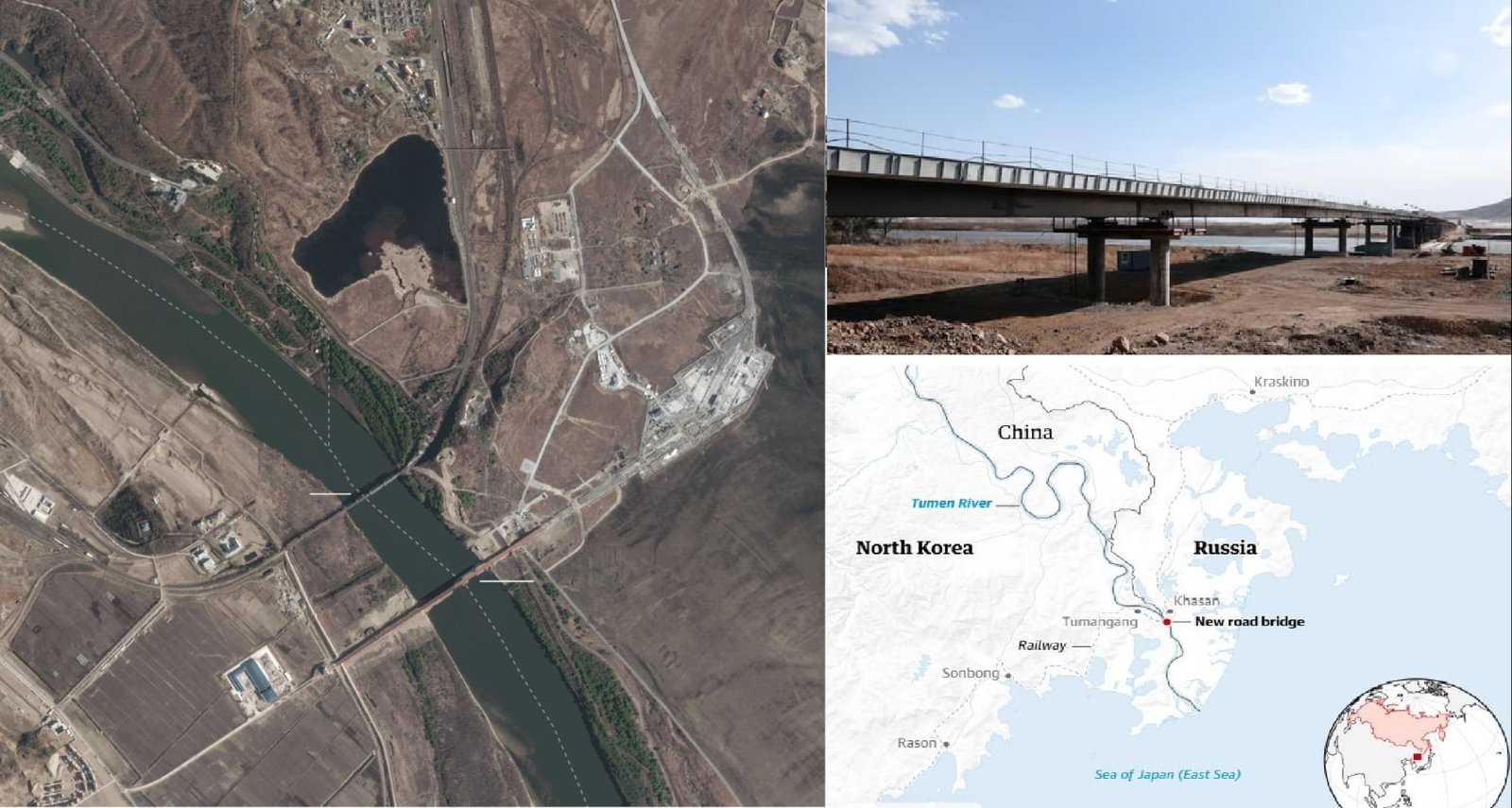
The new bridge links Khasan in Russia's Far East with Tumangang in North Korea. It is approximately one kilometer long and seven meters wide, with two traffic lanes. Including the approach roads, the entire transport crossing extends about 4.7 kilometers. The bridge is located next to the existing Friendship Bridge, a rail-only crossing completed in 1959.
Recent commercial satellite imagery analyzed by researchers, including reports by The Guardian and the U.S.-based 38 North project, indicates that the bridge's main structure is largely complete. North Korea has finished its section of the project, including customs, border control and quarantine facilities.
Construction on the Russian side is still ongoing. Satellite images show work continuing on a large border checkpoint, supporting infrastructure and other facilities. Reports also indicate that Russia is building a 10-lane border checkpoint and a helicopter landing pad as part of the project.
Construction began in early 2025 following an agreement signed during Russian President Vladimir Putin's visit to Pyongyang in June 2024, where Putin and North Korean leader Kim Jong Un concluded a comprehensive strategic partnership agreement.
Russian officials had previously targeted June 19, 2026, for the bridge's opening after an April ceremony marking the joining of the two sections. That deadline passed without the crossing becoming operational. As of late July 2026, no revised opening date has been announced. Putin has previously stated that the bridge is expected to open before the end of 2026.
Governments Present Economic Purpose
Moscow and Pyongyang have consistently described the bridge as an infrastructure project aimed at expanding trade, improving logistics, promoting tourism and supporting economic development in border regions.
Russian Transport Minister Andrey Nikitin has said the crossing will increase bilateral trade, improve transport links, strengthen cultural ties and help develop nearby border areas into economic centers. North Korean state media has also presented the bridge as a project that will facilitate travel and the movement of goods.
The bridge is estimated to cost around $100 million. Official bilateral trade between Russia and North Korea totaled approximately $34 million in 2024.
Tourism between the two countries also remains limited. Around 10,000 Russian tourists visited North Korea in 2025, mostly through organized tours to Pyongyang, which is located nearly 500 kilometers from the new border crossing.
Analysts Question Economic Justification
Despite the official explanation, several analysts argue that the project's scale exceeds current economic demand.
A recent investigation by the Ukrainian human rights organization Truth Hounds, reported by The Guardian, concluded that the bridge's economic justification appears limited when compared with current trade and tourism figures.
The organization suggested the crossing could provide a more flexible transport route for personnel, equipment and other cargo as military cooperation between Russia and North Korea has increased since 2024.
Road Transport Offers Different Logistics Advantages
According to Truth Hounds lead investigator Nazar Myhun, road transport offers practical advantages over rail and sea transport from a logistics perspective.
He said trucks are generally more difficult to monitor using satellite imagery because road networks provide many possible routes, making continuous tracking more challenging than monitoring fixed railway lines.
Myhun also noted that trucks can be loaded and unloaded more quickly than railway cars, reducing the amount of time cargo remains stationary. He added that railway cars often reveal the type of cargo they are carrying, especially when open railcars are used, while standard transport trucks generally appear similar in satellite images regardless of their contents.
Unlike trains, which operate through fixed railway terminals, trucks can be dispatched from many different locations, providing greater operational flexibility.
Direct Route Independent of Chinese Infrastructure
The new road bridge will also provide Russia and North Korea with a direct land connection that does not rely on Chinese infrastructure.
Once operational, the crossing will complement the existing Friendship Bridge and create the first direct road link between the two countries. Infrastructure work on the Russian side, including customs buildings, access roads and related facilities, remains the primary requirement before the bridge can begin operations.
Commercial satellite imagery has continued to track steady progress throughout 2025 and 2026, confirming that while the bridge structure is largely complete, work on Russian border infrastructure remains unfinished. As of late July 2026, both governments have not announced a new opening date.
——— End of Article ———