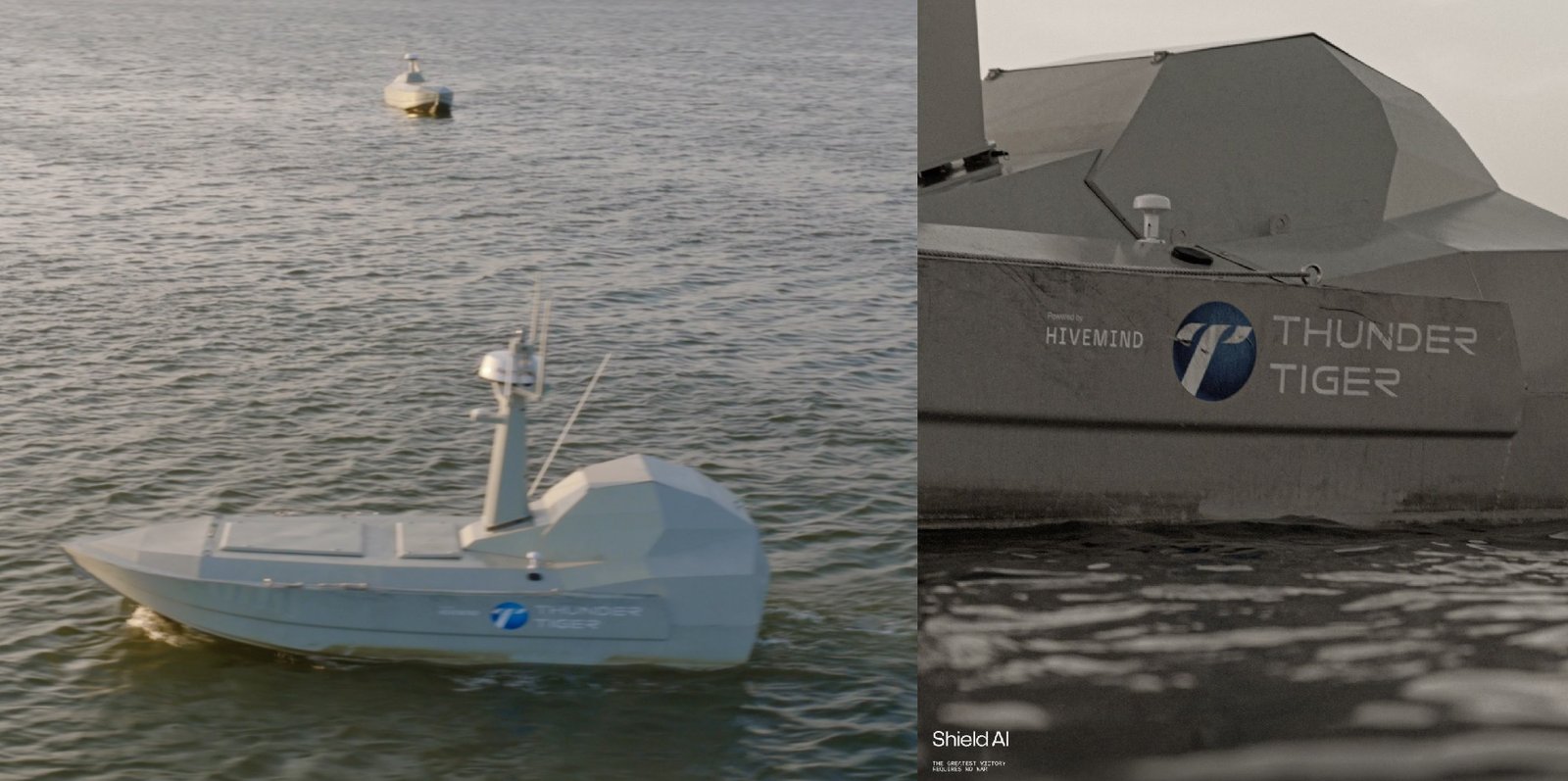
TAIPEI — U.S. defense technology company Shield AI and Taiwan-based Thunder Tiger Corp. have successfully completed Hivemind's first multi-asset autonomous teaming demonstration on water, validating Shield AI's Hivemind artificial intelligence (AI) pilot aboard Thunder Tiger's SeaShark unmanned surface vessels (USVs) during a coordinated maritime mission in Taiwan.
The demonstration, held at Dapeng Bay in Pingtung County, marked the first time Hivemind has coordinated multiple autonomous maritime platforms in a live mission and the first integration of the software with maritime radar and Automatic Identification System (AIS) data.
Two Autonomous Drone Boats Complete ISR Mission
The demonstration involved Thunder Tiger's SeaShark 600 and SeaShark 800 unmanned surface vessels (USVs) conducting a coordinated intelligence, surveillance, and reconnaissance (ISR) mission.
Equipped with Shield AI's Hivemind autonomy software, the vessels used maritime radar, onboard imagery, and AIS data to autonomously plan mission waypoints, search a designated maritime area, identify a target vessel of interest, and coordinate to escort the vessel out of the designated search zone—all without human intervention in mission execution.
According to reports from the demonstration, Hivemind divided the search area into separate sectors and assigned one USV to each vessel. After one SeaShark detected the target boat, it immediately shared the information with the second USV. The second vessel then calculated an optimized interception route, allowing both autonomous boats to complete the escort mission in coordination.
Personnel from Taiwan's National Chung-Shan Institute for Science and Technology (NCSIST) and the Coast Guard Administration attended the demonstration.
Shield AI: Mission Autonomy Can Scale Across Domains
Nathan Michael, Chief Technology Officer at Shield AI, said the demonstration highlighted the ability of Hivemind to operate across multiple domains and platforms.
"Hivemind continues to prove that true mission autonomy can scale across domains, platforms, and functional assets, unlocking new capabilities for distributed intelligence and maritime security missions," Michael said.
"As we continue working with Thunder Tiger to expand the scale and sophistication of autonomous maritime teams, these systems will fundamentally reshape maritime surveillance operations and strengthen deterrence through resilient, intelligent operations."
Partnership Began Earlier This Year
Shield AI and Thunder Tiger announced a strategic partnership and memorandum of understanding (MoU) in May 2026 to integrate the Hivemind AI pilot across Thunder Tiger's unmanned systems portfolio for dual-use maritime missions.
Thunder Tiger manufactures a range of unmanned aerial and surface systems, including Blue UAS-approved first-person view (FPV) platforms that meet cybersecurity and supply-chain standards for U.S. and allied defense applications.
Building on the demonstration, both companies said they will continue collaborating on additional sensor integrations, more advanced autonomous behaviors, larger autonomous teams, and open-ocean operations.
During the event, Maximilian Chen, Shield AI's Director of Government Relations for Asia, said a fleet of five Hivemind-equipped USVs using autonomous route planning could cover up to 8.3 times their combined search area, highlighting the efficiency gains possible through coordinated autonomous operations.
Thunder Tiger Highlights Maritime Security
Gene Su, Board Director and General Manager of Thunder Tiger Corp., said autonomous maritime systems will play an increasingly important role in Taiwan's security.
"As an island nation, the maritime domain is increasingly critical to Taiwan's security. By integrating AI pilots into our portfolio, we can enable distributed, networked teams that coordinate dynamically to build a more complete understanding of the maritime environment—improving the ability to detect, classify, and identify contacts while helping operators respond with greater speed, scale, and effectiveness," Su said.
He added that the demonstration represents an important step toward advancing resilient autonomous maritime capabilities and that the partnership with Shield AI is expected to continue delivering increasingly sophisticated autonomous systems.
Thunder Tiger Chairman William Chen also highlighted the growing importance of unmanned aerial vehicles (UAVs) and unmanned surface vessels (USVs), referencing lessons from the Russia-Ukraine war. He called for legislative action on a drone procurement bill as Taiwan continues expanding its unmanned defense capabilities.
Strengthening Taiwan's Maritime Defense
The demonstration comes as Taiwan continues to invest in asymmetric defense capabilities to strengthen maritime surveillance and coastal defense. Taiwan's Ministry of National Defense has sought funding for coastal reconnaissance drones, attack drones, and unmanned surface vessels as part of broader efforts to build distributed maritime capabilities.
The integration of autonomous AI software such as Hivemind could provide several operational advantages as China continues expanding both its naval fleet and unmanned maritime systems.
Unlike conventionally operated drones that rely on continuous communications with operators, Hivemind processes sensor information and makes navigation and mission decisions onboard the vessel. This allows autonomous USVs to continue operating even when communications are degraded or disrupted by electronic warfare.
Autonomous teams of drone boats can also patrol multiple sectors simultaneously, share information in real time, coordinate target tracking, and maintain persistent surveillance over larger maritime areas. These capabilities can improve maritime awareness while complementing manned naval assets with lower-cost unmanned platforms.
China has also accelerated the development and testing of unmanned surface vessels for the People's Liberation Army Navy (PLAN), increasing the emphasis on resilient and distributed autonomous maritime systems on both sides of the Taiwan Strait.
Lessons from the Ukraine-Russia War
Interest in autonomous drone boats has grown significantly following their operational use during the Ukraine-Russia war.
Since 2022, Ukraine has employed unmanned surface vessels such as the MAGURA and Sea Baby in operations against Russian naval assets and military infrastructure in the Black Sea. These systems have been used to strike warships and other maritime targets, demonstrating how relatively low-cost unmanned platforms can challenge larger conventional naval forces and influence naval operations.
Military planners have drawn lessons from these operations, particularly the value of distributed unmanned systems for surveillance, reconnaissance, maritime security, and coordinated operations while reducing risks to personnel. Taiwan's continued investment in autonomous maritime platforms reflects a broader effort to strengthen coastal defense and maritime situational awareness using unmanned technologies.
Hivemind Across Multiple Military Platforms
Shield AI said Hivemind enables military platforms to sense, decide, and act independently without human intervention in those functions.
Before the Taiwan maritime demonstration, Hivemind had already been integrated with more than 30 different platforms, including F-16 fighter aircraft, jet-powered unmanned aerial vehicles, helicopters, drone boats, and ground vehicles.
Founded in 2015, Shield AI develops autonomy software and aircraft, including the V-BAT and X-BAT systems. Thunder Tiger Corp., listed on the Taiwan Stock Exchange, manufactures unmanned aerial and surface systems for defense, inspection, and other applications, with its FPV platforms holding Blue UAS approval.
——— End of Article ———