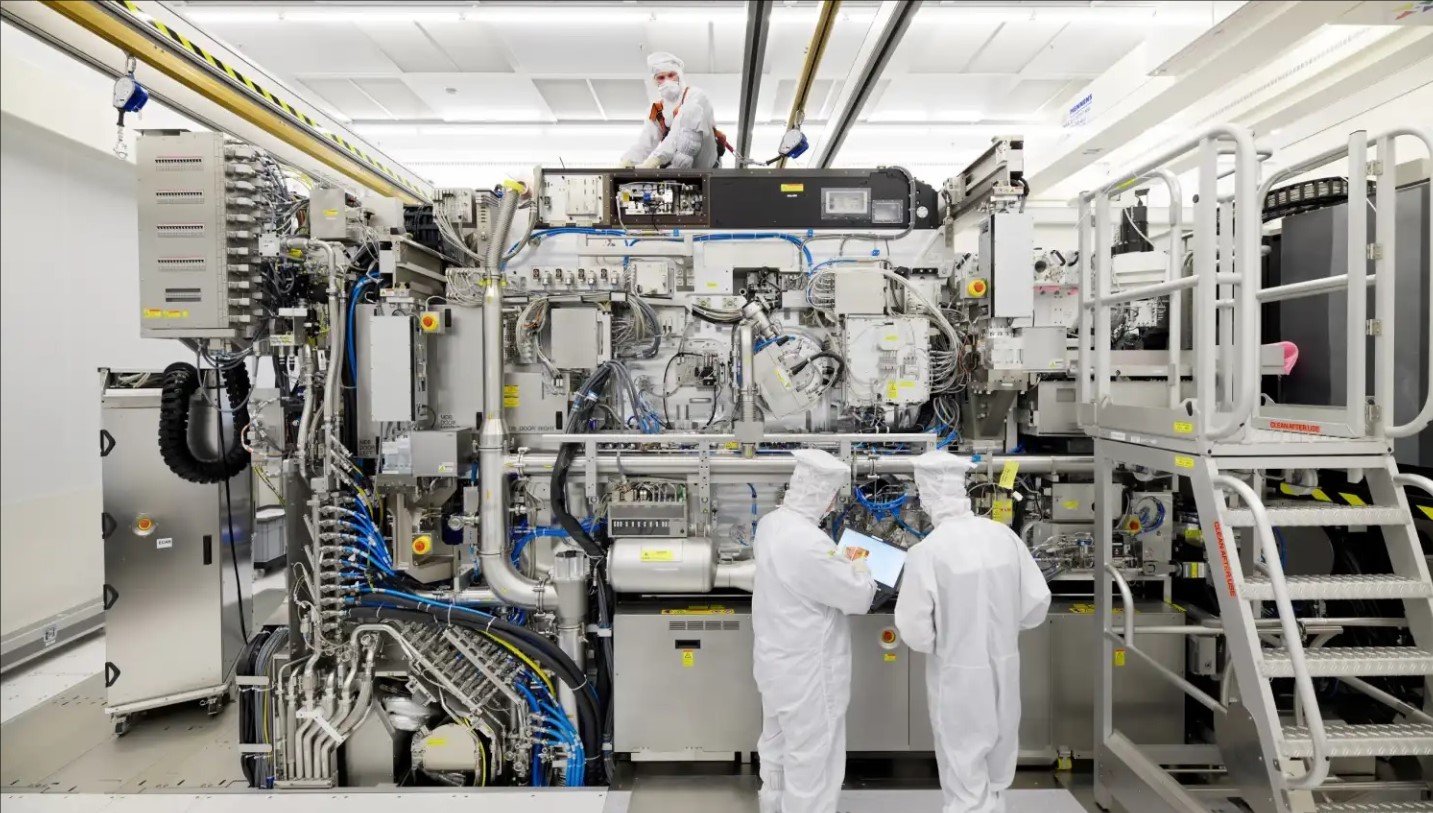
SHANGHAI, China — A Chinese company has started manufacturing domestic immersion deep ultraviolet (DUV) lithography machines, marking an important step in the country's efforts to strengthen its semiconductor manufacturing capabilities following export restrictions on advanced chipmaking equipment.
According to a report by The Information, the immersion DUV lithography systems are expected to be delivered later this year to major Chinese semiconductor manufacturers, including Semiconductor Manufacturing International Corp. (SMIC), Hua Hong Semiconductor, and ChangXin Memory Technologies (CXMT).
The development comes after export controls imposed by the United States and the Netherlands restricted China's access to advanced lithography equipment, including certain systems produced by Dutch chip equipment manufacturer ASML.
Immersion DUV lithography machines are essential tools used to print microscopic circuit patterns onto silicon wafers during semiconductor manufacturing. These systems are widely used to produce mature semiconductor technologies and can also support more advanced chip production through multi-patterning techniques.
Reports identify Shanghai Aishengna Electronic Technology Group, a state-backed Chinese company, as the manufacturer behind the new immersion DUV systems. The company has reportedly brought together engineering teams from several domestic startups to develop the equipment as part of China's broader effort to expand domestic semiconductor manufacturing capabilities.
Initial Production Remains Limited
Current production plans remain relatively modest. Reports indicate that China aims to manufacture about five immersion DUV machines in 2026, with production expected to increase to around 20 units in 2027.
By comparison, ASML plans production capacity for approximately 130 immersion DUV lithography systems in 2026, with additional expansion planned afterward.
Industry analysts note that manufacturing lithography machines is only one part of the challenge. Long-term performance, production reliability, wafer throughput, alignment accuracy, maintenance, and manufacturing yields remain key factors for large-scale commercial semiconductor production.
Reports also indicate that the new Chinese systems still rely on some imported Japanese components, while delays from domestic suppliers have affected production schedules this year.
DUV Systems Can Produce Advanced Chips Through Multi-Patterning
Immersion DUV lithography systems are primarily used to manufacture 28-nanometer semiconductor chips directly. They can also support production of smaller technology nodes, including 7nm chips, by using a process known as multi-patterning.
However, producing advanced chips without access to extreme ultraviolet (EUV) lithography requires significantly more processing steps. Reports indicate that manufacturing a 7nm chip using DUV typically requires approximately 34 exposure steps, compared with about nine exposures using EUV technology.
Each additional exposure increases the possibility of alignment errors, raises manufacturing complexity, and increases production costs. Estimates cited in industry reports suggest that wafer costs can rise by 40 to 50 percent compared with leading EUV-based manufacturing processes, while production yields are often lower than half, increasing the cost of each functioning chip.
China's Domestic Equipment Industry Continues to Expand
China has continued increasing the use of domestically produced semiconductor manufacturing equipment despite export restrictions.
According to industry data cited in recent reports, the domestic share of China's chipmaking equipment increased from approximately 25 percent in 2024 to around 35 percent in 2025. Domestic suppliers account for more than 40 percent of etching equipment, while locally produced lithography equipment remains below 10 percent of the market.
A lithography scanner contains thousands of highly precise components supplied through a specialized global manufacturing network that has developed over decades. Analysts note that replicating this supply chain remains one of the most difficult aspects of developing competitive lithography systems.
Market Reaction and Analyst Views
The reports initially affected semiconductor equipment stocks. ASML shares fell following the publication of the news and were trading about 1.8 percent lower on Tuesday during a broader decline across semiconductor stocks. Despite the decline, the company's shares remain up more than 123 percent for the year.
Analysts said the reports demonstrate China's continued progress toward semiconductor self-reliance but are unlikely to significantly affect ASML's competitive position in the near future.
Stephane Houri, Head of Equity Research at ODDO BHF, told CNBC that the development should be viewed cautiously, noting that China's production could remain limited to lower-end applications.
Analysts also point out that the domestic systems primarily replace equipment that ASML is already restricted from exporting to China under existing export controls, limiting the immediate commercial impact on the Dutch company.
ASML Continues to Benefit From Global AI Demand
Although export controls have reduced ASML's sales into China—from roughly one-third of company revenue in 2024 to around one-fifth more recently—the company continues to benefit from strong demand outside China.
ASML has raised its 2026 sales guidance to between €43 billion and €45 billion, supported by continued investment in artificial intelligence infrastructure by semiconductor manufacturers worldwide.
Industry analysts note that progress in immersion DUV technology does not automatically translate into success with EUV lithography, which required decades of development and extensive investment by ASML and its technology partners.
Broader Supply Chain Challenges Remain
The latest development highlights how export controls have encouraged countries to strengthen domestic semiconductor supply chains rather than eliminate demand for advanced manufacturing equipment.
A similar trend occurred in 2019, when Japan restricted exports of three key semiconductor chemicals to South Korea. Korean companies subsequently reduced dependence on Japanese materials from 34 percent of imports to 25 percent by sourcing supplies from Belgium and Taiwan.
India's semiconductor manufacturing program is also expected to rely initially on imported equipment. The planned semiconductor fabrication facility at Dholera is expected to begin operations using imported tools while gradually developing a domestic supply chain for advanced semiconductor manufacturing equipment.
China's production of domestic immersion DUV lithography machines represents a notable milestone in its semiconductor development efforts under export restrictions. However, industry analysts continue to highlight that expanding production, improving reliability, increasing yields, and developing a complete domestic supply chain remain key challenges before the new systems can compete at scale with established global manufacturers.
——— End of Article ———