TAIPEI — Taiwan’s National Chung-Shan Institute of Science and Technology (NCSIST) has published new details on its domestically developed Strong Bow air defense missile system, also known as Chiang Kung or Sky Bow IV (Tien Kung IV).
The land-based system is designed as a mid-tier interceptor against tactical ballistic missiles. NCSIST says the system is intended to intercept incoming tactical ballistic missiles at medium altitudes and operate with lower-layer air defense systems to create a layered defense network.
Two-stage missile with thrust-vector control
According to NCSIST, the Strong Bow missile uses a two-stage solid-fuel rocket motor and can reach hypersonic speeds. Its guidance system uses inertial navigation with radar uplink corrections during the midcourse phase before switching to an active seeker during the terminal phase.
The missile also uses thrust-vector control during the terminal phase. NCSIST says this provides maneuverability in the thin atmosphere. The interceptor is equipped with precision guidance and a directional warhead, while its integrated composite rocket motor is intended to improve ease of production.
The system has a reported interception altitude of about 70 kilometers. Taiwanese reporting has described this as a higher interception layer than the existing Sky Bow III system, which has a reported altitude of about 45 kilometers.
AESA radar and mobile launch system
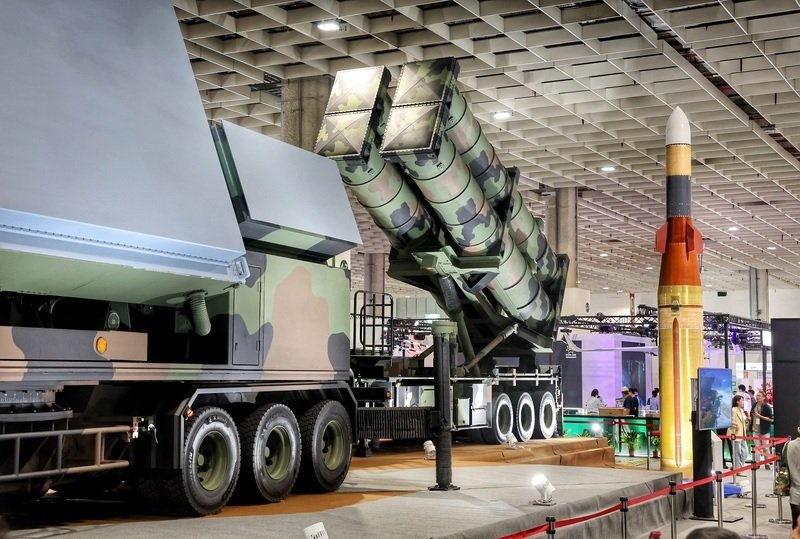
The Strong Bow system includes the missile, a mobile vertical-launch transporter erector vehicle, tactical command vehicle and vehicle-mounted AESA radar. Each launcher can carry four missile canisters.
NCSIST says the radar provides target classification and identification, high-precision tracking, electronic counter-countermeasures and the ability to engage multiple tactical ballistic-missile targets.
The missile canister is about 7.61 meters long, compared with approximately 5.49 meters for the Sky Bow III canister, according to published details on the system.
NCSIST’s seeker information also states that the Strong Bow seeker can actively search for and track targets and provide target information for missile guidance during interception.
Planned deployment
Taiwan plans to procure at least 128 Strong Bow interceptors. A funding proposal reported for the program includes about NT$36.1 billion for two systems and 128 missiles.
The Strong Bow is planned as part of Taiwan’s T-Dome layered air defense network, operating alongside the existing Sky Bow III and U.S.-supplied Patriot Advanced Capability-3 (PAC-3) interceptors. Taiwan’s Ministry of National Defense has described the combination as providing multilayered defense against missile and aircraft threats.
The Strong Bow system was publicly displayed at the 2025 Taipei Aerospace and Defense Technology Exhibition, after development and operational evaluation work had progressed. Taiwan’s NCSIST subsequently confirmed that the system had entered mass production.
The latest NCSIST information provides further details of the missile’s propulsion, guidance, launcher and radar architecture, giving a clearer picture of how Strong Bow is intended to serve as a mid-tier component of Taiwan’s integrated air and missile defense network.
——— End of Article ———