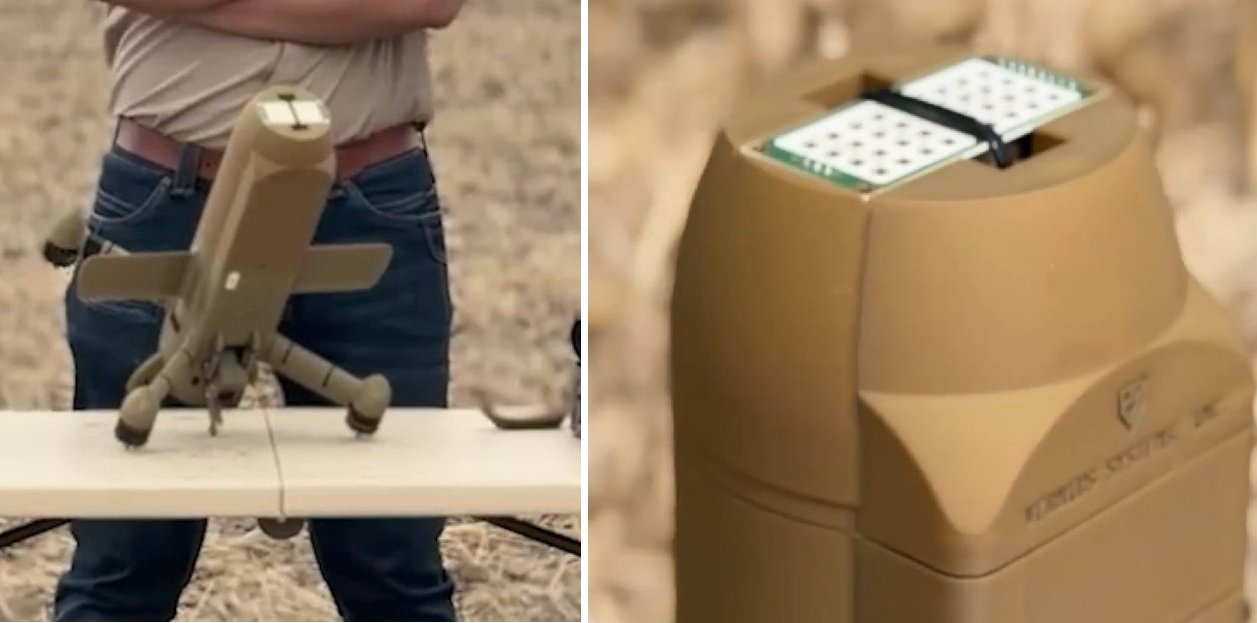
San Francisco — U.S. technology company Vernius Systems has unveiled the Archimedes 1A, an active radar seeker designed for unmanned aerial vehicle (UAV) interceptors. The company demonstrated the guidance head integrated with the STING interceptor UAV, developed by Ukrainian manufacturer Wild Hornets.
The Archimedes 1A is an 80 mm active radar seeker operating at 24 GHz with a fixed beam. Vernius lists a 25° × 14° field of view and says it can detect Shahed-class targets at ranges exceeding 1 kilometre. The stated range is based on targets with a radar cross-section of approximately 0 dBsm. The unit costs around $4,000.
The seeker is designed to support automated interception and operation in fog, smoke, rain and darkness. It has two operating modes. In fully autonomous interception, the interceptor receives a cue from a command-and-control network, uses radar for midcourse guidance beyond visual range, and then transfers to autonomous vision-based terminal guidance. In operator-assisted mode, the seeker provides live target range and bearing information to the pilot, allowing the target to be acquired before it becomes visible.
Vernius Systems unveils the Archimedes 1A, an 80 mm, 24 GHz active radar seeker for UAV interceptors. Integrated with Ukraine’s STING, it detects Shahed-class targets beyond 1 km and costs around $4,000. pic.twitter.com/VwWOsE24H4
— The Defense News (@TheDefenseNews) August 25, 2026
Vernius says the system is designed to adapt to existing interceptor platforms and can also be integrated with jet-powered interceptor UAVs, including the Alexa Spatium system. The company says this could support automated guidance against faster jet-powered attack drones such as the Geran-3, Geran-4 and Geran-5.
According to Vernius, more than 50 percent of Shahed-type attack drones operating over Ukraine are now jet-powered, making manual interception more difficult because of their higher speed and the limited reaction time available to operators. The company states that manual interception currently has a 20–50 percent kill probability, which it expects to decline further in poor visibility.
Vernius Systems is based in San Francisco and develops low-cost radar seekers for counter-UAS applications. It was spun out of the volunteer nonprofit Defense Tech for Ukraine and is backed by Y Combinator. Its team includes personnel with experience in RF PCB engineering, software for the U.S. Navy's Tomahawk missile fleet, satellite systems and FPV hardware used by frontline operators.
The company says its early investors include former U.S. National Security Advisor Lt. Gen. H.R. McMaster, Austin Howard, who is identified as the chief engineer behind VBAT, and Ukrainian military analyst Rob Lee.
Vernius says it has secured $500 million in letters of intent for 2027 from defense manufacturers and military units across the United States, European Union and Ukraine. The company describes its broader objective as using compact radar technology to turn drones into autonomous interceptors and says its approach could reduce the cost per kill from around $4 million for Patriot-class missiles to less than $4,000.
The STING interceptor, developed by Wild Hornets, is a Ukrainian FPV system used against Shahed-type and related drones. It has been used in operational conditions and can, in some cases, be controlled through the Hornet Vision system for remote operation over extended distances.
——— End of Article ———