TAIPEI — April 27, 2026 : Taiwan has received the third and final batch of 28 M1A2T Abrams main battle tanks from the United States, completing a total procurement of 108 vehicles under a long-running Foreign Military Sales (FMS) program launched in 2019.
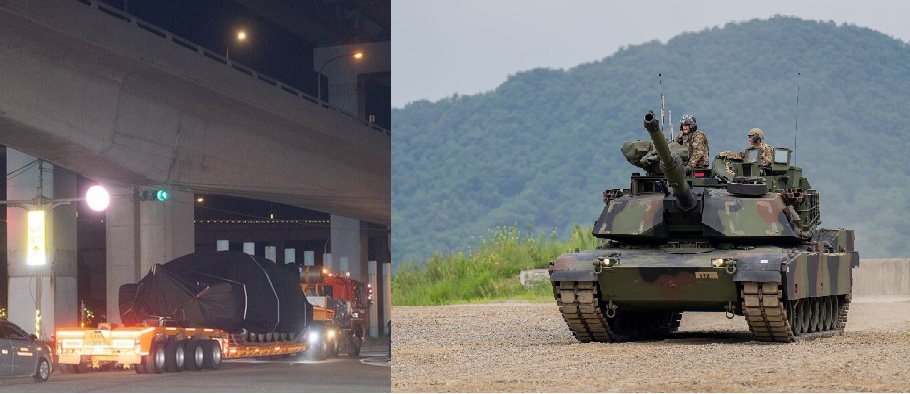
The shipment arrived without disruption at Port of Taipei on the night of April 26. Beginning at approximately 12:10 a.m. on April 27, the tanks were unloaded and transferred onto civilian heavy transport trailers under coordinated military and police escort. The convoy proceeded to the Armored Forces Training Command in Hukou Township, Hsinchu County, where the vehicles will undergo final integration and evaluation.
Procurement Program and Delivery Phases
The completed delivery marks the conclusion of a defense acquisition program valued at approximately NT$40.5 billion (US$1.28–1.45 billion), approved by the United States in 2019. The order was executed in three phases:
- Batch 1: 38 tanks delivered in December 2024
- Batch 2: 42 tanks delivered in July 2025
- Batch 3: 28 tanks delivered on April 26, 2026
In addition to the tanks, the package included supporting equipment designed to enable sustainment and mobility of heavy armored units. This comprises 14 M88A2 armored recovery vehicles, 16 M1070A1 heavy equipment transporters, and 16 M1000 flatbed trailers.
Deliveries were completed ahead of the originally projected schedule, ensuring earlier availability for operational integration.
Deployment Structure and Unit Allocation
All 108 M1A2T tanks are assigned to the Republic of China Army’s 6th Army Corps, which is responsible for defense operations in northern Taiwan. The deployment forms a concentrated armored capability positioned to respond to potential amphibious landing scenarios.
The majority of the tanks are being distributed to the 242nd and 584th Combined Arms Brigades, both based in northeastern Taiwan. Within the 584th Brigade, two tank battalions—the 1st and 3rd Combined Arms Battalions—have already inducted the Abrams into operational service.
With the arrival of the final batch, one additional tank company will be fully equipped. Further allocations are planned for additional companies within the 1st and 2nd Combined Arms Battalions, as well as elements of the 269th Mechanized Infantry Brigade.
The new platforms are replacing Taiwan’s legacy armored fleet, including CM-11 Brave Tiger and M60A3 main battle tanks that have remained in service for more than two decades.
Technical Configuration of the M1A2T Variant
The M1A2T is a Taiwan-specific configuration derived from the M1A2 SEPv3 Abrams platform and manufactured by General Dynamics Land Systems in Lima, Ohio. The configuration incorporates several features aligned with Taiwan’s operational requirements.
The tank is equipped with a 120mm XM256 smoothbore main gun designed to engage modern armored threats. Secondary armament includes a .50 caliber M2 machine gun and a 7.62mm M240 coaxial machine gun.
A key feature is the commander’s independent thermal viewer, enabling “hunter-killer” targeting. This allows the commander to identify and designate targets while the gunner engages another, reducing engagement time and improving battlefield responsiveness.
The platform also includes reconfigured turret armor and an under-armor auxiliary power unit (APU). The APU enables the tank to operate onboard electronics and surveillance systems without running the primary 1,500-horsepower turbine engine, reducing both thermal and acoustic signatures during stationary operations.
Integration, Training, and Operational Timeline
The final batch of 28 tanks will undergo a structured process at the Hukou training facility, including system integration, live-fire exercises, crew training, and formal evaluation. These steps are required prior to full operational commissioning.
Taiwan’s Ministry of National Defense expects the complete fleet of 108 tanks to achieve full operational capability by the end of 2026.
The acquisition forms part of a broader effort to modernize Taiwan’s armored forces and enhance ground defense capacity in northern operational sectors.
——— End of Article ———