Taiwan has taken a significant but understated step in modernizing its littoral strike capabilities, with the Marine Corps conducting a live at-sea firing of the domestically developed Jingfeng-1 (Chin Feng I) loitering munition off Zuoying Harbor in southern Taiwan. According to information published by the Liberty Times Military Channel, the firing took place on December 24, 2025, following a formal firing notice issued a day earlier, and marks the first confirmed operational use of the Jingfeng-1 from a manned naval platform.
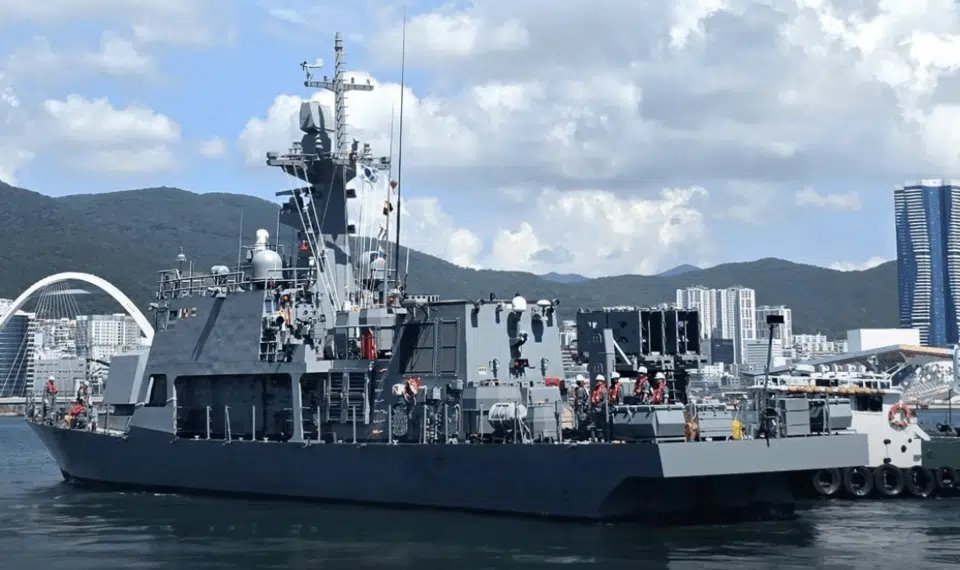
The weapon was launched from an M96 fast attack craft, a platform already optimized for coastal interception and rapid maneuvering. The drone was supplied by National Chung‑Shan Institute of Science and Technology, Taiwan’s primary indigenous defense R&D body, with military sources confirming that the Navy has placed a small initial production order, portions of which have already been delivered to Marine units.
From Shore to Sea: A Shift in Taiwan’s Drone Posture
While Taiwan has previously tested loitering munitions from land sites, the Zuoying firing signals a doctrinal shift—moving attack drones into the littoral and near-sea battlespace, where any future cross-strait conflict would likely be decided. Operating loitering munitions from fast boats allows the Marines to extend strike reach beyond fixed coastal positions, complicating adversary targeting and enabling rapid, distributed attacks.
The test also places the Marine Corps alongside the Army, which on December 18, 2025, conducted its first live-fire exercise of the Altius‑600M near the Zhuoshui River, an event personally inspected by Defense Minister Gu Lixiong. Together, the two exercises underline Taiwan’s accelerating embrace of loitering munitions as a core battlefield tool.
Jingfeng-1: One Weapon, Multiple Platforms
Developed by NCSIST, the Jingfeng-1 exemplifies what Taiwanese defense planners describe as “one missile, multiple uses.” The loitering munition has been designed from the outset for cross-domain flexibility, allowing it to be deployed by infantry, vehicles, unmanned vessels, aerial platforms, and now manned fast attack craft.
Prior to the Marine Corps firing, NCSIST had already demonstrated the system in August 2025, during a live-fire exercise showcasing unmanned aerial vehicle and unmanned surface vessel joint operations. In that test, the Kuai‑Chi unmanned surface craft launched Jingfeng-1 units in a coordinated strike concept that won the backing of the Navy and directly led to procurement.
Reported Specifications and Capabilities
While NCSIST has not released full classified performance data, defense and military sources describe the Jingfeng-1 as a short- to medium-range loitering munition optimized for coastal and expeditionary combat. The system is understood to feature an electric propulsion system, enabling a low acoustic and thermal signature, and a man-portable form factor that allows carriage by a single soldier.
Operationally, the Jingfeng-1 is believed to have an endurance measured in tens of minutes, sufficient for target search, loitering, and terminal attack, with a strike radius suitable for battalion-level engagements. It carries a high-explosive warhead, with NCSIST previously disclosing work on energetic fragmentation designs incorporating CL-20-based explosives, significantly increasing lethality against lightly armored vehicles, small ships, and fortified positions.
Guidance is assessed to combine electro-optical sensors with real-time data links, allowing operators to abort, retask, or manually guide the munition onto targets of opportunity—an essential feature in cluttered littoral environments.
Why the M96 Matters
The choice of the M96 as the launch platform is strategically telling. Fast, agile, and already integrated into Marine Corps coastal defense missions, the M96 enables shoot-and-scoot drone operations at sea, reducing vulnerability to counter-fire while extending surveillance and strike coverage.
By pairing fast boats with loitering munitions, Taiwan effectively creates mobile drone magazines that can disperse, strike, and relocate rapidly—an approach well suited to asymmetric maritime warfare in the Taiwan Strait.
A Quiet Signal with Strategic Weight
Although unannounced in official statements, the December 24 firing represents the first operational allocation of domestically produced attack drones to Taiwan’s Marine Corps, and the first known live-fire launch from a manned naval craft. Military sources indicate that this batch is only the beginning, with additional production and platform integrations under evaluation.
In strategic terms, the message is clear: Taiwan is no longer limiting loitering munitions to static land defenses. By pushing systems like Jingfeng-1 into the littorals, Taipei is layering its coastal defense with mobile, networked, and expendable strike assets—a move that significantly raises the complexity and cost of any hostile amphibious operation.
Quiet in execution, the Zuoying test nonetheless marks a notable evolution in Taiwan’s approach to modern maritime warfare.
——— End of Article ———