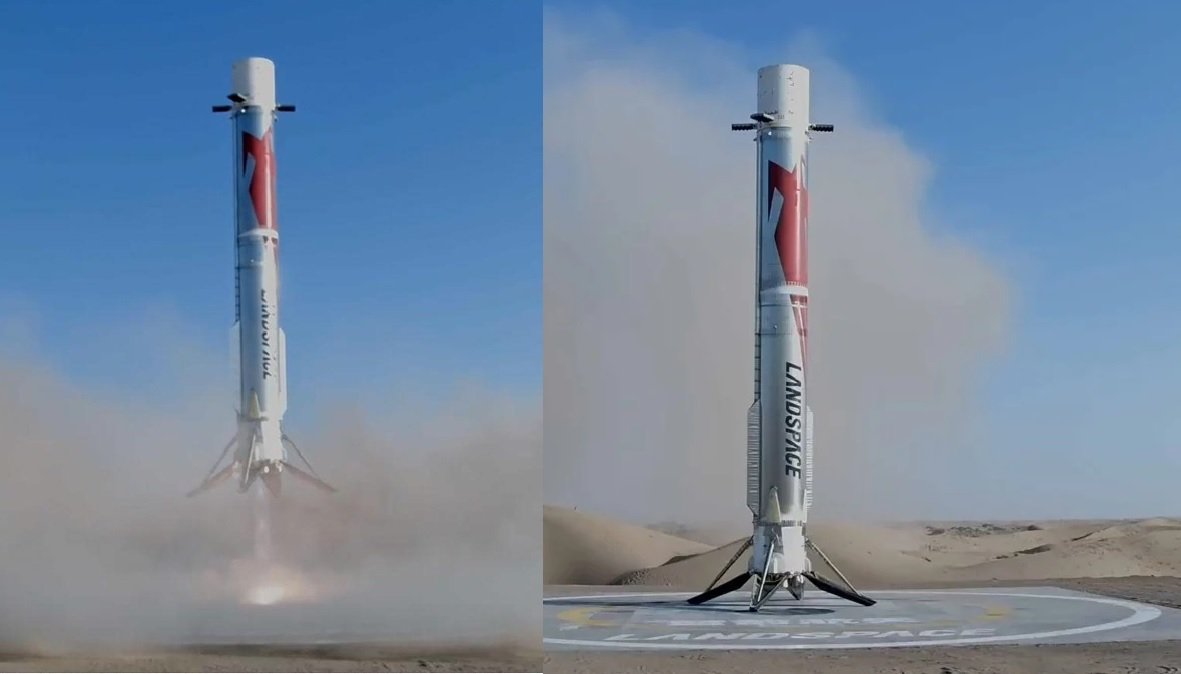
BEIJING, China — China’s private aerospace company LandSpace successfully launched its Zhuque-3 Y2 rocket and recovered its first-stage booster on land on Wednesday, marking China’s first successful land-based recovery of an orbital-class rocket booster using deployable landing legs.
The 66.1-meter-tall rocket lifted off at 7:35 a.m. Beijing Time from the Dongfeng Commercial Space Innovation Pilot Zone in northwest China, part of the Jiuquan Satellite Launch Center. About 137 seconds after liftoff, the first and second stages separated. The second stage successfully placed the Honghu-03 commercial internet satellite, developed by LandSpace affiliate Hongqing Technology, into its designated orbit.
The first stage then carried out its planned return sequence, including high-altitude attitude adjustment, powered deceleration during re-entry, aerodynamic glide control using grid fins, a final landing burn and deployment of landing legs. The booster traveled about 390 kilometers downrange before making a vertical landing at the designated Zhuque-3 recovery site in Minqin County, Gansu Province, at around 7:41–7:43 a.m. Beijing Time.
LandSpace confirmed the launch and recovery mission was a complete success. The achievement also marks the first time a Chinese launch vehicle has completed this type of vertical landing after an orbital mission.
— Mao Ning 毛宁 (@SpoxCHN_MaoNing) August 19, 2026
Reusable Rocket Design
Zhuque-3 is a two-stage, stainless-steel rocket with a diameter of about 4.5 meters. It uses liquid oxygen and methane propellants, while its first stage is powered by nine Tianque-12A engines.
The rocket is designed for low-cost, high-frequency commercial launches, with the first stage intended to be reused up to around 20 times. LandSpace has indicated that it plans to inspect and potentially reuse a recovered booster within about six months.
Second Zhuque-3 Flight
The mission was the second flight of Zhuque-3. During its December 2025 maiden flight, the rocket successfully reached orbit, but the first-stage recovery attempt ended with an anomaly during the final landing burn.
For the Y2 mission, engineers applied improvements based on the earlier flight, including refinements to the landing propulsion approach and enhancements to the onboard autonomous flight safety system.
The successful recovery provides flight-verified data on the booster’s complete return process, from high-speed flight and re-entry to controlled landing.
China’s Two Booster Recovery Methods
The Zhuque-3 recovery follows the July 10, 2026 sea-based recovery of a Long March-10B first stage by state-owned China Aerospace Science and Technology Corporation (CASC), which used a net-capture system on a recovery vessel.
China has now demonstrated controlled recovery of orbital rocket stages through both sea-based net capture and land-based vertical landing methods.
LandSpace is also in the inquiry phase for an IPO on the Shanghai Stock Exchange’s STAR Market, aiming to raise 7.5 billion yuan with a profitability target for 2029.
The Zhuque-3 mission moves LandSpace closer to its planned reusable commercial launch operations and supports China’s broader development of reusable launch technology aimed at reducing satellite launch costs and enabling more frequent launches.
——— End of Article ———