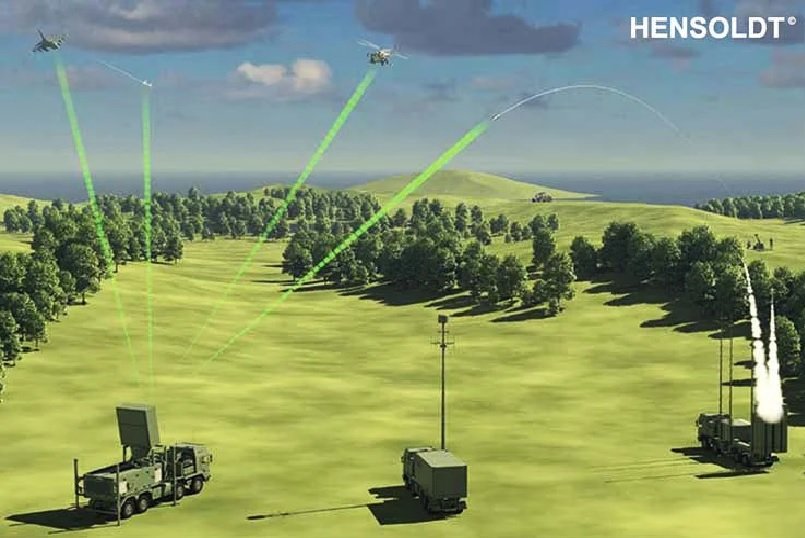
Ulm, Germany — Rheinmetall Air Defence and HENSOLDT have successfully demonstrated the integration of HENSOLDT’s Twinvis passive radar with Rheinmetall’s Skymaster command and weapon engagement system during the German Air Force’s Timber Express 2026 exercise.
During the exercise, the air picture generated by Twinvis was connected to Skymaster, which then used the data to direct a deployed Skynex air defence battery against exercise targets.
The demonstration was conducted under realistic NATO networking conditions. Sensor data from the systems was fused and correlated through NATO’s Link 16 network to create a common air picture. HENSOLDT reported that Twinvis successfully detected and tracked airborne targets during the exercise.
Passive Radar and EMCON
Twinvis is a passive radar system that uses existing signals from radio and television transmitters rather than transmitting its own radar signals. This allows it to detect and track airborne targets without producing a distinctive active radar emission.
The passive approach supports emissions-control (EMCON) operations and can provide an additional sensor source for distributed air defence networks. Twinvis is designed for wide-area military airspace surveillance and can also be used for civil air traffic control applications.
Sensor Fusion Through Skymaster
The exercise demonstrated Skymaster’s ability to combine information from different sensors. The system merged data from active radars, passive sensors and electro-optical systems into a single air picture.
Rheinmetall and HENSOLDT said this sensor fusion improves situational awareness and supports the surveillance and protection of high-value infrastructure, critical facilities and mobile military units. Passive sensors can also extend existing air defence architectures by providing additional tracking information without active radar emissions.
Future Air Defence Applications
The companies said the results provide a basis for integrating passive sensor technology into different future air defence configurations. The same networked approach could be applied to stationary Skynex systems, mobile Skyranger solutions and counter-UAS configurations such as Skyspotter.
The demonstration involved German Air Force organisations, the Timber Express exercise management team and specialist teams from Rheinmetall Air Defence and HENSOLDT. The companies said the NATO-compatible integration showed that distributed active and passive sensors can be combined within modern air defence networks while maintaining an open architecture for future systems.
Timber Express is an annual German Air Force exercise focused on testing real-time tactical data exchange between participating units and weapon systems. The 2026 exercise also included live-virtual-constructive elements, with synthetic aircraft and threats integrated into the training environment alongside real participants.
HENSOLDT has also worked on civil applications of Twinvis, including studies with Germany’s air navigation service provider DFS for possible certification for air traffic control use. The system uses digital receiver technology and algorithms to process signals from multiple transmitters simultaneously and generate real-time tracks.
The successful Timber Express 2026 demonstration provides a basis for combining Twinvis passive radar data with existing command-and-control and air defence systems in a networked architecture.
——— End of Article ———