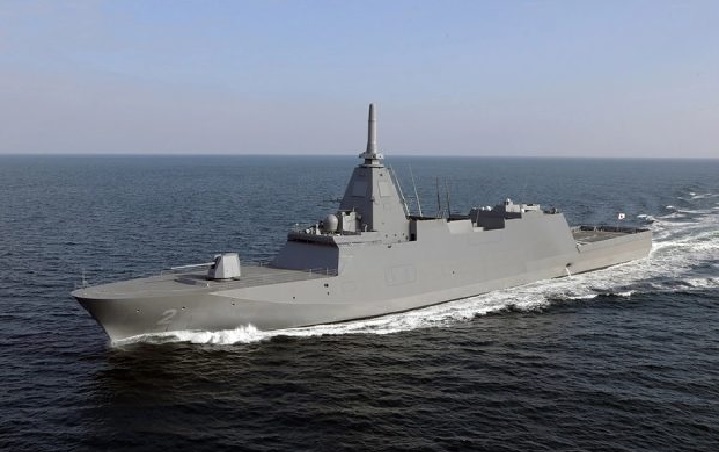
TAIPEI — April 19, 2026 : The Republic of China (ROC) Navy is assessing Japan’s New FFM frigate design—also known as the upgraded Mogami-class or 06FFM—as a leading candidate for its planned 6,000–6,500-ton next-generation surface combatant, according to multiple Taiwanese media reports published in mid-April.
Evaluation of Japanese Design
The evaluation follows reports that the ROC Navy has examined foreign warship designs to accelerate development timelines for its future surface fleet. The service has focused on Japan’s New FFM due to its alignment with Taiwan’s operational and technical requirements, particularly in the 6,000-ton class.
On April 15, 2026, UP Media reported, citing an anonymous source, that Japan had eased restrictions on exporting warship blueprints to Taiwan amid expanding security cooperation. Subsequently, on April 17, Liberty Times Net (LTN) reported that an individual familiar with Taiwan–Japan relations approached Japanese authorities regarding potential cooperation on warship development, including the possibility of blueprint transfers or joint development. According to the report, Japan did not oppose the proposal.
Operational Requirements and Platform Suitability
The ROC Navy’s next-generation combatant is being designed around network-centric warfare concepts with a high degree of automation, targeting a crew size of approximately 100 personnel. This requirement excludes larger Japanese Aegis-equipped destroyers—such as the Kongo-, Atago-, and Maya-class vessels—which displace around 10,000 tons.
While smaller Japanese destroyers, including the Akizuki- and Asahi-class, fall closer to Taiwan’s displacement requirements, the New FFM is considered more suitable due to its enhanced stealth features and higher automation levels. The platform’s combat management system (CMS) and ability to integrate unmanned systems support reduced crew workload and improved operational efficiency.
The design is also compatible with U.S.-origin systems, enabling interoperability with weapon systems currently used by Taiwanese forces. Japan has promoted the New FFM for export to partner nations, including Australia, where it has been selected as the basis for a general-purpose frigate program.
Technical Characteristics
The New FFM has a standard displacement of approximately 4,880 metric tons and a full-load displacement of about 6,200 metric tons. The vessel measures around 142 meters in length with a beam of approximately 17 meters and can achieve speeds exceeding 30 knots.
Compared to the baseline Mogami-class, the upgraded variant features a 32-cell vertical launch system (VLS), doubling the capacity of earlier configurations. The ship supports operations with a single helicopter or unmanned aerial vehicle (UAV) and incorporates a high level of onboard automation across its systems.
Domestic Systems Integration
Even if Taiwan acquires the New FFM platform design and associated combat systems from Japan, the resulting vessels are expected to be equipped primarily with domestically developed weapon systems. These systems would be supplied by the National Chung-Shan Institute of Science and Technology (NCSIST), Taiwan’s principal defense research organization.
Program Background and Development Timeline
Taiwan’s next-generation frigate program dates back to 2016, initially focused on a 4,500-ton platform intended to replace the aging Cheng Kung-class frigates—derived from the U.S. Oliver Hazard Perry-class—and the Kang Ding-class frigates, based on the French La Fayette-class.
In 2022, the program encountered delays after the ROC Navy required an active electronically scanned array (AESA) radar system, while NCSIST had developed a passive electronically scanned array (PESA) system. This mismatch led to a shift toward producing two types of 2,500-ton light frigates—one configured for anti-air warfare (AAW) and the other for anti-submarine warfare (ASW).
The large surface combatant program was revived in 2024. President Lai Ching-te confirmed the restart and stated that the new class would displace approximately 6,500 tons. Funding for design and evaluation activities was included in the Ministry of National Defense’s 2026 budget. Earlier concept models of the future frigate had been displayed at the Taipei Aerospace & Defense Technology Exhibition (TADTE) in 2017.
Separately, the ROC Navy continues plans to construct ten light frigates—five AAW and five ASW variants—scheduled to enter service between 2028 and 2040.
Export Policy and Political Constraints
Despite technical compatibility, the potential transfer of the New FFM to Taiwan faces political challenges. Yoshihiro Inaba, a Japan-based contributor to Naval News, noted that Japan has relaxed defense export restrictions to strengthen its industrial base and security partnerships, which could facilitate exports of platforms such as the FFM.
However, he emphasized that Japan does not formally recognize Taiwan as a sovereign state and maintains no official diplomatic relations. While limited, non-public defense cooperation may exist, transferring a major naval platform would represent a significant shift and could negatively affect Japan–China relations.
As a result, despite reported interest and improving security ties, the export of the New FFM to Taiwan remains uncertain.
——— End of Article ———