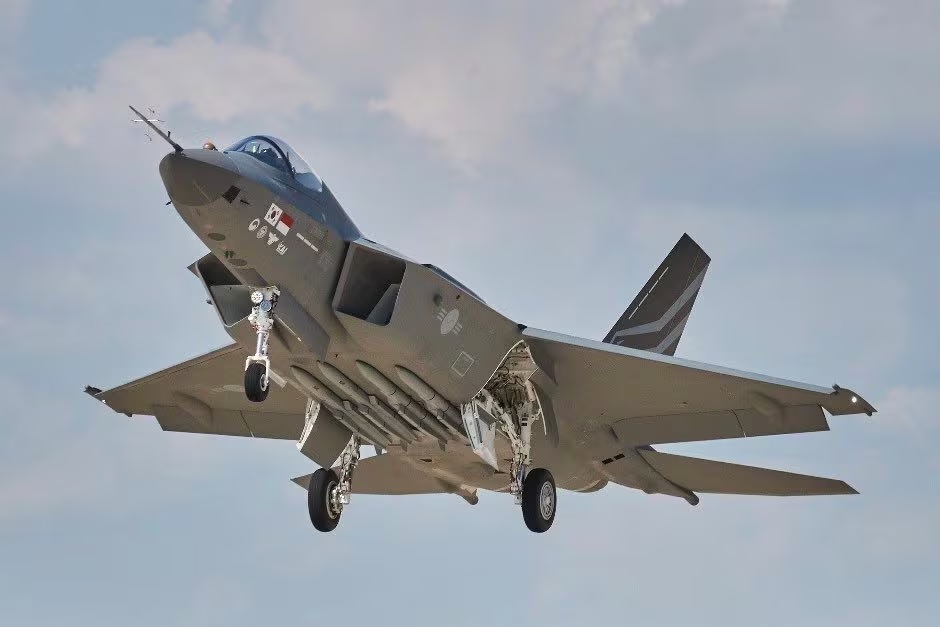
SEOUL — May 9, 2026 : South Korea’s indigenous KF-21 Boramae fighter jet has received final combat suitability approval from the Ministry of National Defense, completing the development phase of the Block-I air-to-air variant and clearing the aircraft for operational deployment with the Republic of Korea Air Force (ROKAF).
The Defense Acquisition Program Administration (DAPA) announced on May 7, 2026, that the fighter successfully met all required operational capability standards following a multi-year testing and verification campaign. The approval formally concludes the KF-21 Block-I system development program, which began in December 2015.
The first serial production aircraft, manufactured by Korea Aerospace Industries, rolled off the assembly line in March 2026 and is scheduled for delivery to the ROKAF in September 2026.
Extended Flight Testing Completed
DAPA stated that the final approval followed an extended operational evaluation process conducted after the aircraft received provisional combat suitability certification in May 2023.
Between May 2021 and February 2026, six KF-21 prototypes completed more than 1,600 accident-free test flights covering approximately 13,000 flight test conditions. The evaluation campaign verified the aircraft’s flight stability, structural integrity, durability, mission systems, and operational reliability under combat-related conditions.
The testing program also included aerial refueling trials, weapons release evaluations, flight performance analysis, and system integration verification across the aircraft’s operational envelope.
Flight testing concluded on January 13, 2026, approximately two months ahead of the original schedule. The first production aircraft later completed its maiden flight on April 15, 2026, in Sacheon.
Technical Configuration and Combat Systems
The KF-21 Boramae was developed as a 4.5-generation multirole fighter intended to replace South Korea’s aging F-4 Phantom II and F-5 Tiger II fleets.
The aircraft incorporates semi-stealth design features, including a reduced frontal radar cross-section and semi-recessed weapon integration for selected air-to-air munitions.
The Block-I configuration is optimized primarily for air superiority and air-to-air combat missions. The aircraft is powered by two General Electric F414-GE-400K turbofan engines and can achieve a maximum speed of Mach 1.81, or approximately 2,200 kilometers per hour.
The fighter is equipped with the domestically developed APY-016K Active Electronically Scanned Array (AESA) radar produced by Hanwha Systems. The radar system enables simultaneous detection and tracking of multiple aerial targets during combat operations.
The KF-21 Block-I includes 10 external hardpoints and can carry a maximum weapons payload of approximately 7,700 kilograms. The aircraft has been integrated with MBDA Meteor beyond-visual-range missiles and IRIS-T short-range air-to-air missiles.
Phased Deployment Plan
South Korea is fielding the KF-21 through a phased capability expansion program designed to accelerate operational deployment while additional mission systems continue development.
Under the current production schedule, South Korea plans to deliver 40 Block-I aircraft to the ROKAF between 2026 and 2028.
Development of the Block-II variant is continuing in parallel. The upgraded configuration is intended to expand the aircraft’s air-to-ground and maritime strike capabilities through additional weapons integration and mission system enhancements.
DAPA plans to acquire an additional 80 Block-II aircraft between 2029 and 2032, bringing the planned KF-21 fleet to 120 aircraft by 2032.
Strategic and Industrial Significance
DAPA officials described the approval as a major milestone for South Korea’s domestic aerospace and defense industry.
Noh Ji-man, head of DAPA’s Korean Fighter Program Group, stated that the certification demonstrates South Korea has secured independent fighter jet development capabilities through cooperation between the military, government agencies, and domestic industry partners.
The KF-21 program represents South Korea’s largest indigenous aerospace development effort to date, combining a domestically designed airframe with locally developed avionics, radar systems, and integrated weapons systems to meet ROKAF operational requirements.
System development for the KF-21 program is scheduled to formally conclude in June 2026, with operational integration into frontline air force units expected to continue following the first deliveries later this year.
——— End of Article ———