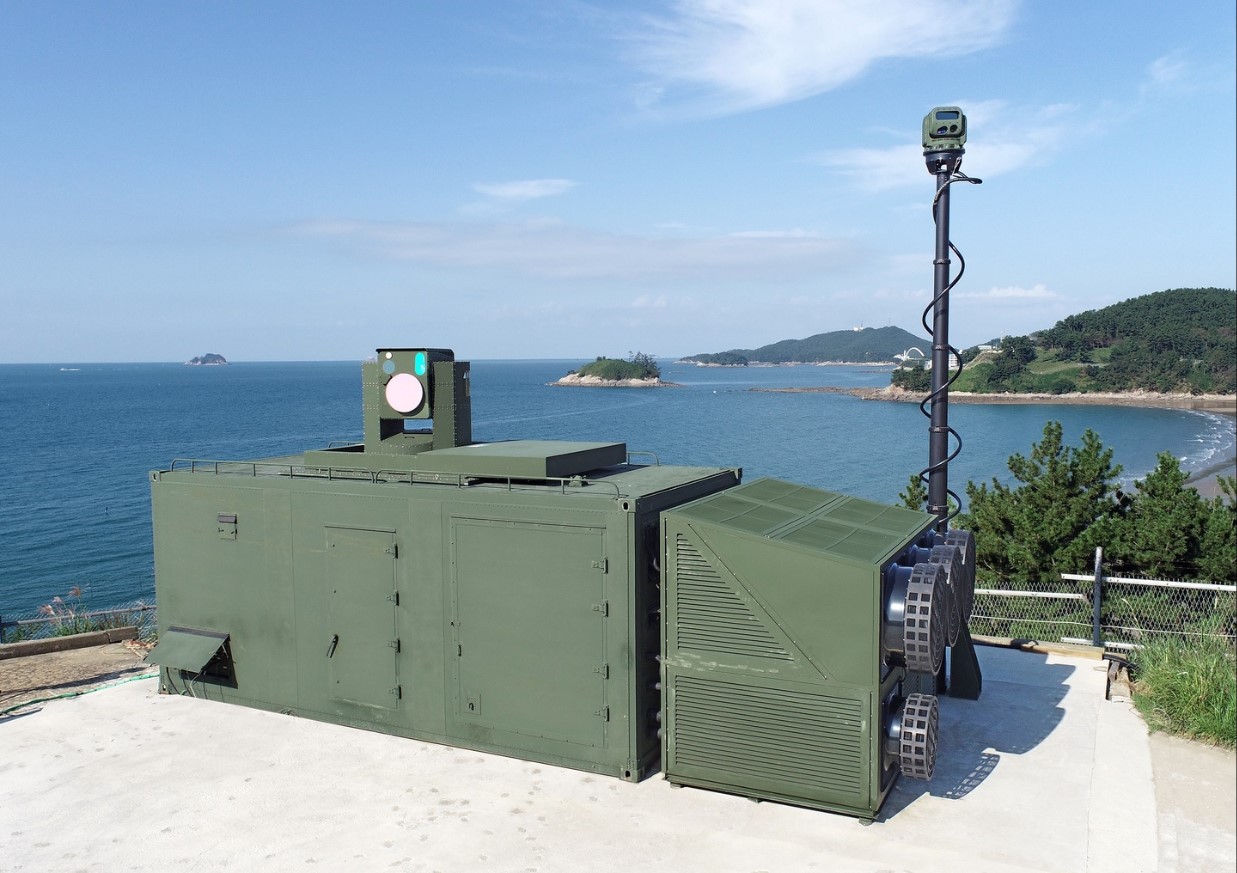
SEOUL, — June 01, 2026 : South Korea’s Defense Acquisition Program Administration (DAPA) announced on Monday the successful domestic production of the laser oscillator used in the country’s Cheongwang (Sky Light) Block-I directed energy air defense system, marking a major step in strengthening local defense manufacturing and counter-drone capabilities.
The development, finalized in late May, increases the domestic component rate of the Cheongwang system from 76 percent to 90 percent by value. With the achievement, South Korea joins the United States, Israel, China, and Germany as one of the few countries capable of independently manufacturing high-performance laser oscillators, a technology subject to strict export controls.
The laser oscillator is the central component of a high-energy laser weapon system. It generates the coherent laser beam and directly affects output power, beam quality, precision, and operational efficiency. Until now, South Korea relied on imported German-made oscillators for the system.
To reduce supply dependency and shorten procurement timelines, South Korea pursued a parallel localization strategy during system development. The Agency for Defense Development (ADD) led the project, while Hanwha Systems served as the prototype manufacturer for the domestically developed oscillator. The Cheongwang weapon system itself was jointly developed by ADD and Hanwha Aerospace.
According to DAPA, testing showed that the new domestic oscillator improved key performance indicators, including output power, by more than 50 percent compared with the imported system it replaces.
Performance testing conducted on the Cheongwang Block-I prototype demonstrated shorter engagement times against aerial threats. Rotary-wing drones, including first-person-view (FPV) systems, saw interception times reduced from 2–4 seconds to 1–2 seconds. For fixed-wing unmanned aerial vehicles (UAVs), interception time decreased from more than 10 seconds to within a few seconds.
Cheongwang is a 20-kilowatt-class fiber-optic laser system designed to neutralize small drones and multicopter-type aerial threats at distances of approximately 2 to 3 kilometers (1.2 to 1.9 miles). The system destroys targets by concentrating heat on vulnerable sections and operates silently and invisibly.
Unlike missile-based air defense systems, the laser weapon does not require traditional ammunition and can maintain continuous operation as long as electrical power is available, effectively providing an unlimited magazine capacity. DAPA estimates the cost of a single interception at around 2,000 won (approximately $1.33 to $1.50), making it a lower-cost option compared with conventional missile interceptors, which can cost tens of thousands of dollars per engagement.
South Korea became the first country to operationally deploy a military high-energy laser weapon after the Cheongwang system entered service in December 2024. Hanwha Aerospace-built units are currently deployed at frontline military positions and key government facilities in central Seoul, including locations near the Ministry of National Defense and the Presidential Office in Yongsan.
Following the standardization of defense specifications completed in May 2026, all future mass-produced Cheongwang Block-I systems will incorporate the domestically manufactured laser oscillator.
The effort to accelerate deployment and modernization of the system was influenced by growing concerns over aerial incursions from North Korea. In December 2022, five North Korean drones crossed into South Korean airspace, with one briefly entering the no-fly zone in central Seoul near the Presidential Office. The incident highlighted vulnerabilities in defending against low-cost and small unmanned aerial systems and contributed to a faster development and deployment timeline for Cheongwang.
In June 2024, South Korea signed a production contract worth approximately 100 billion won (about $72 million) with Hanwha Aerospace, enabling the initial deployment of the system later that year.
Jeong Gi-yeong, head of DAPA’s Future Forces Bureau, said the application of more capable domestically produced laser oscillators to the Cheongwang system is expected to strengthen the military’s independent response capabilities against hostile drones and unmanned aircraft threats.
Building on the successful localization effort, DAPA has also outlined plans for the next-generation Cheongwang Block-II system. The future program will focus on increasing output power and precision while reducing size and weight to improve mobility. A more compact design is expected to support vehicle-mounted versions, allowing laser-based counter-drone capabilities to expand beyond fixed installations and frontline positions to mobile field units.
The localization of the laser oscillator forms part of South Korea’s wider effort to improve self-reliance in critical defense technologies while developing cost-effective responses to evolving aerial threats.
——— End of Article ———