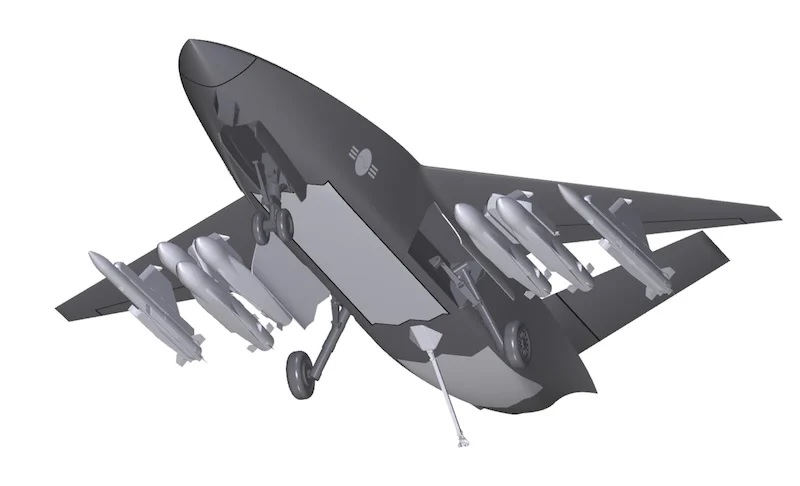
South Korea has officially entered the race to develop a new generation of naval combat drones with the unveiling of its first carrier-capable unmanned combat aerial vehicle (UCAV). Developed by Korea Aerospace Industries (KAI), the ambitious project marks a major milestone for the country’s defense innovation, placing South Korea alongside the United States and Türkiye as one of the few nations building jet-powered UCAVs designed specifically for aircraft carriers.
The announcement came on July 8 during the 8th Korea Strait Victory Seminar, held at the National Assembly. There, KAI introduced the naval variant of its upcoming Air Force UCAV, reimagined for launch and recovery from conventional aircraft carriers. The design reflects South Korea’s growing focus on building a blue-water navy backed by modern airpower assets.
At the heart of this UCAV is a stealthy, jet-powered platform weighing under six tons, with the ability to carry up to 800 kilograms of mission payloads. It is designed with a combat radius of about 300 nautical miles, and can perform a wide array of missions, including air-to-air combat, precision ground strikes, and intelligence, surveillance, and reconnaissance (ISR) operations.
Technically, the drone is loaded with cutting-edge systems such as:
-
AESA radar (Active Electronically Scanned Array) for superior tracking and target engagement.
-
IRST (Infrared Search and Track) for passive detection of enemy aircraft.
-
Electro-Optical Targeting Systems for real-time identification and precision targeting.
-
Modular nose design, allowing operators to quickly switch sensor payloads based on mission needs.
The UCAV also features low-observable stealth shaping and materials to reduce its radar signature. Reinforced landing gear and a tail hook system make it capable of arrested landings on carriers, while compatibility with electromagnetic catapult systems (EMALS) ensures efficient launches, a feature only the most advanced carriers possess.
One of the most forward-looking aspects of KAI’s drone is its “mothership” capability. It will not just fight alone — it is being designed to deploy and control smaller air-launched drones mid-flight. This drone-swarming ability is intended to overwhelm enemy air defenses, carry out coordinated attacks, or perform high-risk ISR missions without putting the main drone in danger.
In terms of armament, KAI has revealed that the drone will be armed with the MBDA Meteor, a long-range air-to-air missile known for its beyond-visual-range capabilities and ramjet propulsion. This would give the UCAV a powerful punch in aerial combat, something that sets it apart from other carrier drones like the U.S. Navy’s MQ-25 Stingray, which is focused more on refueling than direct combat.
South Korea's defense planners are already preparing for the infrastructure required to operate such advanced drones. A new eight-ton electromagnetic launch system is under development to support these UAVs, with plans to scale it up to 20 tons to accommodate heavier future aircraft. This step also aligns with South Korea’s ongoing plan to develop a light aircraft carrier — the CVX project — that could eventually host these UCAVs as part of its future carrier strike group.
While still in early stages, the carrier-based UCAV represents a bold leap for South Korea’s defense industry. It complements the country’s growing military aerospace ecosystem, which includes the KF-21 Boramae fighter jet program and various drone systems already in use.
As the competition in the global unmanned systems market intensifies, especially with Türkiye’s Bayraktar Kızılelma and China’s upcoming stealth drones, South Korea is aiming to carve out a niche in high-performance naval UCAVs. With the blend of stealth, heavy payload capacity, smart sensors, and mothership drone control, KAI’s concept could become a game-changer in future naval warfare.
The years ahead will determine how soon the prototype flies and whether South Korea’s carrier ambitions fully materialize. But for now, the country has taken a significant step toward redefining its role as a serious player in next-generation aerial combat systems.
——— End of Article ———