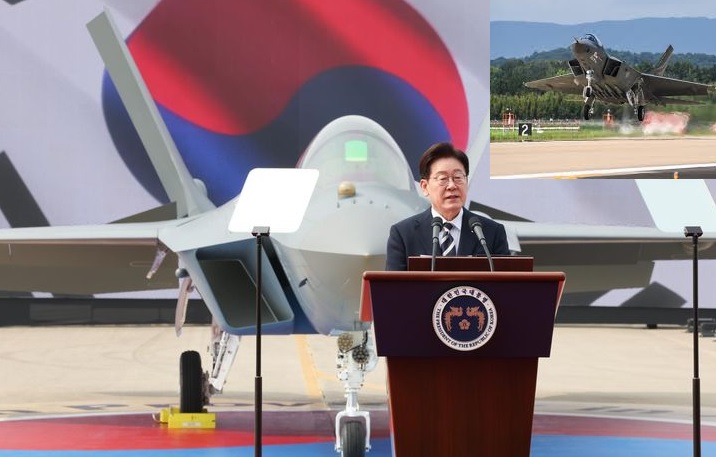
SACHEON, South Korea — March 25, 2026 : South Korea has formally initiated mass production of the KF-21 Boramae fighter jet, marking a transition from development to full-scale manufacturing for its first domestically developed advanced combat aircraft. The rollout of the first production unit took place at the headquarters of Korea Aerospace Industries (KAI) in Sacheon, signaling the program’s entry into the operational phase after more than a decade of development.
The KF-21 program, launched in 2015 under the Korea Fighter eXperimental (KF-X) initiative, has progressed from initial design to serial production in approximately ten years and six months. Development involved six prototypes that collectively completed over 1,600 flight tests across a 42-month campaign, concluding in January 2026, two months ahead of schedule without reported incidents. System development is scheduled for completion in the first half of 2026, with initial operational capability expected shortly thereafter.
Domestic Production and Strategic Objectives
South Korean President Lee Jae-myung, speaking at the rollout ceremony, stated that mass production of the KF-21 represents a key milestone in strengthening national defense autonomy and advancing the country’s defense industrial base. The government has positioned the program as part of a broader objective to elevate South Korea into the top tier of global defense exporters.
The KF-21 Boramae is designed as a 4.5-generation multirole fighter incorporating low-observable design features. It is intended to replace aging fleets of F-4 Phantom II and F-5 Tiger II currently operated by the Republic of Korea Air Force. South Korea plans to procure a total of 120 aircraft by 2032, with the first batch of 40 Block I units scheduled for delivery beginning in the second half of 2026.
Technical Characteristics and Performance
The KF-21 is a twin-engine supersonic fighter powered by two General Electric F414-GE-400K engines. It has a maximum speed of approximately Mach 1.81, a combat radius of around 1,000 kilometers, and a maximum payload capacity of 7.7 tonnes. The aircraft measures 16.9 meters in length with an 11.2-meter wingspan and a maximum takeoff weight of 25,600 kilograms.
The platform integrates several domestically developed systems, including an active electronically scanned array (AESA) radar, infrared search and track (IRST), and an electronic warfare suite. It is designed for network-centric operations and supports both air-to-air and air-to-ground missions in its initial Block I configuration. Future Block II variants are planned to incorporate enhanced stealth features and internal weapons carriage.
Unit costs are estimated at approximately $83 million for Block I aircraft and $112 million for Block II configurations, positioning the KF-21 within the mid-tier fighter segment. South Korean officials have indicated that the aircraft is intended to serve as a cost-effective alternative to the F-35 Lightning II, particularly for countries with restricted access to fifth-generation platforms.
Transition Toward Defense Self-Reliance
The KF-21 program reflects South Korea’s long-term effort to reduce reliance on foreign military equipment, particularly U.S.-supplied systems that have formed the backbone of its air power for decades. By developing and producing a domestically controlled fighter platform, Seoul aims to secure greater operational independence while expanding its defense export portfolio.
The rollout also establishes full-rate production capability at KAI’s Sacheon facility, enabling sustained manufacturing and delivery schedules aligned with military requirements.
Export Prospects and Indonesian Agreement
South Korea is concurrently advancing export efforts for the KF-21, with Indonesia expected to become the launch international customer. Indonesia has been a co-development partner in the program since its inception in 2015.
A preliminary agreement is expected to be finalized during the state visit of Indonesian President Prabowo Subianto to South Korea from March 31 to April 2, 2026. The deal is expected to cover an initial batch of 16 aircraft, equivalent to one operational squadron for the Indonesian Air Force (TNI-AU). A binding contract is anticipated in the first half of 2026 following final price negotiations.
Positioning in the Global Fighter Market
Beyond Southeast Asia, South Korea is positioning the KF-21 for potential sales in the Middle East, where several countries are seeking to modernize aging fleets of fourth-generation aircraft such as the F-15 and F-16. Access to advanced fifth-generation fighters like the F-35 remains limited due to export controls and geopolitical considerations, creating an opportunity for alternative platforms.
South Korean officials have indicated that the KF-21’s combination of performance, cost structure, and potential for technology transfer and local assembly could appeal to countries seeking to diversify procurement sources and reduce reliance on traditional suppliers.
Program Outlook
With mass production now underway, the KF-21 program enters a phase focused on operational deployment and export realization. Deliveries to the Republic of Korea Air Force are scheduled to begin later in 2026, while international agreements are expected to define the aircraft’s position in the global defense market over the coming years.
——— End of Article ———