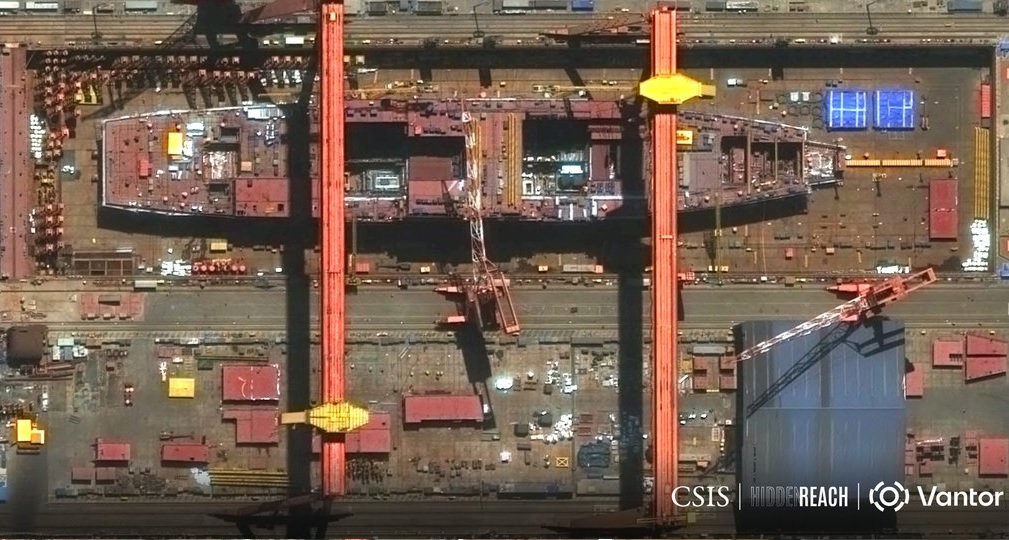
BEIJING — May 29, 2026 : Recent satellite imagery has confirmed rapid progress in the construction of China’s first nuclear-powered aircraft carrier at the Dalian Shipyard in Liaoning Province, reflecting the pace and production capacity of the country’s maritime shipbuilding industry. In less than a year, prefabricated hull sections have been assembled into a clearly recognizable structure, reinforcing assessments that the vessel could enter service in the early to mid-2030s.
Widely designated by analysts as the Type 004, the carrier forms part of a broader naval shipbuilding program involving the simultaneous construction of two supercarriers. While Dalian Shipyard is leading development of the nuclear-powered platform, a conventionally powered supercarrier is also under construction. Both vessels are understood to be based heavily on the design and technical framework of the Fujian, China’s first supercarrier, which officially entered service in November 2025.
Design and Construction Progress
The Type 004 is expected to be significantly larger than the conventionally powered Fujian, with analysts estimating a full-load displacement of approximately 110,000 to 120,000 tons. Recent satellite imagery indicates a hull measuring roughly 286 meters in length and 46 meters in beam, highlighting the scale of the platform as construction advances.
The vessel is expected to integrate four electromagnetic aircraft launch catapults and three aircraft elevators, structural additions projected to increase aircraft launch capacity and sortie generation rates by approximately 33 percent compared with the Fujian. Construction accelerated after hull sections first appeared in dry dock during early 2025, with imagery captured by May 2026 showing substantial structural progress.
Recent satellite observations have also revealed reactor-related compartments and 15-by-15-meter containment structures consistent with assessments that the carrier will employ nuclear propulsion.
Nuclear Propulsion and Supporting Infrastructure
Evidence of the propulsion system aligns with reports from November 2024 that identified a land-based prototype naval reactor under development near Leshan in Sichuan Province. The project, known as the Longwei program at Base 909, is intended to test the pressurized water reactor architecture expected to power the Type 004.
The adoption of nuclear propulsion is expected to provide the carrier with greater operational endurance and expanded deployment flexibility compared with conventionally powered platforms, supporting sustained operations across distant maritime regions.
Infrastructure development is also underway to support future carrier operations. In Qingdao, Shandong Province, where the aircraft carrier Liaoning is currently based, naval facilities are being expanded through new pier construction and demagnetization infrastructure designed to accommodate larger supercarriers expected to enter service in the early 2030s.
Air Wing and Fleet Development
The Type 004 is expected to operate an air wing composed of aircraft currently deployed or undergoing testing aboard the Fujian. These include the J-35 fifth-generation fighter, which has already conducted takeoffs from the supercarrier, the J-15T long-range air superiority fighter, the J-15D electronic attack aircraft, and the KJ-600 airborne early warning and control (AEW&C) aircraft. Supporting helicopters from the Z-20 family are also expected to operate from the vessel.
China’s carrier development strategy is expected to divide production responsibilities between major shipyards. The Jiangnan Shipyard, builder of the Fujian, is likely to continue producing conventionally powered supercarriers, while Dalian Shipyard focuses on nuclear-powered designs. This approach would provide the People’s Liberation Army Navy (PLAN) with a mixed fleet structure, combining conventionally powered carriers suited for regional operations with nuclear-powered vessels capable of sustained deployments in the mid-Pacific, Middle East, and Indian Ocean.
Carrier Expansion Outlook
The rapid advancement of the Type 004 program aligns with a U.S. Department of Defense assessment projecting that the PLAN intends to field six additional aircraft carriers capable of operating fixed-wing manned aircraft by 2035, increasing China’s total carrier fleet to nine vessels.
Analysts assess that the Type 004 could be launched between 2027 and 2028, with entry into service anticipated during the early 2030s as China continues expanding both its carrier fleet and supporting naval infrastructure.
——— End of Article ———