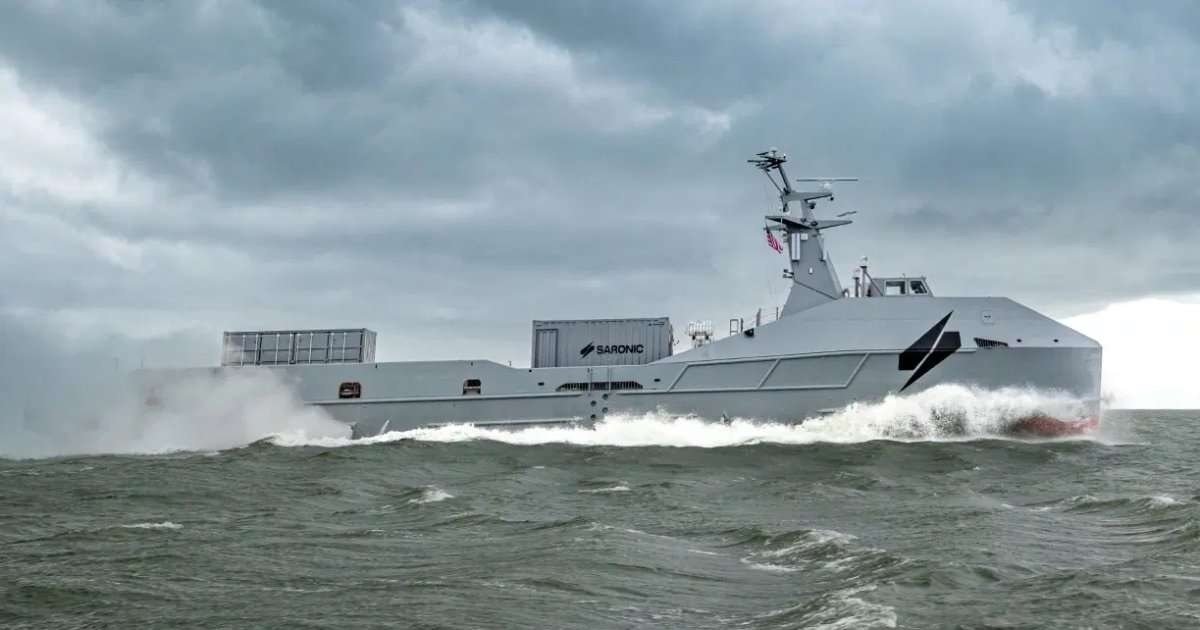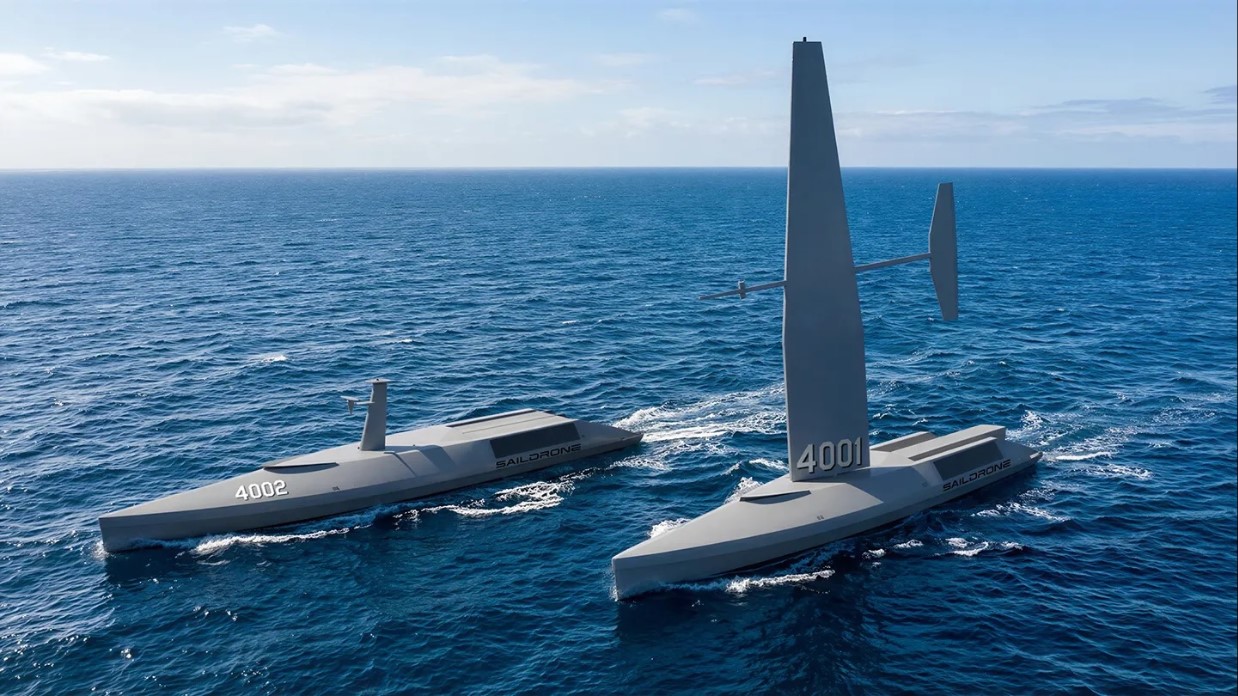
National Harbor, Maryland — April 20, 2026 : Saildrone has unveiled the design of its largest and most capable unmanned surface vehicle (USV), named Spectre, during the Sea Air Space 2026 conference. Developed in partnership with Lockheed Martin under a $50 million agreement signed in October 2025, the 52-meter platform is intended for anti-submarine warfare (ASW), intelligence, surveillance and reconnaissance (ISR), and strike missions for the United States Navy and allied forces.
Platform Design and Development
The Spectre USV is the result of more than two years of design work based on operational data gathered over Saildrone’s 12-year history, during which its fleet has logged over 2 million nautical miles at sea. The platform builds on earlier systems such as the Voyager and Surveyor, incorporating lessons learned from real-world deployments to meet evolving maritime operational requirements.
Measuring 52 meters (170 feet) in length and displacing approximately 250 tonnes, Spectre is the largest vehicle in Saildrone’s portfolio. The vessel is engineered to operate with an ultra-quiet acoustic signature, a critical requirement for ASW missions where onboard noise can interfere with the detection of submarines.
Variants and Mission Profiles
Saildrone has developed two primary configurations of the Spectre to support different mission sets.
The Spectre Silent Endurance variant incorporates the company’s signature wing system, enabling extended range operations exceeding 8,000 nautical miles with near-silent propulsion. This configuration is optimized for long-duration ISR and ASW missions requiring persistent presence.
The Spectre Stealth Strike variant removes the wing structure to reduce radar cross-section and overall visual profile, allowing for higher speeds and suitability for kinetic strike operations.
Propulsion and Performance
The vessel uses a hybrid propulsion system combining wind, solar, and diesel power. Twin shaftlines integrate dual electric and diesel propulsion systems, allowing Spectre to operate in near-silent electric mode at speeds up to 12 knots. For higher-speed operations, two 5,000-horsepower Caterpillar diesel engines enable speeds of up to 27 knots with a full payload.
At a cruising speed of 25 knots carrying a 25,000-kilogram payload, Spectre achieves a range of approximately 3,280 nautical miles in calm seas and 2,790 nautical miles in Sea State 4 head seas. Controllable-pitch propellers support efficient operation across speed ranges and facilitate low-speed, low-noise performance required for towed sonar systems.
Payload Capacity and Modular Architecture
Spectre features a concealed payload deck located close to the waterline, designed to accommodate modular, containerized payloads. The vessel can carry configurations including two 40-foot containers, five 20-foot containers, or mixed arrangements, with a total payload capacity exceeding 70 tonnes.
The deck is optimized for transom deployment and protects equipment from sea spray during high-speed operations. The platform provides up to 50 kW of payload power and supports mission durations exceeding six months without resupply.
Integrated Systems and Partnership with Lockheed Martin
Under the strategic partnership, Saildrone and Lockheed Martin are integrating a range of advanced payloads and mission systems. These include Lockheed Martin’s TB29 thin-line towed array for ASW, the Mk70 vertical launch system with capacity for two launchers, and the CAPTAS-4 variable-depth sonar system developed by Thales.
The collaboration also includes enhancements to command-and-control systems and broader integration of defense technologies to support multi-mission capability.
Paul Lemmo, Vice President and General Manager at Lockheed Martin, stated that the Spectre platform provides a persistent, low-observable capability capable of supporting a wide spectrum of naval missions, including undersea surveillance and strike operations.
Testing, Certification, and Autonomy
The Spectre design has undergone physical validation using a one-seventh-scale model tested at Force Technologies’ tow tank facility in Copenhagen, Denmark. Testing confirmed propulsion performance and seakeeping capabilities at full operational speeds in Sea State 5 conditions.
The platform has received Approval in Principle (AIP) from the American Bureau of Shipping (ABS) under High Speed Naval Craft classification standards. Saildrone’s autonomy software, refined over more than a decade, complies with international collision regulations (COLREGS) for both day and night operations.
Manufacturing and Production Plans
Construction of the Spectre will take place at Fincantieri Marine Group shipyards in Wisconsin, with a production capacity of up to five vessels per year. The vessels will be built using aluminum hull structures suited for high-speed naval applications.
The 43-meter composite wing used in the Silent Endurance variant will be manufactured by American Magic Services at its High Performance Center in Pensacola, Florida, also with an annual production capacity of five units.
Fincantieri Marine Group CEO George Moutafis stated that the program aligns with the company’s experience in serial production of aluminum vessels and its role in supporting advanced naval platforms.
American Magic Services CEO Tyson Lamond noted that the company’s composite manufacturing capabilities and proximity to U.S. naval operations support the production requirements of the Spectre program.
Deployment Timeline and Related Programs
Construction of the first Spectre vessel is scheduled to begin in the near term, with initial sea trials planned for early 2027.
The platform builds on Saildrone’s existing collaboration with the U.S. Navy and broader efforts to integrate unmanned systems into naval operations for persistent maritime presence.
In a related program, Lockheed Martin is integrating its Joint Air-to-Ground Missile (JAGM) launcher onto the smaller 20-meter Saildrone Surveyor platform. A live-fire demonstration is planned during the U.S. Navy’s Rim of the Pacific (RIMPAC) exercise in summer 2026, supporting payload integration efforts applicable to the Spectre system.
Operational Context
The Spectre USV reflects ongoing efforts by the U.S. Navy and defense industry partners to expand the role of unmanned systems in maritime operations. With its combination of endurance, modular payload capacity, and low acoustic signature, the platform is designed to address operational requirements in anti-submarine warfare and distributed naval operations.
——— End of Article ———