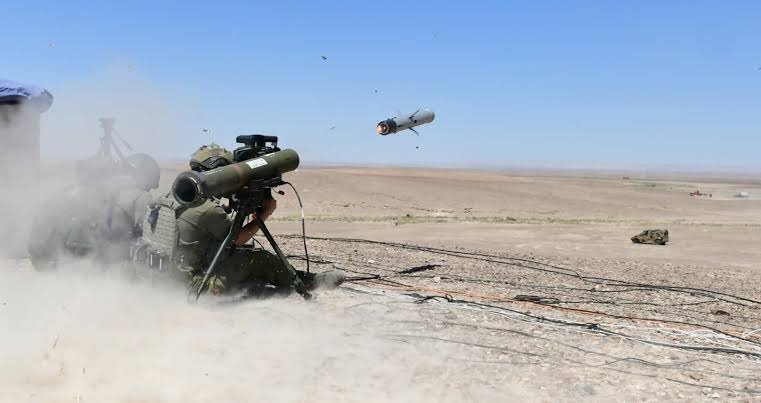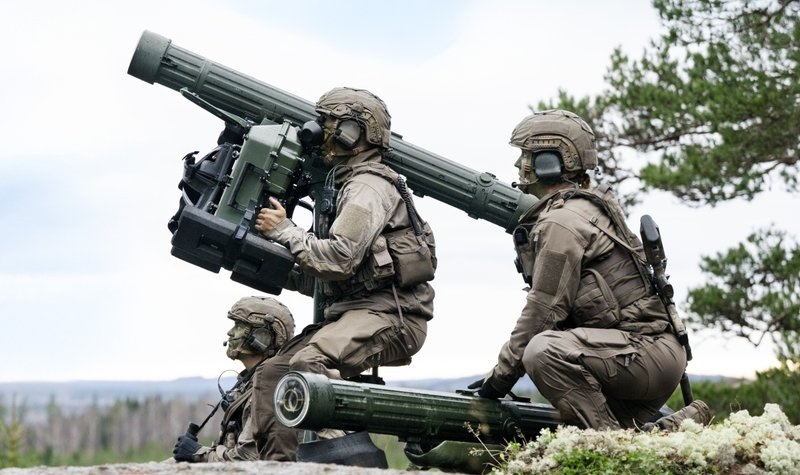
KARLSKOGA, Sweden — May 8, 2026 : Swedish defence company Saab has officially unveiled the Bolide 2 missile, a next-generation interceptor developed for the RBS 70 short-range air defence (SHORAD) system. The new missile introduces a larger warhead, enhanced terminal flight performance, expanded sensor coverage, and a modular architecture designed to simplify future upgrades and adaptation to evolving aerial threats.
The Bolide 2 will become the standard missile for the modern RBS 70 NG air defence system, with initial customer deliveries scheduled to begin in 2027. Saab stated that the missile has been developed to improve operational effectiveness against a wide range of airborne threats, including aircraft, helicopters, cruise missiles, and unmanned aerial systems.
Larger Warhead and Redesigned Internal Structure
A central element of the Bolide 2 programme was increasing lethality without increasing the overall size or weight of the missile. Saab engineers redesigned several internal components and introduced lighter structural materials to accommodate a larger explosive payload while maintaining the missile’s existing dimensions.
According to Saab, the Bolide 2 carries 50 percent more explosive material than the original Bolide missile and generates 40 percent more fragmentation. Because the fragmentation pattern is dispersed over the same area as the earlier missile, the density of fragments within the blast zone is significantly higher, improving the probability of destroying or disabling airborne targets.
To offset the increased explosive content, Saab replaced the traditional steel outer casing with an aluminum shell. The company also replaced the original copper shaped-charge liner with an aluminum cone. Saab representatives stated that the aluminum cone reduces over-penetration while increasing pressure and spalling effects inside the target after detonation.
Guidance and Flight Performance Improvements
The Bolide 2 retains the unjammable laser beam-riding guidance method that has characterized the RBS 70 missile family for decades. Saab stated that the guidance system continues to provide strong resistance against electronic warfare and jamming attempts while maintaining accurate target tracking.
The missile also introduces an inertial navigation unit intended to improve maneuverability and engagement capability at higher altitudes. According to Saab, the additional navigation capability enhances flight stability and targeting performance against fast-moving and maneuvering threats.
Further improvements were made to the missile’s proximity fuse system. Saab increased the number of laser-based proximity sensors positioned around the missile’s nose section, creating a wider detection area intended to improve detonation reliability against agile targets and small drones.
Designed for Emerging Air Threats
Saab stated that the Bolide 2 programme was developed in response to the increasing complexity of modern air threats, particularly the rapid growth in the use of small unmanned aerial systems on the battlefield.
Mats-Olof Rydberg, Saab’s head of Ground-Based Air Defence, noted that while the earlier Bolide missile was already capable of engaging commercial drones, the Bolide 2 improves that capability significantly and allows such targets to be intercepted more effectively.
Despite the internal redesigns and expanded warhead, the missile maintains the same operational engagement envelope as the earlier Bolide variant. Saab confirmed that the Bolide 2 retains an effective intercept range of up to 9 kilometers and altitude coverage of approximately 5,000 meters.
Modular Design and Backward Compatibility
The Bolide 2 was developed over a period of approximately four and a half years. Saab stated that modularity was incorporated into the missile’s architecture to simplify future upgrades and allow adaptation to emerging operational requirements without extensive redesign work.
Stefan Öberg, head of Saab’s Missile Systems business unit, said the missile was designed to provide operators with greater flexibility across different deployment configurations.
“With Bolide 2 we are ready to provide our customers with an even more capable missile, ready to be adapted for any new threats in the sky,” Öberg said.
“RBS 70 users can benefit from improvements including a more powerful warhead, whether they are operating in the man-portable role or, as is increasingly common, from a vehicle firing unit,” he added.
Saab confirmed that maintaining backward compatibility with existing launch systems was a key requirement during development. As a result, the Bolide 2 can be fired from both the latest RBS 70 NG launchers and earlier generations of the RBS 70 platform already in operational service.
Testing and Operational Role
The company stated that the missile has successfully completed a series of live test firings during the development phase. Saab did not disclose the exact number of trials conducted but confirmed that testing validated the missile’s new warhead configuration, guidance performance, and engagement capability.
The RBS 70 family has remained in operational service since the late 1970s and is currently used by more than 20 countries. The system supports both man-portable and vehicle-mounted configurations and is designed for day-and-night, all-weather operations when paired with compatible sighting systems.
The latest RBS 70 NG variant incorporates upgraded thermal imaging systems, improved target tracking, and enhanced command-and-control integration. With the introduction of the Bolide 2 missile, Saab is further expanding the operational capability of the RBS 70 family while preserving compatibility with existing launcher infrastructure and operator inventories.
——— End of Article ———