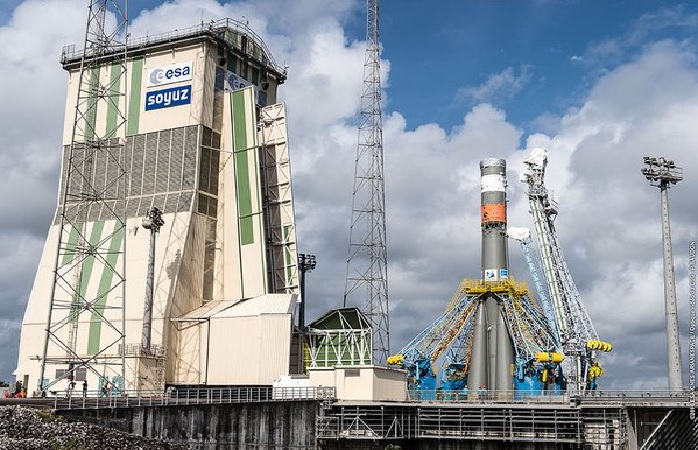
KOUROU, French Guiana — April 24, 2026 : MaiaSpace has initiated dismantling work at the former Soyuz-ST launch complex at the Guiana Space Centre, marking the start of site conversion activities for its upcoming two-stage Maia launch vehicle.
The facility, known as the Ensemble de Lancement Soyouz (ELS), has remained inactive since its last Soyuz-ST mission on February 10, 2022. Operations ceased after the European Space Agency ended cooperation with Russia following the suspension of joint space activities.
Dismantling and Site Preparation
Initial dismantling work has focused on removing key launch infrastructure. The service tower at the pad has been demolished, while earlier phases included cutting the four primary support arms used to hold the Soyuz rocket prior to liftoff and dismantling cable masts. Progress at the site was reported by the Russian Telegram community Zakrytyy kosmos.
Transition to Maia Rocket Operations
MaiaSpace, a subsidiary of ArianeGroup, was selected in September 2024 by the CNES to operate from the former Soyuz launch site. The selection followed a call for applications issued in April 2024.
On February 24, 2026, MaiaSpace signed a Temporary Public Domain Occupancy Agreement with CNES and local authorities, formally granting access to the site and enabling modification work to begin. The facility has since been renamed ELM2, and the company plans to conduct all Maia launches from this location.
Infrastructure Reuse and Investment
The redevelopment strategy is based on reusing approximately 80 percent of existing infrastructure. Retained elements include assembly buildings, propellant and fuel storage systems, and railway tracks used for transporting rocket components. Total investment for the upgrade is expected to remain within several tens of millions of euros.
Commercial Contracts and Launch Plans
MaiaSpace has secured Eutelsat as a launch customer. A multi-launch agreement signed on January 16, 2026, covers deployment of satellites for the OneWeb low Earth orbit constellation, with missions scheduled to begin in 2027.
The company’s development roadmap includes a suborbital test flight planned for late 2026. The mission will use a reduced propellant load and is intended to validate key flight phases such as liftoff, stage separation, and second-stage engine ignition, targeting an altitude of at least 100 kilometres.
Ahead of this, the first Maia rocket is scheduled to be erected vertically on the launch pad by the end of 2026 for ground testing.
Timeline for First Flights
The first full orbital launch of the Maia rocket and the start of commercial operations are planned for 2027. MaiaSpace has not disclosed a detailed schedule for completion of dismantling activities or the start of new construction at the site.
The Maia launcher is designed to deliver approximately 500 kilograms to low Earth orbit in reusable configuration and up to 1,500 kilograms in expendable mode.
——— End of Article ———