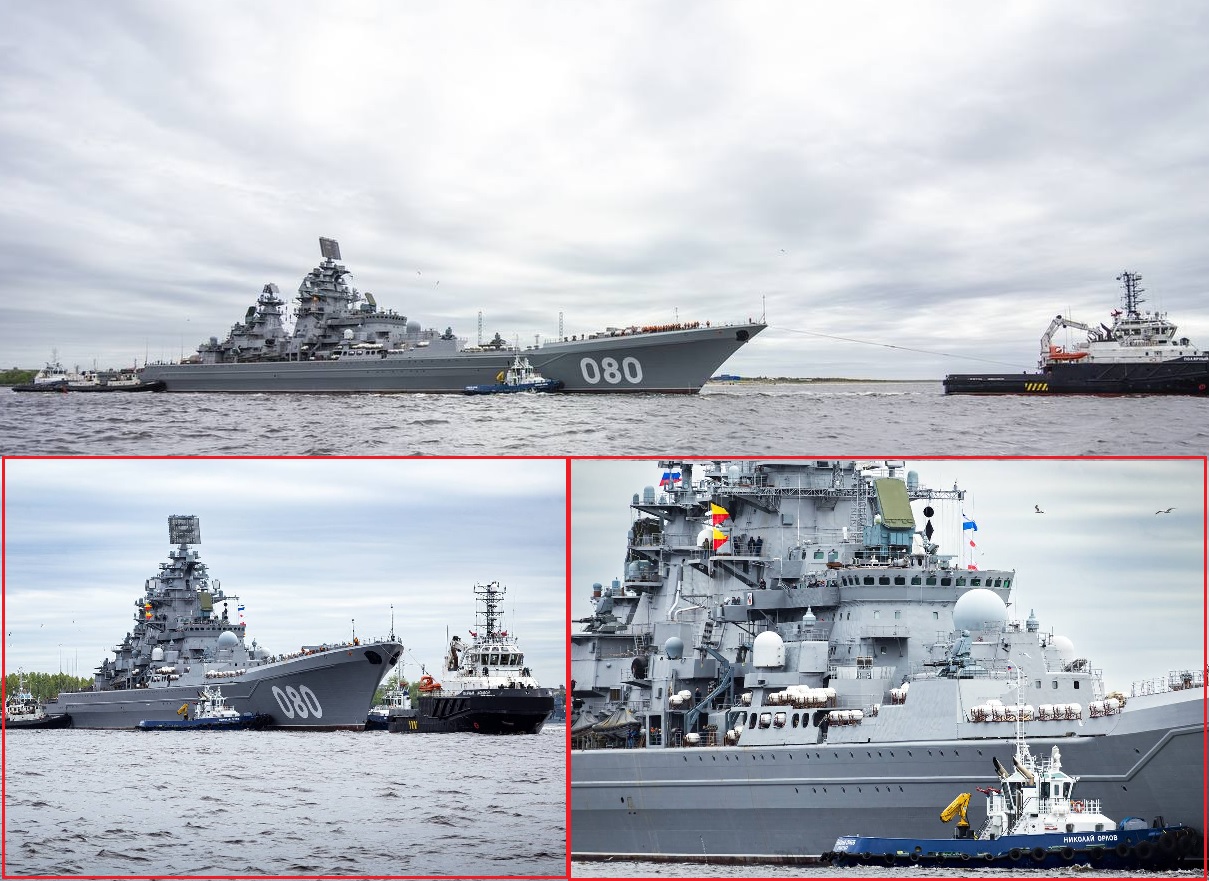
Moscow — June 02, 2026 : The Russian Navy’s heavy nuclear-powered battlecruiser Admiral Nakhimov (Pennant Number 080), a modernized Project 11442M Kirov-class warship, officially entered the final phase of sea trials on June 1, 2026, marking a major milestone in one of Russia’s longest and most extensive naval modernization programs.
The warship is currently undergoing final evaluations of its navigational, propulsion, combat, and defensive systems before its expected return to operational service with Russia’s Northern Fleet. The testing phase follows years of modernization work intended to transform the vessel into one of the Russian Navy’s most capable surface combatants.
A Long Modernization Program
Originally commissioned into the Soviet Navy in 1988 under the name Kalinin, the battlecruiser served for roughly a decade before being withdrawn from active operations following the collapse of the Soviet Union. In 1999, the vessel was docked at the Sevmash shipyard in Severodvinsk after funding shortages and maintenance limitations affected the Russian Navy’s ability to sustain large warships.
The decision to modernize the cruiser was formally approved in 2006, although intensive reconstruction and modernization work began between 2013 and 2014. Over nearly 25 years of inactivity and refitting, the program has reportedly cost an estimated $5 billion.
The vessel entered factory sea trials in the second half of 2025 after leaving Sevmash under its own power for the first time in more than two decades. Initial testing in the White Sea and Barents Sea focused on propulsion systems, navigational safety, and general operational performance.
The current phase of sea trials is expected to concentrate on validating weapons integration, radar performance, defensive systems, combat readiness, propulsion reliability, and overall operational capability before final acceptance into naval service.
Size and Propulsion Capabilities
With a fully loaded displacement of approximately 28,000 tons and a length of 251.1 meters (823 feet 10 inches), Admiral Nakhimov remains among the world’s largest surface combatants excluding aircraft carriers. The Kirov-class warships continue to be regarded as the largest operational combat vessels of their category.
To support operations of a vessel of this size, Admiral Nakhimov uses a combined nuclear and steam propulsion system (CONAS). During the modernization period, the ship’s two KN-3 nuclear reactors received new fuel elements, with reactor start-ups taking place between late 2024 and early 2025.
The propulsion system generates approximately 300 megawatts of thermal power and 140,000 horsepower, allowing the cruiser to reach speeds of up to 32 knots (59 km/h) when operating with combined nuclear and steam power. On nuclear propulsion alone, the vessel can reportedly reach speeds of approximately 25 knots (46 km/h).
Comprehensive Weapons Upgrade
A central objective of the modernization effort involved replacing the ship’s Cold War-era launch systems with a modern modular Vertical Launch System (VLS) architecture. The upgraded battlecruiser now integrates a total of 176 vertical launch cells designed to improve offensive strike, fleet air defense, and anti-submarine warfare capabilities.
Offensive Strike Systems
The cruiser is equipped with 80 launch cells arranged in 10 octuple complexes for anti-ship and land-attack missions. These launchers are designed to fire several missile systems, including the 3M-55 Oniks supersonic anti-ship missile, the 3M14Y Kalibr-NK land-attack cruise missile, and the newer 3M-22 Tsirkon (Zircon) hypersonic missile.
The Tsirkon missile is reported to be capable of carrying both conventional and nuclear warheads, increasing the vessel’s long-range strike flexibility.
Air Defense Systems
An additional 96 launch cells are reportedly reserved for surface-to-air missile systems intended to provide fleet-wide air defense. Reports indicate the ship may carry naval variants of the S-400 air-defense system or the S-300 Fort-M system.
For close- and medium-range protection against missiles, aircraft, and drones, the vessel is equipped with Pantsir-M naval air-defense systems designed to intercept incoming aerial threats.
Anti-Submarine Warfare Capability
The ship has also received anti-submarine warfare upgrades through the integration of Paket-NK and Otvet systems, which are intended to improve defense against underwater threats and strengthen protection for naval formations.
Fleet Integration and Operational Role
Upon successful completion of sea trials, Admiral Nakhimov is expected to formally rejoin the Russian Navy and be assigned to the Northern Fleet.
The vessel is widely expected to assume a flagship role, replacing its sister ship Pyotr Velikiy, which is not expected to undergo a similar modernization due to operational expenses and defense budget limitations. Russian reports suggest Pyotr Velikiy could face early retirement and possible scrapping.
Once commissioned, Admiral Nakhimov will become a unique asset in global naval operations as the only nuclear-powered surface combatant of its class and size expected to remain in active blue-water service following an extensive modernization program.
——— End of Article ———