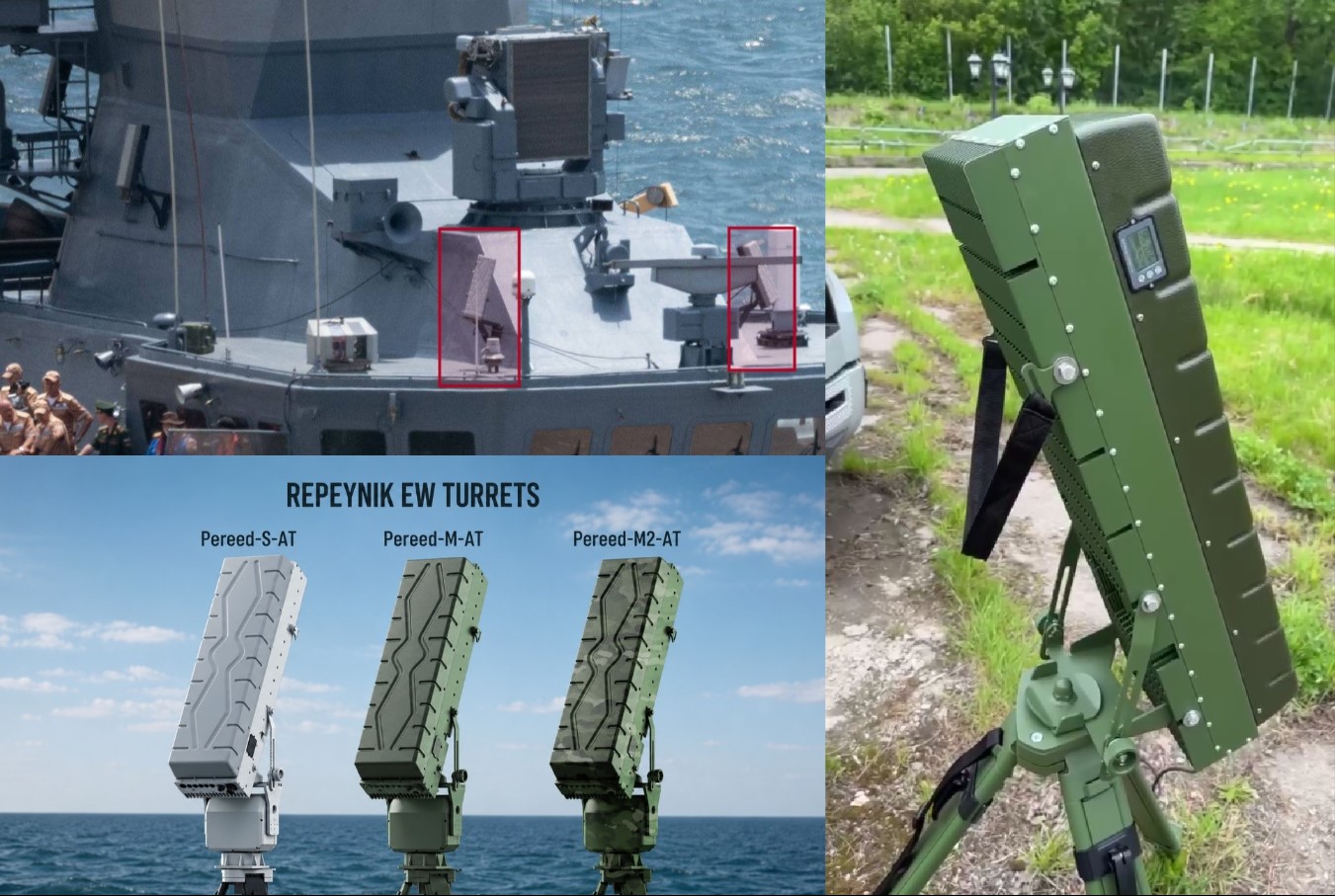
Moscow — The Russian Navy has started equipping several surface warships with the Pereyed-M electronic warfare (EW) system as part of efforts to strengthen protection against the growing threat posed by small unmanned aerial vehicles (UAVs).
Recent images shared on Russian military-affiliated social media channels show the Pereyed-M system installed on four warships: the Project 1164 guided-missile cruiser Varyag, the Project 20380 corvette Steregushchiy, the Project 1155 large anti-submarine ship Udaloy, and the Project 11540 guard ship Neustrashimy.
The installations indicate that the Russian Navy is expanding the use of dedicated counter-drone electronic warfare systems across different classes of surface combatants.
Designed to Counter Small UAV Threats
The Pereyed-M complex is designed to defend ships against small drones, including first-person view (FPV) drones and reconnaissance quadcopters. The system combines target detection with automated electronic jamming to disrupt incoming UAVs before they can reach a vessel.
At the center of the system is the Repeynik radar, a compact radar that was first introduced in 2022. According to available technical information, the radar can detect small radar cross-section targets, including commercial quadcopters, at ranges of up to 15 kilometers and altitudes of up to 5,000 meters.
The radar provides 360-degree coverage and can track targets moving at speeds of up to 200 kilometers per hour.
Once a drone is detected, the system automatically directs a self-aiming electronic warfare turret toward the target. The turret jams the drone's control and video transmission links at ranges of approximately 2.5 kilometers. The jammer operates across a broad range of frequencies, including bands that have reportedly been used to avoid standard electronic countermeasures.
Adaptation for Naval Operations
The Repeynik radar was originally developed as a portable system for ground forces. Earlier descriptions of the equipment stated that it could be carried by a single soldier in modular sections and assembled in about five minutes using battery power.
The installations on Russian warships suggest that the system has been adapted for naval use. While the exact modifications have not been publicly detailed, the shipboard version appears to be integrated into the vessels' superstructures and is likely connected to onboard power systems rather than relying on portable batteries.
Response to Increasing Drone Threats
The deployment of the Pereyed-M system comes as Russia continues to adapt its naval defenses to counter the increasing use of drones in maritime operations.
During 2026, Ukrainian forces have expanded the use of both airborne UAVs and unmanned surface vessels in long-range attacks against Russian naval assets, including operations conducted far from the front line.
One reported incident involved a drone strike on the Project 20380 corvette Boiky while the vessel was undergoing repairs near St. Petersburg, highlighting the vulnerability of ships to small drone attacks.
Conventional naval air-defense systems are primarily designed to intercept aircraft and missiles, making smaller, low-flying drones more difficult to engage. Electronic warfare systems such as Pereyed-M are intended to complement existing defenses by detecting and disrupting these smaller aerial threats.
The appearance of the Pereyed-M system on multiple ship classes suggests that the Russian Navy is introducing dedicated counter-drone electronic warfare capability as part of a broader effort to improve the protection of its surface fleet against unmanned aerial threats.
——— End of Article ———