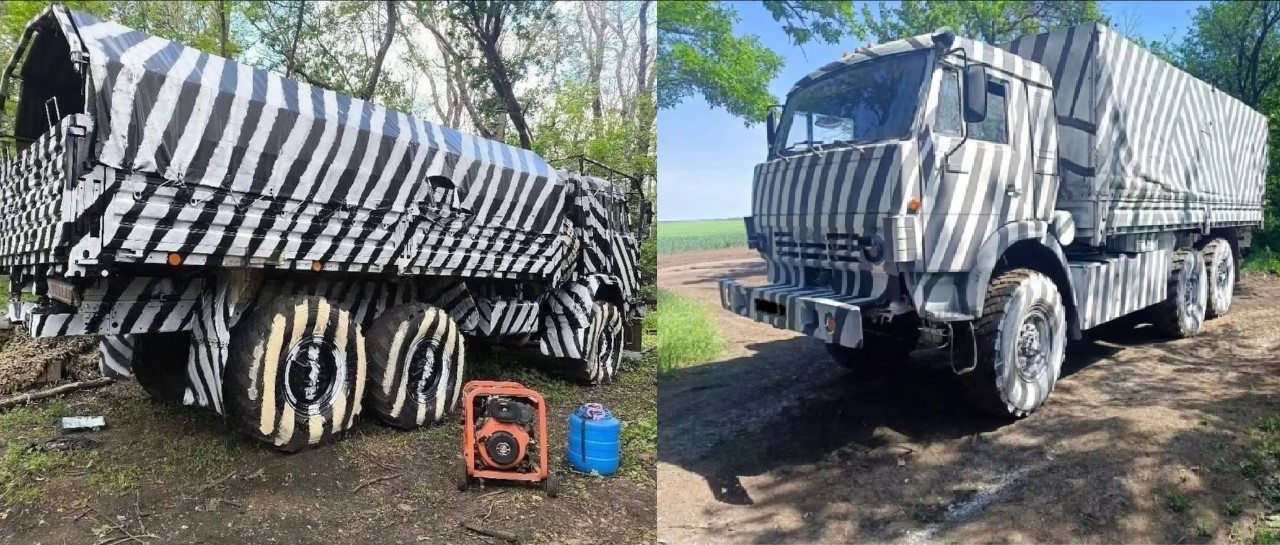
Russian forces have begun painting military logistics vehicles with bold black-and-white zebra-like patterns in an effort to reduce detection by artificial intelligence-assisted Ukrainian strike drones, reflecting the growing role of AI and counter-AI technologies in the war.
Recent images shared on social media show Ural and KAMAZ military trucks operating in Russian-held areas of Ukraine with high-contrast striped and swirling paint schemes. The vehicles have been seen as Ukraine continues to expand drone strikes against Russian logistics targets located as far as 200 kilometers behind the front line.
The camouflage is based on the concept of "dazzle camouflage," a technique designed to interfere with visual recognition rather than conceal an object completely.
Designed to Confuse AI Target Recognition
According to defense experts, many AI-assisted drone targeting systems rely on computer vision models trained using large databases of labeled images of military equipment. These systems identify vehicles by recognizing common visual features such as shape, color, markings, and structural details.
The unusual black-and-white patterns are intended to alter the vehicle's visual appearance enough that it no longer matches the images the AI was trained to recognize.
Todd E. Humphreys, an aerospace and AI expert at the University of Texas at Austin, said the camouflage pushes the vehicle "out of distribution," meaning its appearance falls outside the data used to train the AI model.
Branka Marijan of the Centre for International Governance Innovation explained that the contrasting paint breaks up the vehicle's outline and edges, making it more difficult for computer vision systems to classify it correctly.
Geert De Cubber, an autonomous systems specialist at the Military Academy of Belgium, also noted that if the camouflage pattern is unfamiliar to the AI system, it can reduce recognition performance until the software is updated with new training data.
Ukrainian Drones Continue to Target Logistics Routes
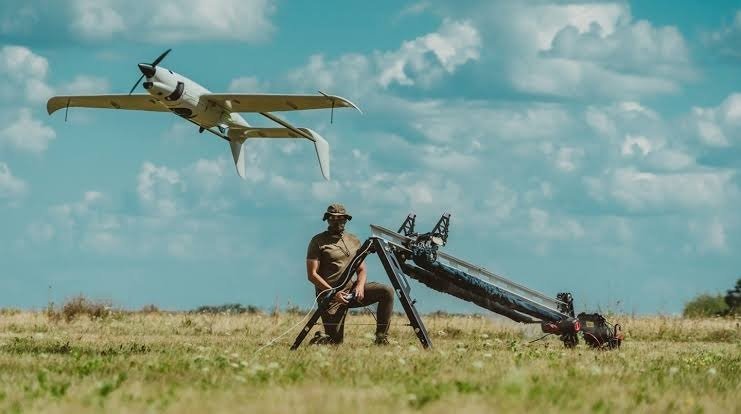
Ukraine has increasingly targeted Russian logistics vehicles using long-range attack drones, including the U.S.-made Hornet loitering munition. The drone reportedly costs around $6,000 per unit and uses an AI-assisted targeting system during the final stage of flight.
Under its operating process, a human operator selects the target before launch, after which the onboard AI helps maintain target lock during the terminal attack phase. Ukrainian officials have emphasized that human operators remain responsible for authorizing final strikes.
James Patton Rogers, a drone warfare researcher at Cornell University, said logistics vehicles remain among the most important targets in the conflict because they transport ammunition, fuel, and other supplies needed to support frontline operations.
Experts Say the Benefit May Be Temporary
While the new camouflage may initially affect AI recognition systems, experts believe its effectiveness could decline as drone software is updated.
Humphreys said human operators can still recognize the disguised vehicles without much difficulty, while AI systems can be retrained using thousands of new images of zebra-painted trucks. Once those images become part of the training database, the camouflage is likely to lose much of its advantage.
Experts also note that the paint scheme mainly affects optical recognition. Nick Reynolds, a research fellow in land warfare at the Royal United Services Institute, said the camouflage offers little protection against drones equipped with thermal imaging because it does not hide the vehicle's engine heat signature.
A spokesperson for Ukraine's Brave1 defense technology initiative said Russian forces continue testing new camouflage methods, but Ukrainian developers are adapting their systems in response to maintain targeting effectiveness.
A Century-Old Camouflage Technique
The concept behind dazzle camouflage dates back to 1917 during World War I. British artist Norman Wilkinson developed the technique for naval ships, using bold geometric patterns to make it harder for German submarine commanders to estimate a vessel's speed, direction, and distance through periscopes.
Unlike traditional camouflage, the purpose was not to hide ships but to confuse observers. Today, the same principle is being adapted to challenge machine-learning algorithms instead of human vision.
Part of Russia's Broader Deception Efforts
The zebra-style paint is the latest example of Russia using low-cost visual deception during the conflict.
In 2023, satellite imagery showed Russian strategic bombers at Engels-2 Air Base covered with automobile tires. Former U.S. Central Command Chief Technology Officer Schuyler Moore said the altered appearance could affect computer vision systems used by autonomous weapons.
Russia has also painted two-dimensional outlines of aircraft and submarines on airfield surfaces in an effort to mislead image-recognition systems and draw attacks away from actual military assets.
Experts say the continued use of such methods reflects the ongoing competition between AI-enabled targeting systems and countermeasures designed to reduce their effectiveness. As both sides introduce new technologies and update existing systems, visual camouflage is expected to remain one element of a broader effort to improve survivability on the battlefield.
——— End of Article ———