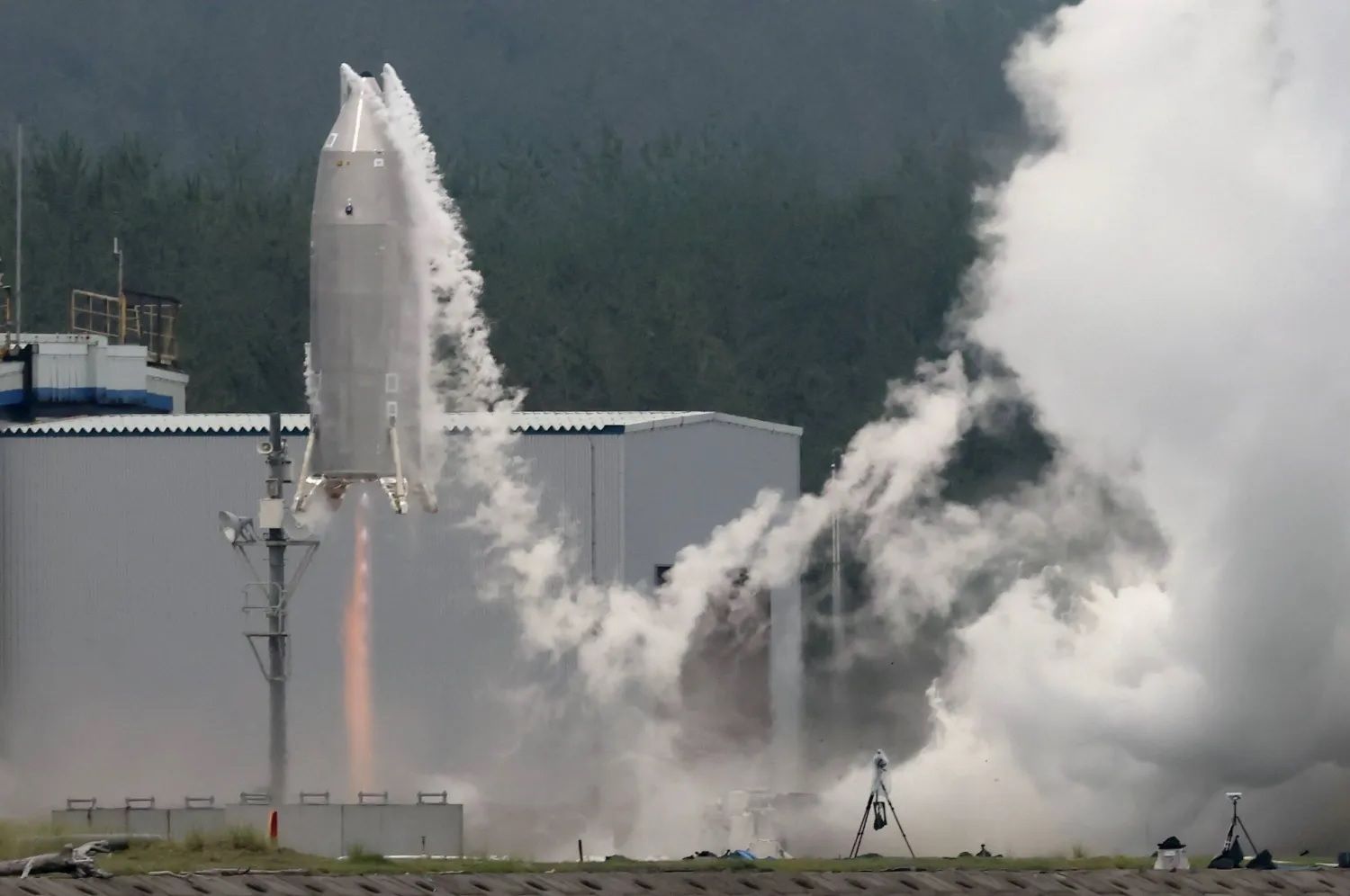
AKITA, Japan — The Japan Aerospace Exploration Agency (JAXA), in partnership with Mitsubishi Heavy Industries, has successfully completed the first flight test of its experimental RV-X reusable rocket at the Noshiro Rocket Testing Center in Akita Prefecture. The low-altitude test marks an important step in Japan's effort to develop reusable launch technology aimed at reducing future space launch costs.
The test took place on Saturday, July 11, with the prototype completing a controlled flight lasting approximately 40 seconds. During the demonstration, the rocket lifted off vertically, reached an altitude of 11 meters (36 feet), moved 16 meters (52 feet) horizontally while maintaining an upright position, and then safely returned to the landing pad under controlled descent.
According to JAXA, the primary objective of the flight was to verify the vehicle's ability to perform vertical takeoff, controlled flight, and precision landing while collecting engineering data for future development.
JAXA Confirms Successful Test
Speaking during an online press briefing after the flight, Takashi Ito, JAXA's reusable rocket project manager, said the mission achieved its planned objectives.
"The flight test went well. I feel relieved. We completed the test flight properly and obtained data that we had wanted."
JAXA officials said the collected flight data will be analyzed and used to improve future test flights and support the development of larger reusable launch systems.
RV-X Designed for Reusable Launch Technology
The Reusable Vehicle eXperiment (RV-X) is an experimental rocket developed to demonstrate technologies required for reusable launch vehicles.
The prototype measures 7.3 meters in length and 1.8 meters in diameter. It is powered by a liquid hydrogen engine and is equipped with four shock-absorbing landing legs designed to withstand the impact of vertical landings.
Before the first flight, JAXA carried out extensive ground qualification testing. The rocket engine successfully completed 165 combustion tests, helping engineers verify its durability and performance before flight operations.
Next Goal: 100-Meter Flight
Following the successful hop test, JAXA's next objective is to increase the rocket's flight altitude to 100 meters in future demonstrations.
The agency also plans to use data gathered during the RV-X program to support the development of Callisto, a larger reusable rocket demonstrator being jointly developed by Japan, France, and Germany. The Callisto vehicle is currently scheduled for a launch campaign in French Guiana during fiscal year 2026.
Reusability Seen as Key to Lower Launch Costs
The RV-X program forms part of Japan's broader strategy to develop reusable launch technology as the global space industry increasingly shifts toward rockets capable of multiple flights.
Japan currently relies on the H3 rocket for orbital missions. While the H3 provides modern launch capability, it is an expendable launch vehicle, meaning each rocket is used only once. Developing reusable systems is expected to reduce the cost per launch and improve the competitiveness of Japan's commercial launch services.
Regional Developments in Reusable Rockets
Japan's successful test comes as reusable launch technology continues to gain attention across Asia.
One day before the RV-X flight, Chinese state media reported that China had successfully recovered the first stage of a rocket after launch, reflecting ongoing efforts to expand reusable launch capabilities.
In contrast, South Korea's Nuri rocket remains an expendable launch vehicle, while research on reusable rocket technology is still in the early stages. Japan's successful RV-X flight places it among the countries actively conducting physical flight demonstrations of reusable launch systems.
JAXA said additional flight tests are planned as engineers continue refining the technology and evaluating the data collected during the successful first flight.
——— End of Article ———