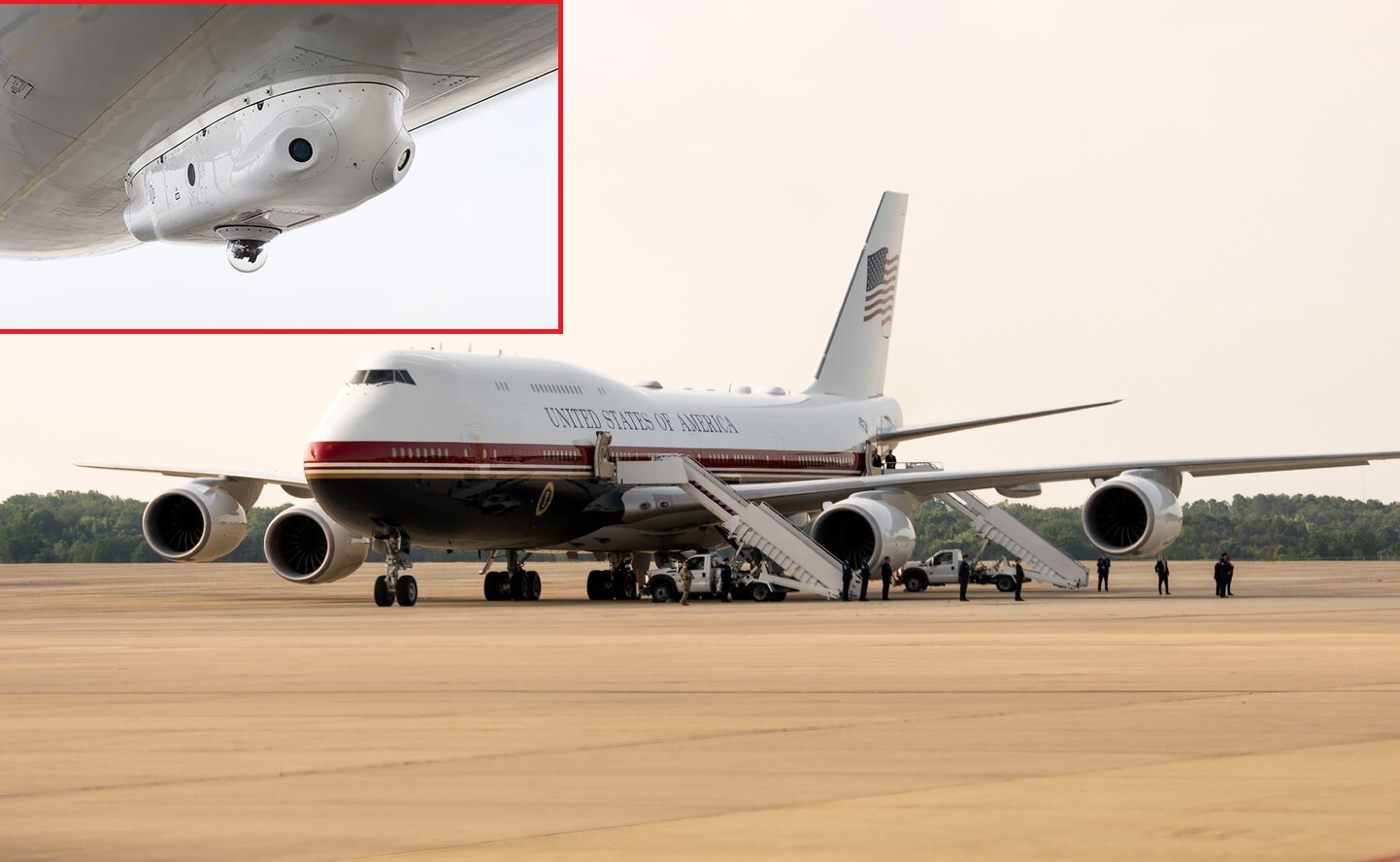
Washington, D.C. — The Boeing 747-8 Business Jet currently serving as the interim C-25B Bridge aircraft for President Donald Trump does not have sufficient self-protection systems against air-to-air and surface-to-air missile threats, according to an Israeli government source.
The aircraft, tail number 25-3300, is a former Qatari government Boeing 747-8 BBJ that was gifted to the United States and modified to serve as a temporary presidential transport until the new VC-25B aircraft enter service.
According to the Israeli source, the absence of complete defensive systems was one of the main reasons Israel advised against using the aircraft for President Trump's return flight from Ankara, Turkey, to Washington, D.C., following a recent NATO summit. Instead, President Trump returned aboard an older VC-25A aircraft that is equipped with the full range of presidential defensive systems.
The Israeli government has also offered to help equip the interim aircraft with appropriate self-protection systems to improve its security during international missions.
Aircraft Serving as a Temporary Presidential Transport
The Boeing 747-8 BBJ was originally built for the Qatar Amiri Flight in 2012. In 2025, Qatar's royal family gifted the aircraft to the U.S. government to serve as an interim presidential aircraft while the U.S. Air Force continues work on the next-generation VC-25B fleet.
The aircraft underwent a rapid retrofit carried out by defense contractor L3Harris. The modifications were intended to prepare the aircraft for presidential missions while the permanent VC-25B replacements remain under development.
Despite the retrofit, the aircraft has not yet received all of the defensive equipment normally found on Air Force One aircraft.
Defensive Systems Still Incomplete
Presidential aircraft are typically equipped with advanced self-protection systems designed to defend against missile threats. These systems can include radar jamming equipment, chaff dispensers that interfere with radar-guided missiles, and flare systems designed to counter infrared-guided missiles. They also feature hardened communications and other mission-specific security capabilities.
According to the Israeli government source, the interim C-25B Bridge aircraft currently lacks adequate protection against both air-to-air and surface-to-air missile threats. As a result, the aircraft is considered unsuitable for certain international missions in its current configuration.
The source said this security concern led to the recommendation that President Trump use a different aircraft for the flight from Ankara back to Washington.
Security Concerns During Ankara Trip
The issue became significant during President Trump's return from the NATO summit in Ankara. Intelligence and security officials reportedly recommended using the older VC-25A because of the interim aircraft's incomplete defensive capabilities.
Journalists traveling aboard the replacement VC-25A were reportedly instructed to keep their window shades closed during departure, a security measure sometimes used during flights from areas considered to have elevated security risks.
Questions Over Retrofit Program
The aircraft's modification program has also attracted political attention in Washington.
The interim C-25B Bridge has undergone upgrades funded by millions of dollars in U.S. taxpayer money. However, despite those expenditures, the aircraft still lacks the complete defensive systems required for presidential international travel, according to the Israeli government source.
The aircraft was intended to provide a temporary solution until two purpose-built VC-25B presidential aircraft are delivered later this decade.
Senate Democrats have requested information from the U.S. Air Force and L3Harris regarding the retrofit program, raising questions about the project's cost and whether security capabilities received sufficient priority during the conversion process.
The U.S. Air Force has previously stated that the modifications focused on essential mission requirements and that no unacceptable security risks were taken. However, former military officials have noted that converting a civilian aircraft into a presidential transport presents significant challenges and may not fully match the capabilities of aircraft designed from the outset for the Air Force One mission.
For now, the interim C-25B Bridge continues to serve as a temporary presidential aircraft, while additional work remains necessary before it can provide the same level of protection as the U.S. Air Force's fully equipped presidential fleet.
——— End of Article ———