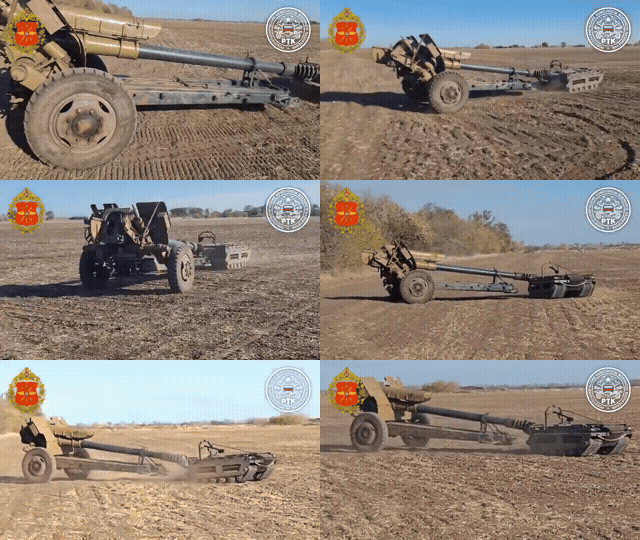
MOSCOW — April 18, 2026 : Russia has conducted field trials of the NRTK Kurier ground robotic complex, demonstrating the tracked unmanned platform’s ability to tow a 122 mm D-30 howitzer weighing more than three tons. The tests were carried out in the area of responsibility of the Dnepr group of forces, according to information released in mid-April 2026.
Video footage published by the NRTK Telegram channel shows the remotely controlled Kurier platform towing the artillery system in its marching (transport) configuration across open terrain. The platform maintained mobility while moving the towed load over field conditions.
Towing Capability Demonstrated in Field Conditions
The towing of the D-30 howitzer represents a significant operational test for the compact robotic system. The 122 mm D-30 is a widely used towed artillery system with a combat weight exceeding three tons, typically requiring a crew-operated vehicle for displacement.
During the trials, operators reported that the Kurier platform successfully traversed fields, sandy terrain, and small elevations while towing the artillery system. The test expands the known capabilities of the platform beyond its previously demonstrated logistics role.
Platform Specifications and Performance
The Kurier is a multi-purpose tracked unmanned ground vehicle (UGV) developed since 2022 by engineers from Buryatia, specifically the Sadaev Group, with support from the People’s Front organization under the Kulibin Club initiative.
The platform has a base weight of approximately 250 kilograms and is capable of reaching speeds of up to 35 kilometers per hour. Its standard payload capacity is 200 kilograms. When equipped with a trailer, it can tow an additional 200 kilograms, with earlier tests indicating the ability to transport up to 400 kilograms in total using a trailer configuration.
Military sources involved in testing stated that the platform demonstrates stable mobility across varied terrain types, including fields, sand, and uneven ground.
Development Background and Support Framework
The Kurier program forms part of a broader effort to introduce unmanned ground systems into operational use. Development began in 2022 under the Sadaev Group in Buryatia, with institutional support provided through the People’s Front initiative. The Kulibin Club framework has been used to identify, test, and scale technical solutions for deployment in military units.
Modular Design and Operational Roles
The Kurier platform is designed with a modular architecture, allowing it to be configured for multiple roles depending on mission requirements.
Its primary logistical and support functions include:
- Delivery of ammunition to forward positions
- Evacuation of wounded personnel from high-risk areas
- Engineering reconnaissance and terrain assessment
- Demining and mine-laying operations
In addition to support roles, the platform can be adapted for combat configurations. Tested variants have included mounting of:
- Heavy and light machine guns
- Automatic grenade launchers
- Mortar systems
- Multiple launch rocket systems (MLRS), including adapted 107 mm rocket pods and thermobaric launchers
Operational Benefits in Conflict Environments
The integration of unmanned ground platforms such as Kurier provides operational advantages in combat and conflict zones, particularly in high-risk areas.
By enabling remote execution of tasks such as artillery displacement, ammunition resupply, and casualty evacuation, the system reduces direct exposure of personnel to enemy fire, surveillance, and artillery strikes. This contributes to force preservation while maintaining logistical continuity.
The towing capability demonstrated during the mid-April 2026 trials indicates potential use in repositioning artillery systems closer to or away from frontline positions without requiring crewed vehicles. This can support more flexible deployment patterns and reduce vulnerability during movement phases.
——— End of Article ———