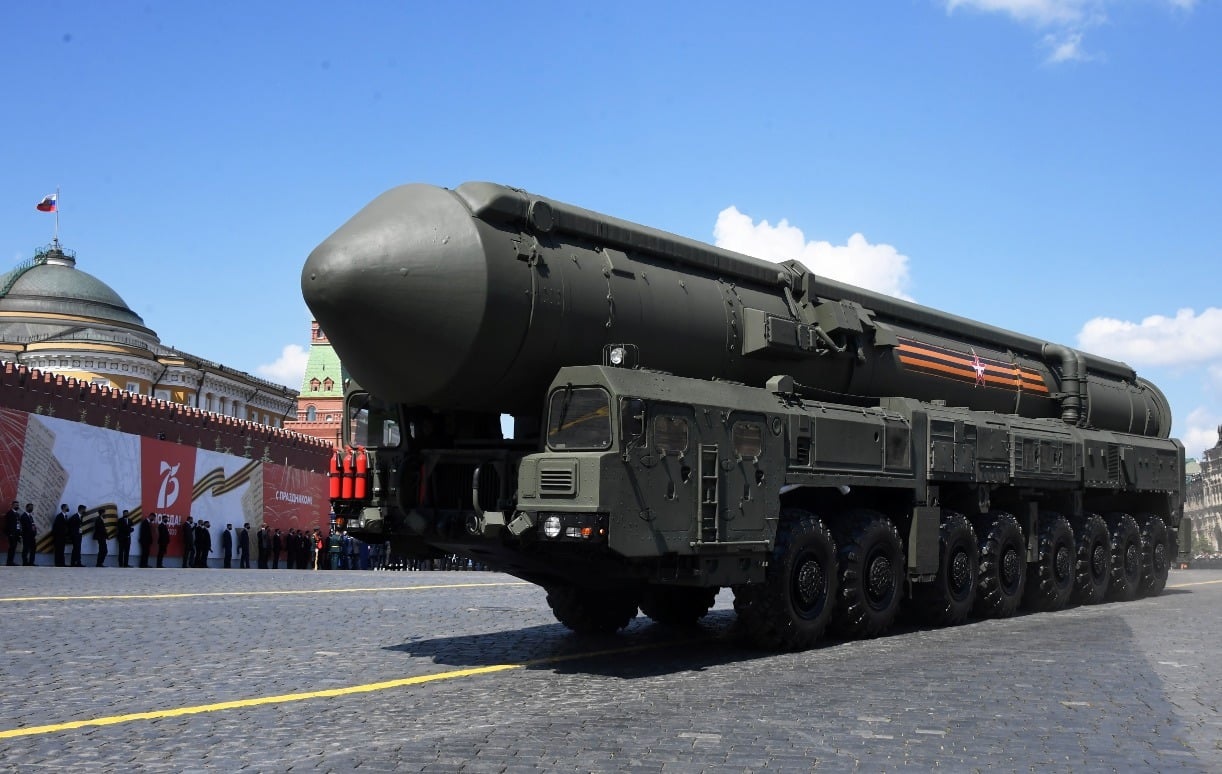
MOSCOW — May 12, 2026 : Russian President Vladimir Putin announced on May 12 that Russia had successfully conducted a test launch of the RS-28 Sarmat intercontinental ballistic missile (ICBM), confirming that the first regiment equipped with the system will officially enter combat duty by the end of 2026 as part of a broader modernization of the country’s strategic nuclear forces.
The launch was conducted from the Plesetsk Cosmodrome, with Strategic Missile Forces Commander Sergei Karakayev reporting that the missile completed all assigned objectives during the test. Russian authorities stated that the first Sarmat regiment will be deployed with the Uzhur missile division in Krasnoyarsk Krai.
During a televised briefing with senior military officials, Putin described the Sarmat as the most powerful missile system currently in existence and said it is intended to replace the Soviet-era R-36M2 Voyevoda, known in NATO terminology as the “Satan” missile system.
According to Russian officials, the liquid-fueled, silo-based ICBM is capable of carrying multiple independently targetable reentry vehicles (MIRVs) as well as hypersonic glide vehicles. Putin stated that the missile can travel along both traditional ballistic and suborbital trajectories, with an operational range exceeding 35,000 kilometers when using a suborbital flight path.
Russian leadership further claimed that the total yield of the warheads carried by the Sarmat is more than four times greater than that of the most powerful comparable Western systems currently in service. Officials stated that the missile surpasses its predecessor in flight range, throw-weight capacity, launch readiness, and onboard countermeasure systems designed to penetrate existing and future anti-missile defense networks.
Putin linked the development of the Sarmat and other advanced strategic systems to the United States’ withdrawal from the Anti-Ballistic Missile (ABM) Treaty in 2002, stating that the move forced Russia to accelerate the development of new deterrence capabilities. He added that Russia’s strategic missile and nuclear modernization programs are advancing across multiple sectors and asserted that no Western equivalents currently exist for several of Russia’s newest systems.
Alongside the Sarmat update, Russian officials also provided status reports on other strategic weapons programs currently under development or operational deployment.
The Oreshnik intermediate-range ballistic missile system has officially entered active combat duty, according to the Kremlin. Russian authorities stated that the hypersonic-capable missile system can be equipped with nuclear warheads and is intended to strengthen regional deterrence capabilities.
Officials also confirmed that testing work is nearing completion for two experimental systems powered by compact nuclear propulsion units. These include the Poseidon autonomous underwater vehicle and the Burevestnik global-range cruise missile, both of which are designed for extended-range strategic operations.
In addition, Russia announced that modernization work continues on the Kh-47M2 Kinzhal air-launched hypersonic missile system. The missile, which entered service in 2017 and has been used in ongoing military operations, is reportedly undergoing accuracy improvements for missions involving conventional, non-nuclear warheads.
The scheduled deployment of the Sarmat missile regiment in 2026, combined with the operational status of the Oreshnik and Kinzhal systems and the continued development of Poseidon and Burevestnik, reflects Russia’s ongoing transition toward a new generation of strategic deterrence platforms.
——— End of Article ———