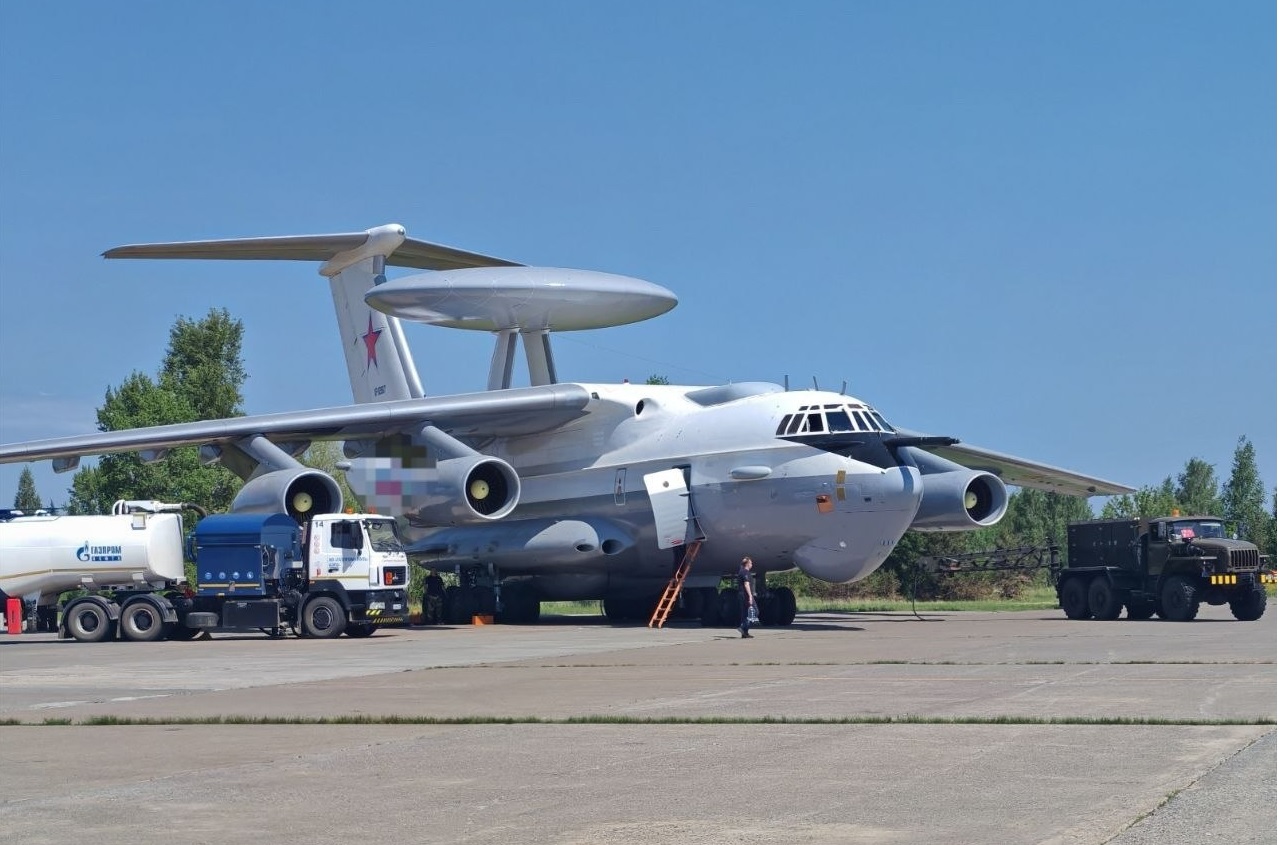
MOSCOW, — June 01, 2026 : The Russian Aerospace Forces (RuAF) have taken delivery of another upgraded A-50U Airborne Early Warning and Control (AEW&C) aircraft, marking a continued effort to restore airborne radar and surveillance capabilities following fleet attrition and production delays linked to industrial constraints and sanctions.
Images of the aircraft handover surfaced on May 31 through the Fighter-Bomber Telegram channel, a platform known for connections to Russian frontline aviation units. The post stated that “another upgraded and modernized A-50U has been handed over to the military.” In the released images, the aircraft’s registration and tactical “Bort” number were blurred, preventing open-source verification of the specific airframe.
The Russian aerospace manufacturer United Aircraft Corporation (UAC) had not released official photographs or issued a public statement regarding the delivery at the time of reporting. However, military analysts believe the aircraft has likely been assigned to the 2457th Aviation Base for Combat Operation of Airborne Early Warning Aircraft at Ivanovo Severny, the primary operating location for Russia’s A-50 fleet.
A-50U Modernization and Operational Capabilities
The A-50U, designated “Mainstay” by NATO, is an upgraded version of the Soviet-era A-50 airborne early warning aircraft that entered service in 1984. The aircraft is built on the Ilyushin Il-76MD strategic airlifter platform and forms part of a modernization program launched in 2003 to improve Russia’s airborne surveillance and command capabilities.
The upgrade program, led by Beriev and supported by radar systems produced by JSC Vega, introduced major improvements in radar performance, avionics, and mission systems. At the center of the modernization is the Vega-M radar, which significantly expands target detection and tracking capacity compared to the original A-50 platform.
According to available specifications, the A-50U can simultaneously track up to 150 aerial targets at distances of up to 595 kilometers. By comparison, the original A-50 was capable of tracking approximately 45 targets at around 225 kilometers.
The aircraft is also capable of guiding up to 12 fighter aircraft during interception missions. Its radar can detect low-flying fighter-sized targets amid ground clutter at distances ranging from 200 to 400 kilometers, while maritime targets can reportedly be identified at ranges of up to 400 kilometers.
Modernization work has replaced legacy analog systems with digital signal processing equipment, updated mission computers, modern liquid-crystal displays, and improved communication and navigation systems. The use of lighter onboard electronics has also improved computing efficiency and reduced crew fatigue during extended patrol operations.
Fleet Losses and Operational Challenges
The latest delivery comes as Russia continues efforts to rebuild a fleet that has experienced significant losses during the war in Ukraine. Prior to this addition, estimates suggested that between five and seven operational A-50U aircraft remained in Russian service.
Ukraine destroyed at least three A-50 aircraft between early 2024 and mid-2025.
The first confirmed loss occurred on January 14, 2024, when an A-50 and an Il-22 radio relay aircraft were lost over the Sea of Azov. A second A-50 was destroyed on February 23, 2024, in the same region. The U.S. Army later stated that the aircraft had been targeted in a “SAMbush” operation involving a Patriot surface-to-air missile system.
Another setback followed on June 1, 2025, during Ukraine’s Operation Spiderweb, when First-Person View (FPV) drones struck at least one A-50 aircraft at an airfield. The operation also targeted several long-range aviation assets, including seven Tu-95 bombers, four Tu-22M aircraft, and an An-12 transport aircraft.
Russia’s airborne radar production and modernization process has historically progressed slowly, with aircraft often completed at intervals of one to two years. Analysts have linked the limited number of operational airborne warning aircraft to reduced radar coverage and challenges in detecting long-range drone and missile attacks inside Russian territory.
In response, Moscow has accelerated domestic production of electronic components and reinforced ground-based air defense systems around key cities and strategic infrastructure.
A-100 Premier Program
Russia’s long-term replacement for the A-50U is the A-100 Premier airborne early warning aircraft, which is based on the newer Il-76MD-90A platform.
The A-100 is designed to incorporate an Active Electronically Scanned Array (AESA) radar system with improved tracking and surveillance capabilities. According to reported specifications, the aircraft can monitor up to 300 targets at distances of approximately 643 kilometers and remain airborne for around 10 hours without refueling.
Radar testing of an A-100 prototype reportedly took place in June 2024, and at least two aircraft are believed to have been constructed. However, serial production has yet to begin as testing schedules and component availability continue to affect program timelines.
Broader Russian Aviation Capability
Despite limitations in airborne radar coverage, Russia continues to maintain a substantial combat aviation inventory.
By the end of 2025, Russian frontline forces reportedly operated 142 Su-34 interdiction bombers, including the upgraded Su-34M variant developed using operational lessons from Ukraine. The fleet also included approximately 384 multirole fighters across the Su-27, Su-30, and Su-35 series.
Russia’s long-range aviation force reportedly consisted of 57 Tu-22M bombers, 47 Tu-95 strategic bombers, and 15 Tu-160 aircraft. Production of specialized aviation systems has also continued, including reported work on a two-seat Su-57D variant of Russia’s fifth-generation fighter aircraft.
The delivery of the latest A-50U reflects Russia’s ongoing effort to maintain and gradually rebuild airborne early warning capacity while the A-100 Premier remains under development. The aircraft is expected to support surveillance, air coordination, and command functions as part of Russia’s wider air defense and aviation network.
——— End of Article ———