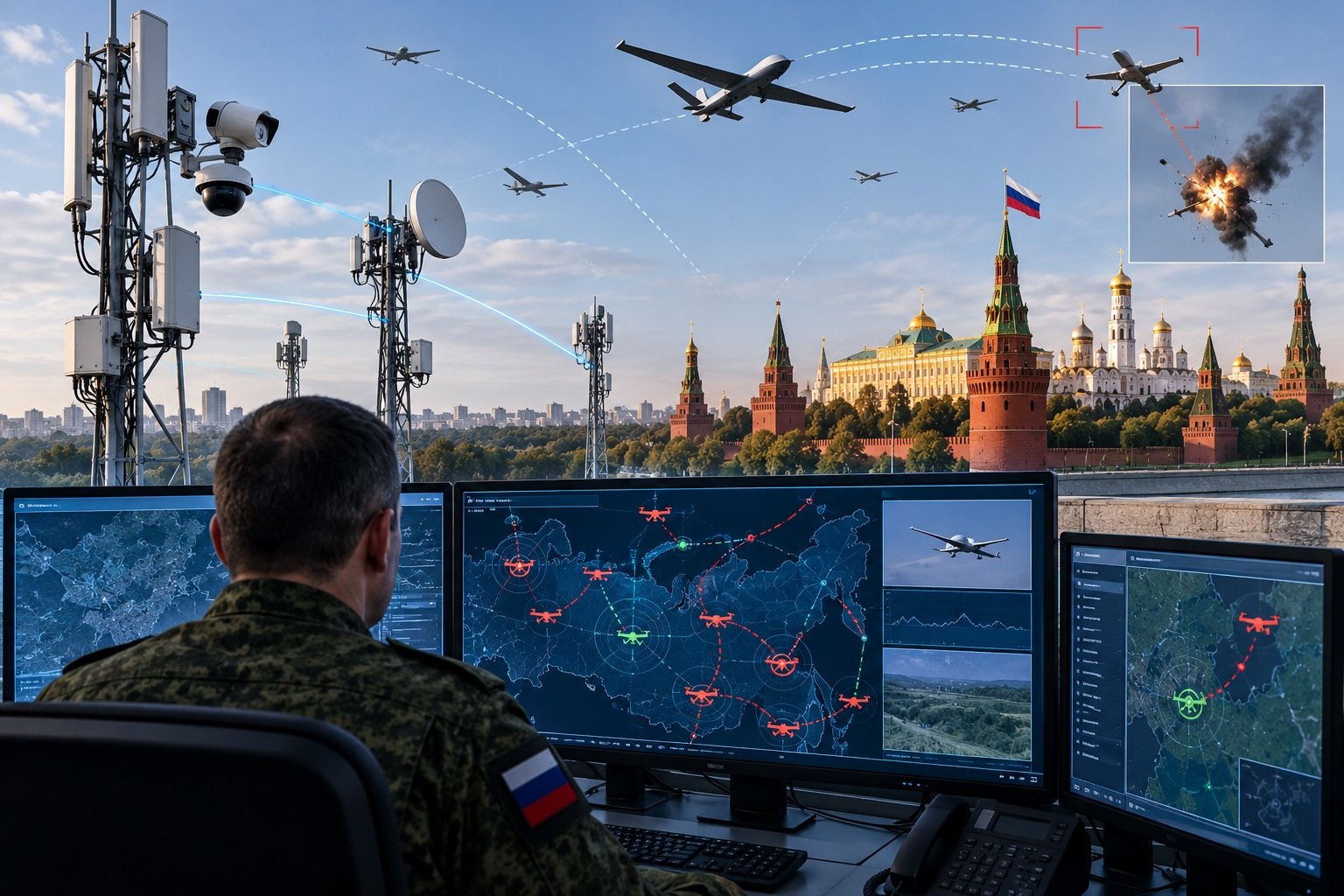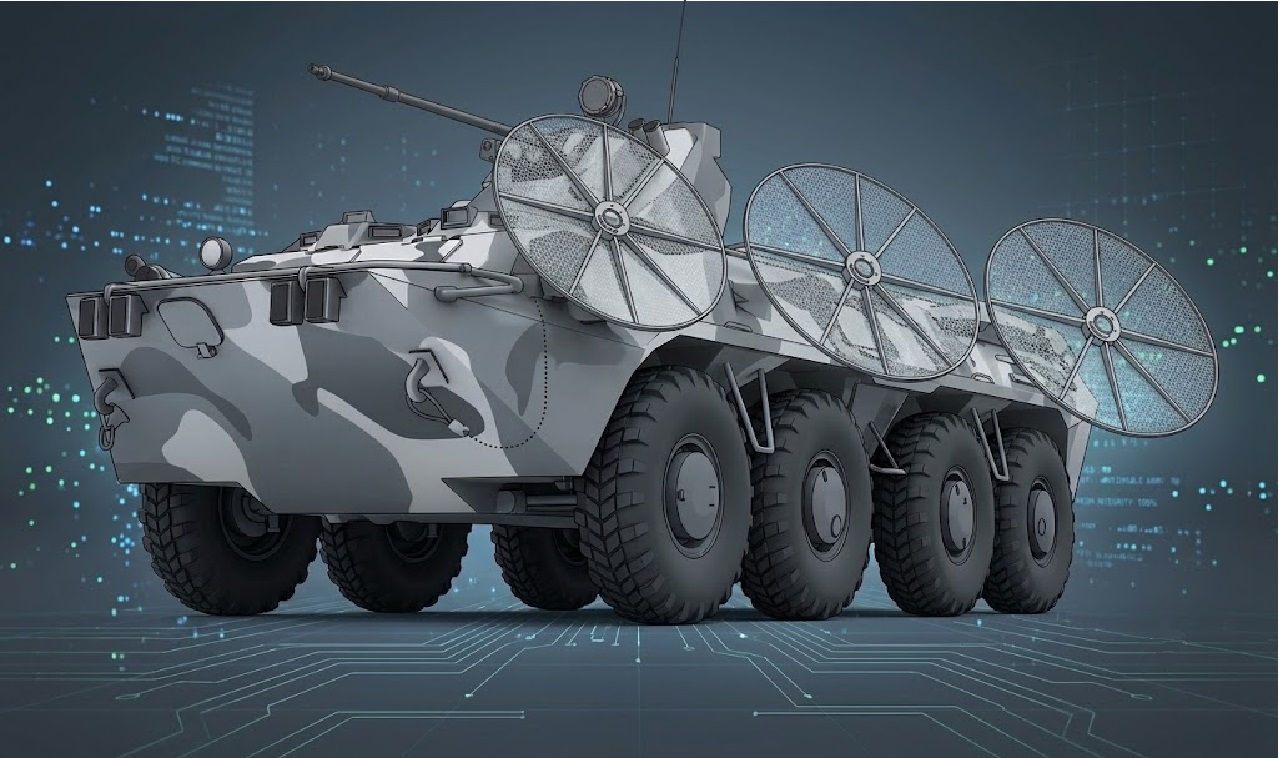
MOSCOW — Russia's Zhukov Order Combined Arms Academy has patented a mechanical protection system that uses a rotating, umbrella-like net launcher to defend armored vehicles against loitering munitions and FPV drones through physical interception rather than electronic jamming.
The patent describes a device that can be mounted on the rear, side, or armor shielding of a vehicle. It consists of a base connected to a tube-shaped holder carrying a cartridge with a protective covering. The base also houses a drive mechanism linked to the holder, allowing it to rotate. An ejection mechanism mounted on the holder releases the cartridge after receiving a remote control signal.
Inside the cartridge is a circular washer fitted with attachment points around its perimeter. Each attachment point is connected to a cable ending in a weight, while protective fabric panels are stretched between adjacent cables. Once the cartridge is ejected, the rotating mechanism spins the assembly and centrifugal force deploys the cables, weights and fabric into a wide net intended to catch an incoming drone before it reaches the vehicle.
The academy states the invention provides an additional method of protecting military equipment from loitering munitions, expanding the range of countermeasures available against unmanned aerial vehicles (UAVs) used in attack roles.
An experimental prototype with part of the patented features was built in 2024. Engineers mounted it on the rear of a pickup truck and used a DJI Mavic quadcopter to simulate a loitering munition. The drone approached from behind, following what the patent describes as a "hunter-like" attack profile.
The launcher activated when the drone was about 3.5 meters from the vehicle. The protective net intercepted the quadcopter, with the simulated detonation taking place roughly 3 meters away from the truck instead of directly on it. The patent states this increased the vehicle's protection by moving the explosion farther from the target.
The filing notes that the test used an unarmed commercial quadcopter. It does not state whether the same stand-off distance would provide equivalent protection against military drones carrying larger explosive payloads.
Loitering munitions, particularly first-person-view (FPV) drones, have become a common threat to armored vehicles in the war in Ukraine. Russian forces have introduced several physical protection measures in response, including welded metal grilles, commonly known as "cope cages," fitted to tanks and other armored vehicles.
The rotating umbrella launcher joins other anti-drone concepts patented by Russian military institutions. These include the Oduvanchik ("Dandelion") system, which uses flexible fiberglass rods to intercept drones, and a net-launching turret for the BTR-82A armored personnel carrier developed by the Karbyshev Military Engineering Academy that deploys perimeter netting with radar support.
Unlike electronic warfare systems that attempt to disrupt radio links, the patented launcher relies on direct physical interception. That approach can also be used against drones operating with autonomous guidance or fiber-optic control, where radio-frequency jamming is ineffective.
The Zhukov Order Combined Arms Academy is one of Russia's military education and research institutions. The patent documents the concept and prototype testing, but do not indicate that the system has entered serial production or operational service.
Source: Btvt.
——— End of Article ———