ORANGE COUNTY, Va. — L3Harris Technologies has completed the first full-scale ground test of a newly developed solid fuel ramjet propulsion system at its Orange County, Virginia, facility, validating a new fuel formulation intended to lower production costs while supporting longer-range, high-speed missile programs.
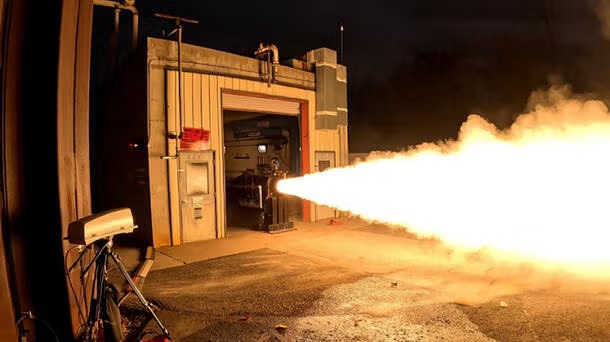
The company announced the successful test on July 1. It was the first full-scale evaluation of a newly formulated solid fuel ramjet grain, with engineers operating the propulsion system in a direct-connect, flight-representative test environment that simulated actual flight conditions.
The test campaign covered a broad portion of the engine's expected flight envelope. L3Harris said the propulsion system generated thrust levels consistent with flight expectations, providing data that will be used before the technology advances into tactical missile flight demonstrations.
The new fuel chemistry was developed to reduce manufacturing costs compared with historical industry standards, addressing production challenges identified across the defense industrial base. The company said the work supports U.S. military requirements for weapons that combine extended range, sustained speed and lower production cost at larger manufacturing volumes.
"This test is an important step in proving solid fuel ramjet propulsion can deliver the speed, range, and affordability our customers need," Scott Alexander, President of Missile Propulsion at L3Harris, said. "We are reducing risk now so we can move faster toward a scalable capability for the warfighter."
Unlike conventional solid rocket motors, a ramjet uses oxygen from the atmosphere instead of carrying an onboard oxidizer. That reduces propulsion system weight and allows sustained supersonic flight, typically above Mach 2, over longer distances. Solid fuel ramjets also have fewer moving parts than liquid-fueled ramjets and do not require complex fuel plumbing, simplifying manufacturing, handling and long-term storage.
"We are designing for manufacturing, performance, and production capacity with a straightforward goal of more speed, more range at a cost point that supports affordable mass," Joel Warhurst, L3Harris Director of Business Development, said.
L3Harris said it is applying advanced manufacturing methods, including high-temperature 3D printing, to shorten production time and simplify component designs. The company has invested internal funding over the past several years to mature its ramjet and advanced propulsion technologies.
The propulsion system was tested at the company's Orange County site, which is being expanded under the Virginia Advanced Propulsion Facilities program. In April 2026, L3Harris announced a $1.5 billion investment to increase solid rocket motor production capacity at the location.
The 2,000-acre campus includes 256,000 square feet of manufacturing space, a static test facility, an aerothermal propulsion laboratory and an altitude test site. L3Harris said additional ground testing will be completed before the propulsion system moves into live tactical missile flight demonstrations.
Source: L3Harris.
——— End of Article ———