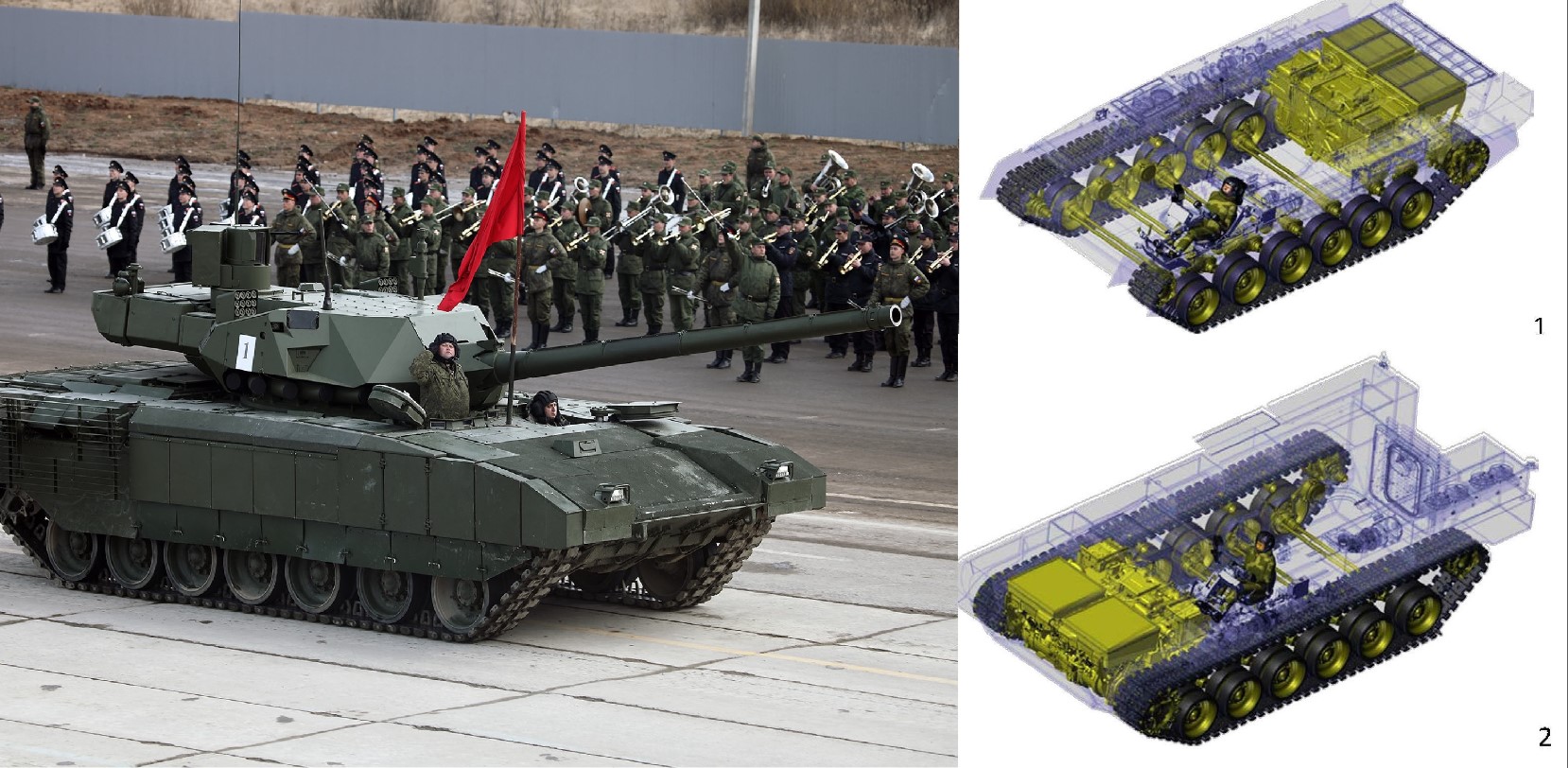
MOSCOW — Russia's T-14 Armata main battle tank underwent major design changes during development after engineering constraints forced the program to move away from its original compact configuration, resulting in the larger seven-road-wheel vehicle now associated with the platform.
Early concept presentations showed the Armata on a six-road-wheel chassis with a smaller hull. During development, engineers incorporated the Motor-Transmission Unit (MTU) from the canceled T-95 (Object 195) program into the new platform. The size of that powerpack required a larger hull, and the final design shifted to a seven-road-wheel chassis to accommodate the internal components.
The T-95 project had been canceled before the Armata program moved forward. UKBTM, the Ural Design Bureau of Transport Machine-Building, carried over elements from the earlier project while developing the new tank under its parent company, Uralvagonzavod (UVZ).
Reports on the program say the preliminary images shown during the approval stage differed from the final vehicle that entered prototype production. Once physical prototypes were built, the original compact layout could no longer accommodate the large MTU and the chassis had to be redesigned.
Engine selection became another issue during development. One option was the 6TD opposed-piston diesel engine. After the breakup of the Soviet Union, production facilities for the engine remained in Ukraine, leaving Russia without direct access to it for the Armata program.
Another alternative was the gas turbine engine used in the T-80 series. Development priorities inside Russia's armored vehicle industry favored other programs, while competition between different tank designs affected decisions on future powerplant selection.
The production vehicle uses the A-85-3, also known as the 12N360, an X-shaped 12-cylinder multi-fuel diesel engine. The complete Motor-Transmission Unit weighs about 5,150 kg, while the engine itself weighs roughly 1,550 kg.
The engine is rated at about 1,500 horsepower, although part of that output is consumed by onboard systems including cooling fans, compressors and auxiliary pumps required to operate the powerpack.
Its size had a direct effect on the overall dimensions of the tank. The larger engine compartment increased the vehicle's length and contributed to the adoption of the seven-road-wheel chassis instead of the six-wheel layout shown in early concepts.
The T-14 also introduced an unmanned turret, with the crew placed inside a protected armored compartment in the hull rather than beneath the turret. The tank remains the only Russian main battle tank built around that configuration.
Production of the Armata has remained limited, and public information on the number of tanks in operational service is still limited. Development of the platform has involved repeated changes from its original concept as engineering requirements, engine availability and internal design decisions evolved during the program.
Source: Btvt.
——— End of Article ———