KYIV — May 1, 2026 : Russia has established a rapidly growing and increasingly structured ground combat robotics manufacturing sector over the course of the war in Ukraine, with a significant portion of its industrial base operating outside Western sanctions regimes, according to an April 2026 report by the Kyiv-based think tank StateWatch.
The report, produced under the Trap Aggressor project, documents the emergence of a serialized unmanned ground vehicle (UGV) industry that has shifted from experimental state-led programs to a hybrid ecosystem involving private firms and public-private partnerships. Researchers identified 32 distinct Russian ground robotic systems and confirmed the manufacturers behind 29 of them using corporate registries, financial disclosures, customs records, and open-source intelligence current as of April 2026. At least 20 of these systems have been documented in operational use on Ukrainian territory as well as in Russia’s Kursk region.
Battlefield Demand Driving Industrial Expansion
The expansion of ground robotics manufacturing is closely linked to battlefield conditions that emerged following Russia’s full-scale invasion of Ukraine in February 2022. The widespread deployment of FPV drones and loitering munitions has created contested tactical zones extending 10 to 15 kilometers from the line of contact, where conventional troop movements and vehicle logistics face persistent risk.
Both Russian and Ukrainian forces have adapted by increasing reliance on unmanned systems. According to the StateWatch findings, approximately 90 percent of Ukrainian military resupply operations along the Pokrovsk front are now conducted using unmanned platforms. Russian deployment remains more limited in scale, with UGVs accounting for roughly 0.2 percent of total logistics volume, though their tactical use is expanding in specific operational sectors.
The report also highlights rapid growth in Russia’s civilian-to-defense robotics transition. The number of registered companies operating in the service robotics sector increased by 21.5 percent within a single year, reaching 563 entities by September 2025 and effectively doubling compared to pre-war levels in 2021.
Transition From Prototype Systems to Serial Production
Prior to 2022, Russia’s ground robotics programs were largely experimental and demonstrated limited operational reliability. Systems such as the Uran-9, tested during deployments in Syria, encountered repeated technical failures, including 19 recorded instances of lost operator control and an inability to fire its main weapon while in motion. These earlier platforms were not adopted for active deployment in Ukraine and remain absent from the current battlefield.
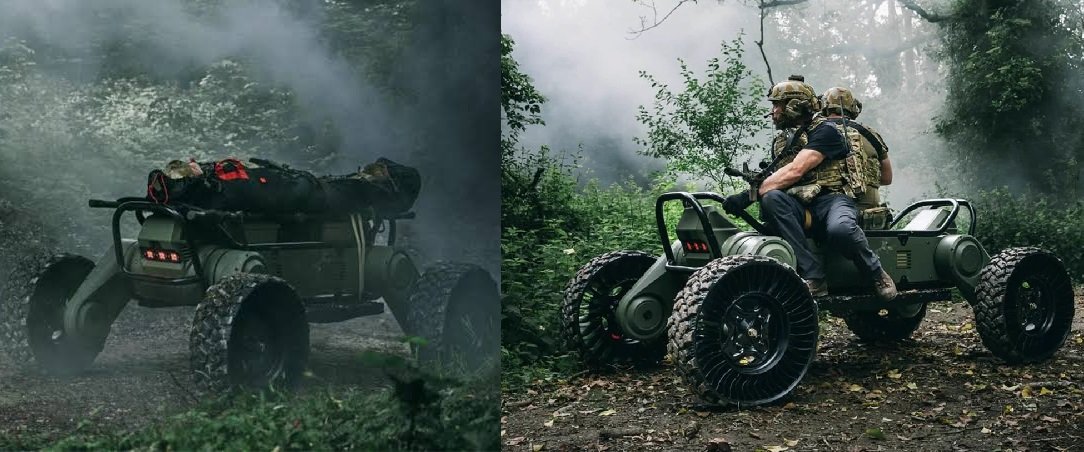
In contrast, the current generation of systems reflects a shift toward simpler, scalable designs optimized for serial production and operational use. Among the most widely deployed platforms are the Kuryer, Varan, and Impulse-M systems.
The Kuryer platform, manufactured by LLC NRTK Caps, is a tracked unmanned vehicle capable of carrying payloads up to 200 kilograms, reaching speeds of 35 kilometers per hour, and operating within a control range of 3 to 10 kilometers. By late 2024, at least 50 units had been deployed in combat zones, with total production reaching into the hundreds. In April 2026, range trials demonstrated an updated configuration integrating an automated 82mm mortar system (“Bagunlnik-82”), with a reported reload cycle of approximately five seconds.
The Varan system is produced by LLC Agency of Digital Development, while the Impulse-M platform is manufactured by LLC Gumich-RTK. By early 2026, hundreds of Impulse-M units had been delivered to Russian forces.
Russian Defense Minister Andrei Belousov stated in April 2025 that several hundred unmanned ground systems were supplied to the military during 2024, with production targets for 2025 increased by an order of magnitude. Development efforts are supported by the Foundation for Advanced Research, which provides state funding and coordination through engineering initiatives such as the Kulibin Club, linking volunteer developers and private firms to defense requirements.
Gaps in Sanctions Coverage
Despite the growing operational presence of these systems, the report identifies significant gaps in international sanctions enforcement. As of March 2026, only 10 of the 20 identified large-scale manufacturers of Russian UGVs are subject to U.S. sanctions, nine are sanctioned by Ukraine, and three by the European Union.
Companies responsible for producing several of the most actively deployed systems—including the Kuryer, Varan, Omich, Bogomol, Bratishka, and Krot platforms—remain unsanctioned across major jurisdictions. The report notes that existing sanctions frameworks have primarily targeted legacy Soviet-era defense enterprises, which play a comparatively limited role in the current ground robotics sector.
Supply Chain Dependence and Import Practices
The manufacturing of Russian ground robotic systems remains heavily dependent on imported components, particularly from China. StateWatch estimates that approximately 90 percent of electronic components used in these systems originate from Chinese suppliers.
Customs data reviewed in the report details specific procurement channels. LLC NRTK Caps imports DC motors from HD LED Technology, while LLC Gumich-RTK sources ball screw assemblies from Qingdao Tsingleader. LLC RENG, associated with the Omich platform, acquires drivetrain components from AHI Enterprise. Meanwhile, lithium batteries supplied by Gaoneng Battery and EVE Energy, along with Arduino microcontrollers and other electronic components, are used across multiple systems.
To reduce regulatory scrutiny, imported components are frequently declared under alternative classifications, including “quadcopter spare parts” or industrial equipment such as “plastic forming machinery”, allowing continued access to foreign supply chains.
Technical Capabilities and Operational Constraints
Internal Russian military assessments referenced in the report indicate that current UGV platforms retain several operational limitations. Most systems rely on standard radio control links, which are vulnerable to electronic warfare (EW) interference. This has led to ongoing development of alternative control methods, including fiber-optic tethering and relay-based communication systems.
Weight constraints aimed at maximizing payload and battery efficiency have resulted in minimal armor protection, leaving many platforms susceptible to FPV drone strikes. Additional limitations include restricted operational range, due to battery capacity and lower performance of thermal imaging systems.
However, the report also identifies functional advantages. These include stable operation of Starlink-based satellite communication channels, effective daytime optical systems, and sufficient terrain mobility provided by tracked chassis configurations.
Long-Term Industrial Scaling
Russia’s ground robotics sector is supported by a broader national robotics development program valued at approximately 300 billion rubles, scheduled to run through 2030. Current production levels are estimated in the hundreds of units annually across more than 20 manufacturers, indicating steady industrial scaling, though still below the mass production levels observed in aerial drone manufacturing.
To address the identified gaps, StateWatch recommends expanding sanctions coverage to include currently unsanctioned manufacturers involved in serial production of combat UGVs. The report also calls for targeted export controls on key component categories, including DC motors, lithium batteries, programmable controllers, remote control systems, and autonomous platforms with payload capacities exceeding five kilograms.
The findings indicate that Russia’s ground combat robotics industry, which had limited operational relevance prior to 2022, has evolved into an active and expanding sector integrated into ongoing military operations, with continued growth expected under existing industrial and governmental support structures.
——— End of Article ———