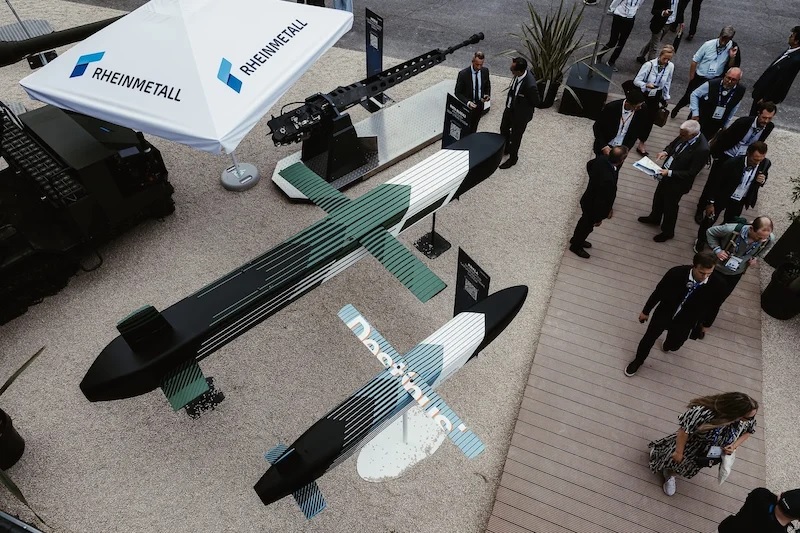
PARIS, — June 20, 2026 : Rheinmetall Destinus Strike Systems has announced plans to accelerate development of its Ruta Block 3 deep-strike cruise missile while commencing serial production of the Kryla and Ruta Block 2 cruise missile systems. The announcement follows presentations made by the company during the Eurosatory 2026 defense exhibition in Paris.
The joint venture, established between Germany's Rheinmetall AG and the Netherlands-based Destinus Group BV, aims to expand Europe's long-range precision-strike capabilities through a fully European industrial and supply chain framework. Rheinmetall holds a 51 percent stake in the partnership, while Destinus owns the remaining 49 percent.
The company stated that its missile portfolio is designed to provide NATO and European armed forces with scalable strike capabilities across different operational ranges and mission requirements. Final assembly, integration, and testing activities will take place at Rheinmetall's facility in Unterlüß, Germany, with initial delivery readiness targeted for later in 2026.
European Industrial Partnership
The joint venture combines Destinus' expertise in cruise missile design, propulsion systems, autonomous navigation technologies, and operationally validated architectures with Rheinmetall's industrial manufacturing capabilities, warhead production, booster rocket motor development, qualification processes, and large-scale system integration.
According to the companies, the program is built around a 100 percent European value chain intended to strengthen supply security and reduce dependency on non-European suppliers. The long-term objective is to achieve full NATO qualification, allowing the systems to be offered across NATO and European Union member states.
Destinus currently produces more than 2,000 cruise missiles annually and contributes key technologies including the T150 and T220 turbojet engines used within the company's missile family.
Ruta Block 3 Deep-Strike Missile
The centerpiece of the joint venture's future roadmap is the Ruta Block 3 cruise missile, which is being developed as a strategic deep-strike weapon capable of engaging high-value and hardened targets at long distances.
Powered by the in-house Destinus T220 turbojet engine, Ruta Block 3 is designed to fly at subsonic speeds of approximately Mach 0.8 while maintaining low-altitude, terrain-following flight profiles. The missile is expected to have a range exceeding 2,000 kilometers and carry a conventional precision warhead weighing up to 250 kilograms.
The system incorporates low-observable shaping and advanced autonomous navigation designed to operate in GNSS-denied environments. Terminal guidance will be provided through electro-optical and infrared (EO/IR) systems, with additional guidance capabilities currently under development.
A key feature of the missile is its containerized launch architecture. Ruta Block 3 is launched from standard 40-foot ISO containers, allowing deployment from mobile platforms such as Rheinmetall HX trucks, maritime vessels, and fixed installations. The company states that the system can transition from transport configuration to firing readiness in approximately two minutes.
Flight testing of Ruta Block 3 is scheduled to begin in 2027 in Ukraine, where earlier variants of the Ruta family have already undergone operational validation and testing.
Kryla Enters Serial Production
While Ruta Block 3 remains under development, Rheinmetall Destinus Strike Systems is beginning serial production of the Kryla cruise missile to meet near-term operational requirements.
Kryla is a compact, cost-efficient cruise missile equipped with a 50-kilogram warhead and optimized for massed saturation attacks. Unlike the Ruta family, Kryla can be launched from both standard shipping containers and existing Multiple Launch Rocket Systems (MLRS), allowing military operators to add cruise missile capabilities to current artillery launcher fleets without major modifications.
The missile offers a range of more than 800 kilometers and supports coordinated strikes using time-on-target attack profiles, enabling multiple missiles to reach targets simultaneously.
Ruta Block 2 Production Underway
The company is also beginning serial production of Ruta Block 2, which serves as the immediate predecessor to the Block 3 variant.
Ruta Block 2 carries a 250-kilogram warhead and is intended for precision engagements against hardened and high-value targets. The missile has a range exceeding 700 kilometers and utilizes low-altitude terrain-following flight combined with EO/IR terminal guidance and AI-assisted target recognition.
The design incorporates foldable wings and control surfaces that allow storage within sealed launch canisters. Like the future Block 3 system, Ruta Block 2 is launched exclusively from containerized platforms and supports salvo-launch operations from both land-based and maritime platforms.
Expanding European Strike Capabilities
The combined portfolio of Kryla, Ruta Block 2, and Ruta Block 3 is intended to provide layered long-range strike options covering a wide range of operational scenarios. By utilizing standardized container-based launch systems across much of the portfolio, the company aims to simplify deployment and integration across existing military platforms.
Officials from Rheinmetall and Destinus stated that the partnership is focused on rapidly increasing European production capacity for long-range precision-strike systems while supporting NATO and national defense requirements.
Production activities at Rheinmetall's German facilities are expected to expand through 2026 and 2027, while Ukraine continues to contribute to testing, development, and component manufacturing activities associated with the Ruta missile family.
The initiative represents a broader effort by European defense industries to increase sovereign production capacity and strengthen long-range strike capabilities through industrial cooperation and scalable manufacturing.
——— End of Article ———