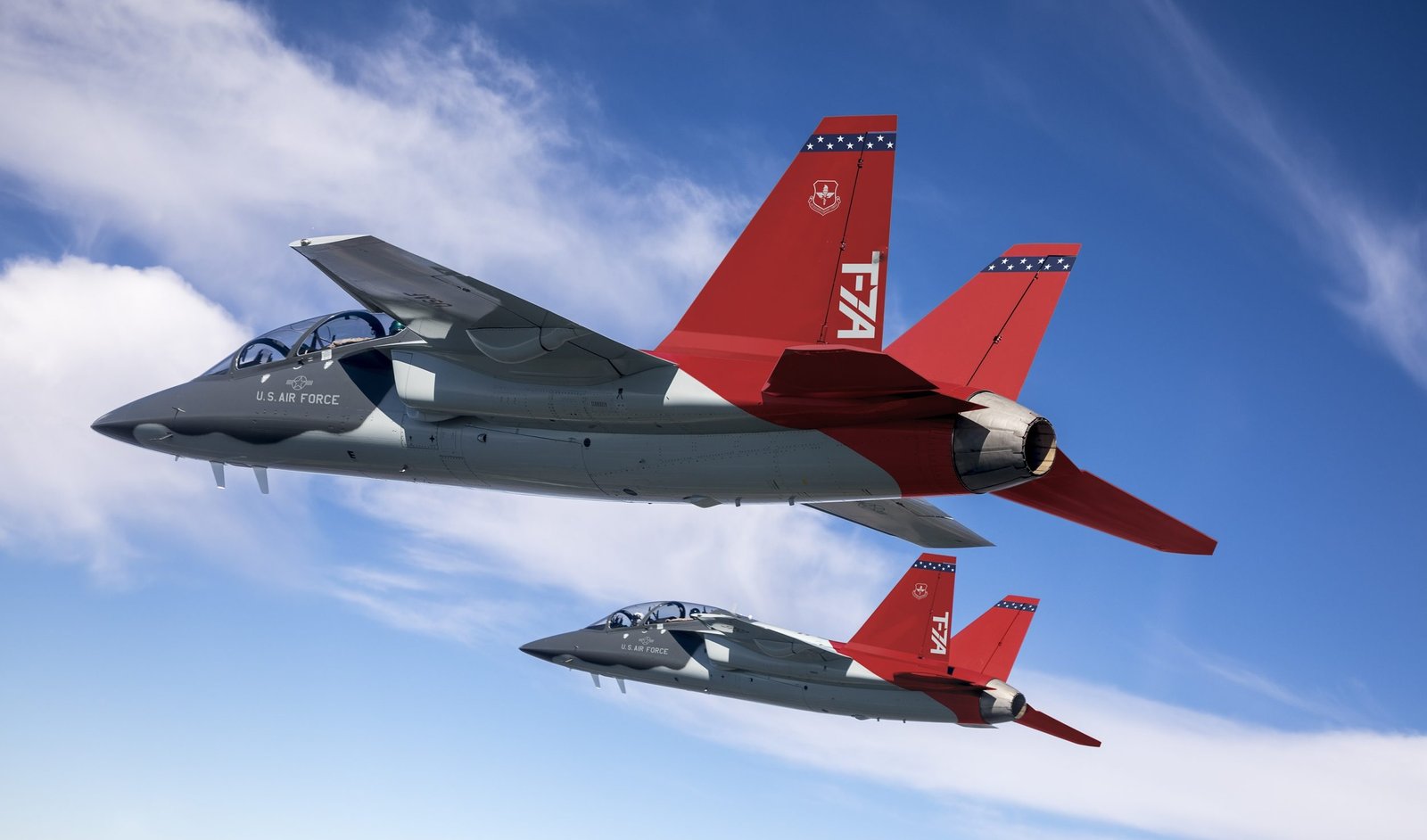
WEST LAFAYETTE, Ind. — The Boeing-Saab T-7A Red Hawk advanced jet trainer program has entered a new phase after the U.S. Air Force approved Milestone C on April 23, 2026, allowing the aircraft to move from development into low-rate initial production (LRIP).
The decision, announced publicly in early May 2026, was followed by a $219 million contract awarded to Boeing for the first 14 production aircraft, together with associated support equipment, training systems, and spare parts. The approval marks a significant milestone for both the U.S. Air Force and Saab, which manufactures the T-7A's aft fuselage at its dedicated production facility in West Lafayette, Indiana.
The T-7A Red Hawk is being developed jointly by Boeing and Saab to replace the U.S. Air Force's T-38 Talon advanced trainer, which has served for more than six decades. The aircraft is intended to prepare future pilots for operating modern combat aircraft, including the F-35 Lightning II, F-22 Raptor, F-15EX Eagle II, and B-21 Raider.
Indiana Facility Expected to Increase Production
Saab's West Lafayette facility was built specifically to support long-term production of the T-7A. The plant uses digital manufacturing methods developed jointly with Boeing and is now the exclusive production site for all T-7A aft fuselage sections after manufacturing was transferred from Sweden to the United States.
The facility has operated below planned capacity in recent years because of delays in the T-7A program. As a result, Saab has experienced underutilization at the plant, affecting the financial performance of its Aeronautics business.
During Saab's second-quarter 2026 earnings presentation, President and CEO Micael Johansson said the start of production contracts means manufacturing activity now needs to increase. He noted that Saab had already begun work on initial production batches under earlier contracts from Boeing but added that it will take several quarters and "a couple of years" before the Indiana operation reaches stronger financial performance.
Johansson also said the T-7A program continues to have a negative impact on Saab's Aeronautics business while production volumes remain below efficient operating levels. Despite the gradual ramp-up, he described the Red Hawk as a long-term industrial program that is expected to become "an excellent franchise program over many years."
Milestone C Clears the Way for Production
In the U.S. Department of Defense acquisition process, Milestone C authorizes a program to move from engineering and manufacturing development into the production and deployment phase. For the T-7A, the approval allows the aircraft to enter low-rate initial production rather than full-rate manufacturing.
The U.S. Air Force is using an incremental production strategy for the Red Hawk. Instead of approving large-scale production immediately, the service plans to review and approve each of the first three LRIP lots separately. This approach allows engineers to incorporate lessons learned from developmental testing before larger production quantities are authorized.
The phased production strategy is intended to reduce technical and manufacturing risks while allowing aircraft deliveries to continue.
Budget planning documents outline potential follow-on production lots, including 23 aircraft in fiscal year 2027 and 36 aircraft in fiscal year 2028, although each lot will require separate approval.
Digital Design Supports Future Growth
The T-7A Red Hawk is the first U.S. Air Force aircraft designed and developed using fully digital engineering methods. The aircraft features modern avionics, open-architecture systems, and embedded training capabilities intended to support future upgrades throughout its service life.
The program of record includes 351 T-7A aircraft and 46 ground-based training simulators, with deliveries planned to five Air Education and Training Command bases over the coming decade.
The aircraft is expected to become the U.S. Air Force's primary advanced trainer for pilots preparing to transition to current and future combat aircraft.
Program Moving Toward Initial Operational Capability
The T-7A program has experienced development challenges, including work related to the aircraft's ejection seat and flight-control software, resulting in schedule adjustments during testing. Boeing has continued development under the program's fixed-price contract.
Five test-configured aircraft have already been delivered, with the first aircraft arriving at Joint Base San Antonio-Randolph in late 2025 for Air Education and Training Command activities.
With Milestone C now complete, Boeing and Saab can gradually increase production in line with future U.S. Air Force contracts. Initial production aircraft will support instructor and maintainer training as the Air Force works toward achieving Initial Operational Capability (IOC) in 2027.
For Saab, the approval also marks the beginning of a gradual increase in manufacturing activity at its Indiana facility. While company executives expect financial improvements to take time, they continue to view the West Lafayette operation as a long-term production center that will benefit as aircraft output expands and the T-7A program progresses.
——— End of Article ———