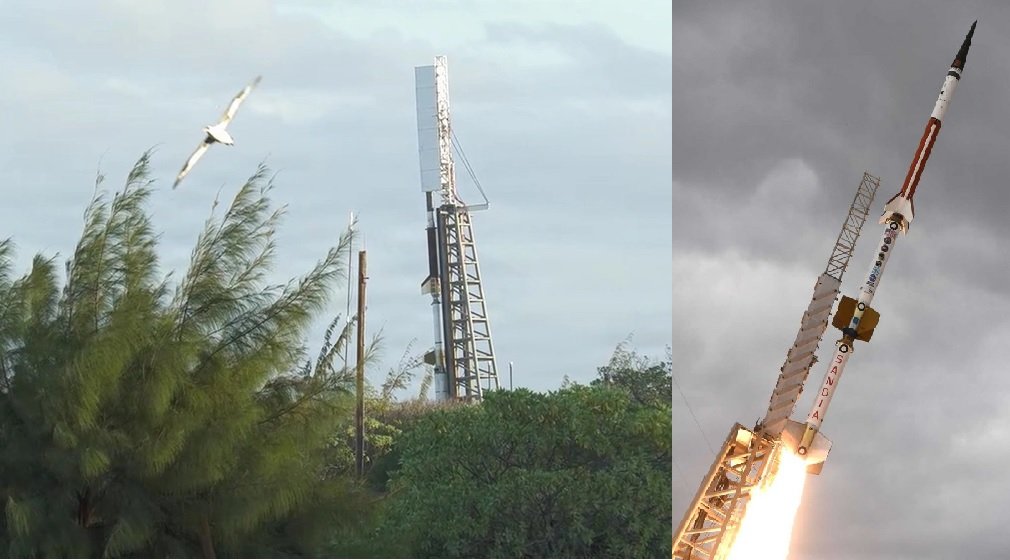
WAKE ISLAND, Pacific Ocean — The U.S. Navy has released new details of the Space Measurement of A Rocket-released Turbulence (SMART) mission, a scientific sounding rocket experiment conducted on February 12, 2026, from the remote Pacific atoll of Wake Island. The mission was designed to study how plasma energy converts and behaves in space, providing data that could improve understanding of space weather and its effects on satellites and other space-based systems.
The SMART mission was managed by the U.S. Naval Research Laboratory (NRL) and carried out by the Naval Surface Warfare Center (NSWC), Port Hueneme Division's White Sands Detachment. The launch marked the detachment's largest sounding rocket mission to date and its first flight of a four-stage sounding rocket.
Mission aimed at studying plasma turbulence
The experiment focused on understanding plasma turbulence and energy conversion in Earth's upper atmosphere. Scientists say space weather can affect satellite communications, navigation systems, and other spacecraft operating in low Earth orbit.
Dr. Gurudas Ganguli, NRL Senior Scientist for Intense Particle Beams and Plasma Processes, said space weather poses challenges for spacecraft in much the same way atmospheric weather affects aircraft.
To carry out the experiment, the Navy launched Oriole IV, a 68-foot (20.7-meter), four-stage sounding rocket built using four repurposed motors—Talos, Terrier, Oriole, and Nihka. According to officials, using existing rocket motors significantly reduced mission costs compared with developing a new large single-stage motor capable of reaching the same altitude.
The rocket reached an altitude of approximately 539 kilometers (335 miles), within the region where many satellites operate. At that point, the payload separated, and a directional shape charge vaporized several pounds of barium metal, creating an artificial plasma cloud in the ionosphere.
After the release, sunlight ionized the neutral barium atoms. Officials said the neutral atoms glowed green, while the ions produced blue and purple colors. Earth's magnetic field confined the ions, triggering electrostatic plasma turbulence.
A second payload carrying scientific instruments then passed through the plasma cloud to measure the resulting electric and magnetic field changes and other electromagnetic effects.
Testing plasma-wave conversion in space
According to the Naval Research Laboratory, the mission was designed to confirm how electrostatic lower hybrid waves convert into electromagnetic whistler waves during a high-speed metal vapor release in the ionosphere.
Christopher Netwall, Branch Head for Dynamics and Control Systems at the Naval Research Laboratory's Naval Center for Space Technology, SMART program manager, and experiment lead, said the experiment addressed a scientific question that had previously been studied mainly in laboratory conditions.
Officials reported that the team successfully induced and measured plasma turbulence in the space environment using this method. Instruments recorded electric and magnetic field fluctuations, while ground-based sensors tracked the plasma cloud's size, optical intensity, and the propagation of the resulting electromagnetic waves.
The complete mission sequence, from liftoff to final measurements, lasted about 10 minutes before the vapor dispersed and recombined with atmospheric elements.
Jay Breuer, Senior Test Director in the White Sands Detachment's Suborbital Vehicles Division, said the mission demonstrated scientific theories that could eventually support future operational capabilities.
Wake Island selected for safety reasons
The SMART mission was originally planned for NASA's Wallops Flight Facility in Virginia. However, NASA safety assessments determined that detonating a shape charge at such a high altitude could spread debris across an area too large for that location.
The project was subsequently transferred to the U.S. Navy, which selected Wake Island, a remote atoll managed by the U.S. Air Force.
Located approximately 2,300 miles (3,701 kilometers) west of Honolulu and 1,500 miles (2,414 kilometers) northeast of Guam, Wake Island's isolation allowed the military to safely close the required airspace and ocean areas. The nearest inhabited island is nearly 600 miles (966 kilometers) away.
Breuer described the location simply as being "in the middle of nowhere."
Building a launch site in a remote environment
Launching from Wake Island required extensive preparation because the island lacks permanent sounding rocket infrastructure.
Unlike established launch ranges such as White Sands Missile Range, the Hebrides Range in Scotland, or the Pacific Missile Range Facility in Kauai, Wake Island did not have permanent telemetry systems or launch control facilities.
An advance team surveyed the island months before the mission, and eight personnel from the White Sands Detachment spent about seven weeks, from early January through late February, establishing the launch site.
The launch control center was set up inside an abandoned garage with a dirt floor, leaking roof, and mold-covered walls. The team relied on Starlink satellite terminals for internet connectivity throughout the operation.
In total, 42 personnel participated in the mission, including scientists from the Naval Research Laboratory, NASA's Goddard Space Flight Center, the Naval Surface Warfare Center Indian Head Division, university research teams, and supporting contractors.
Rocket and equipment transported across the Pacific
Transporting personnel, rocket hardware, and equipment to Wake Island required three C-17 Globemaster III cargo aircraft operating from Holloman Air Force Base in New Mexico.
Aircraft carrying rocket stages and explosives stopped at Travis Air Force Base in California and Joint Base Pearl Harbor-Hickam in Hawaii before continuing across the Pacific to Wake Island.
Officials said the journey covered approximately 5,800 miles (9,334 kilometers) and took about four days.
The launch used a Missile Defense Agency launcher capable of handling payloads of up to 50,000 pounds (22,680 kilograms). The launcher was extended to accommodate the 68-foot Oriole IV sounding rocket.
Mission planners also delayed launch opportunities several times to avoid potential conflicts with orbiting satellites before successfully completing the flight.
Mission supports future research and testing
Following the successful launch, the Missile Defense Agency transferred ownership of the heavy-duty Wake Island launch rail to the White Sands Detachment.
According to Navy officials, the successful expeditionary launch demonstrated the unit's ability to conduct complex sounding rocket operations from remote locations. They said this capability could support future hypersonic vehicle testing and work related to the Golden Dome for America homeland missile-defense architecture.
The Naval Research Laboratory said the SMART mission successfully confirmed laboratory predictions of plasma-wave conversion in the actual space environment while providing valuable data to improve understanding of space weather and its potential effects on satellites and other space-based systems.
The mission involved multiple government organizations, including the Naval Research Laboratory, Naval Surface Warfare Center divisions, Pacific Air Forces Regional Support Center Wake Island Detachment, U.S. Army Space and Missile Defense Command Reagan Test Site, U.S. Space Force 19th Space Defense Squadron, Missile Defense Agency Test Directorate, NASA Goddard Space Flight Center, the University of Alaska Fairbanks, and the University of Washington. Sponsors included the Office of the Undersecretary of Defense for Research and Engineering, the Office of Naval Research, the Department of War Space Test Program, the Rocket Systems Launch Program, the Defense Advanced Research Projects Agency (DARPA), and the Space Security and Defense Program.
——— End of Article ———