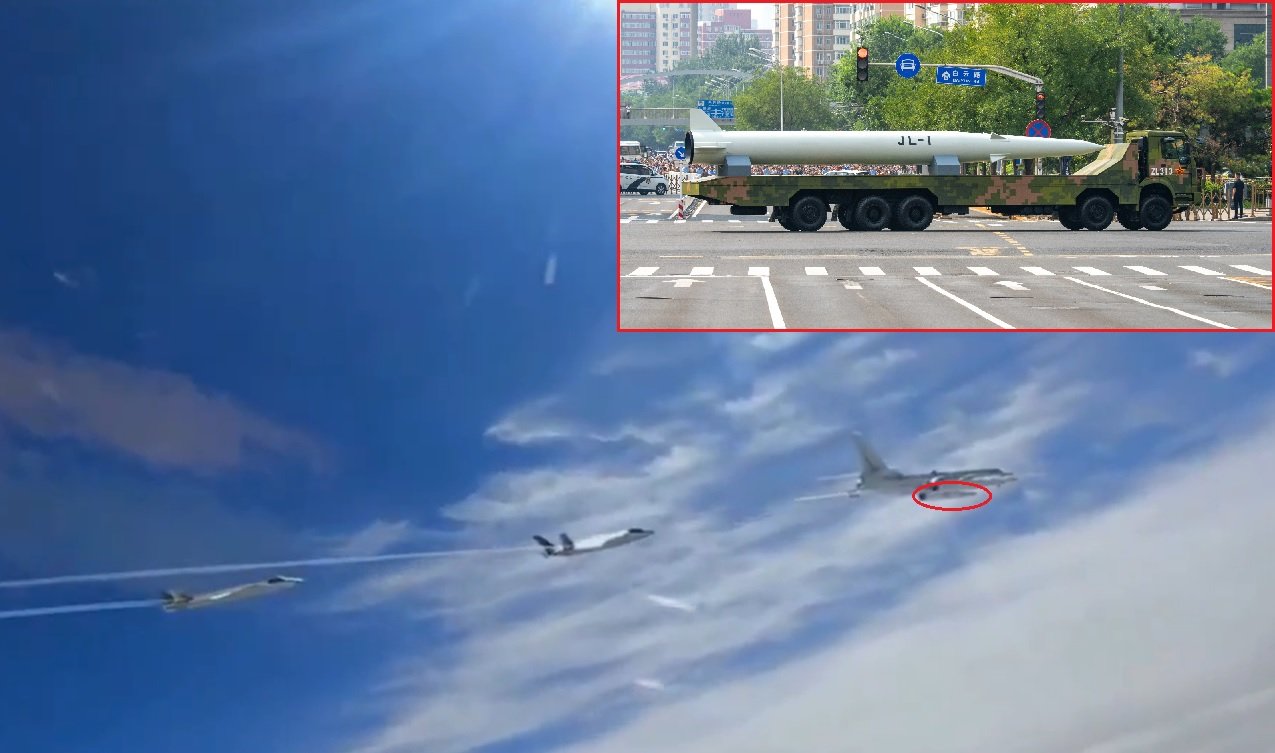
BEIJING — China has released the first official in-flight footage of its H-6N strategic bomber carrying what military analysts identify as the JL-1 air-launched ballistic missile (ALBM), providing the clearest official view so far of the aircraft and missile combination.
The footage appeared in the final episode of the documentary Securing Victory, broadcast by state broadcaster CCTV as part of events marking the 99th anniversary of the People's Liberation Army (PLA) on August 1. The documentary was jointly released by the Central Military Commission's Political Work Department, the Cyberspace Administration of China, and China Media Group.
In the video, the H-6N bomber is shown flying with a large externally mounted missile beneath its fuselage while being escorted by two J-20 fifth-generation stealth fighters. Although CCTV did not identify the weapon by name, military observers and Chinese media reports assessed it to be the JL-1, also known as Jing Lei-1 ("Startling Thunder"), based on its size and external appearance.
The footage marks the first official confirmation of the JL-1 being carried by an H-6N during flight. The missile had previously appeared publicly during a military parade in Beijing in September 2025 alongside other strategic weapons, while unofficial images of the aircraft and missile combination had circulated online earlier.
H-6N Modified for Air-Launched Ballistic Missile Operations
The H-6N is a modified version of China's H-6 bomber family, designed to carry oversized external payloads. The aircraft features a recessed section under the fuselage to accommodate large weapons such as the JL-1 and is equipped with an aerial refueling probe to extend its operational range.
According to defense assessments, the bomber has a combat radius of around 4,000 kilometers with aerial refueling support. Open-source assessments also estimate the JL-1's range at more than 5,000 kilometers, with some reports placing it at nearly 8,000 kilometers depending on payload configuration and launch profile.
Launching a ballistic missile from an airborne platform provides greater operational flexibility than a ground launch by allowing the missile to begin its flight at altitude and speed. Analysts also note that an air-launched system can expand operational reach and provide additional launch options.
The JL-1 is widely assessed as a nuclear-capable air-launched ballistic missile that forms the airborne component of China's nuclear triad alongside land-based and sea-based nuclear forces. Military analysts also state that the missile can carry conventional warheads for tactical missions.
Footage Shows Simulated Joint Anti-Ship Exercise
The documentary presents the footage within a simulated joint exercise conducted by the PLA Southern Theater Command.
According to the exercise scenario, a rapidly maneuvering enemy surface fleet approaches from the southeast while ship-borne aircraft move toward the operational area. PLA forces respond by deploying reconnaissance drones, airborne early warning and control aircraft, and logistics support units before carrying out a coordinated strike.
The exercise depicts anti-ship missiles being launched from multiple platforms, including destroyers, road-mobile launchers, and aircraft. The documentary also shows a Type 052D destroyer launching a YJ-20 hypersonic anti-ship missile through its vertical launch system. This is the first official confirmation of the YJ-20 being launched from a Type 052D destroyer, as the missile had previously been associated with the larger Type 055 destroyers.
In addition, another H-6 bomber variant is shown releasing the YJ-12 supersonic anti-ship missile. The documentary also includes footage of DF-21D anti-ship ballistic missiles during the exercise.
Analysts Outline JL-1's Intended Role
Former PLA Air Force officer and military analyst Fu Qianshao said the JL-1 is intended for targets of greater strategic importance than conventional naval targets, including regional hubs, military bases, command centers, and headquarters.
Fu stated that the combined reach of the H-6N and JL-1 could cover almost the entire Pacific Ocean. He also noted that while the missile serves as part of China's nuclear deterrent, it can also carry conventional warheads for tactical missions.
Wang Yanan, editor-in-chief of Aerospace Knowledge magazine, described the JL-1 as a missile capable of conducting both anti-ship and ground-strike missions.
Bomber and J-20 Escort Reflect Evolving Air Operations
The documentary also highlights the H-6N operating alongside two J-20 stealth fighters.
The combination reflects an operational approach that pairs long-range bombers with advanced fighter aircraft during extended missions. Military observers note that escort fighters can provide protection against potential interceptors while supporting the bomber as it approaches its launch position.
The release of the footage comes as China continues to modernize its long-range aviation and naval strike capabilities through the development of strategic bombers, long-range precision weapons, hypersonic missile systems, aerial refueling aircraft, and fifth-generation fighters.
Chinese authorities have not released additional official information regarding when the footage was recorded, the specific name of the exercise, or the operational status of the JL-1 beyond its public appearance in the documentary.
——— End of Article ———