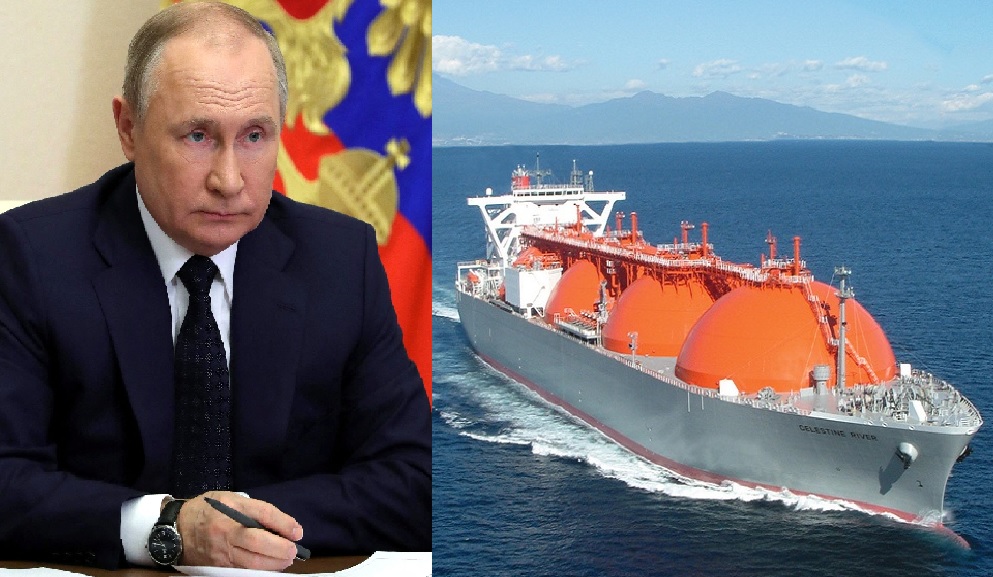
MOSCOW — March 10, 2026 : Russian President Vladimir Putin has indicated that Moscow may consider halting remaining natural gas supplies to Europe ahead of the European Union’s planned phase-out of Russian gas imports by 2027, potentially redirecting volumes to alternative markets in Asia. Russian officials say the idea is under evaluation and has not yet been finalized, but the discussion comes amid tightening global energy markets following disruptions linked to the ongoing Middle East crisis involving Iran.
Putin made the remarks during a televised interview with Russian state correspondent Pavel Zarubin on March 4, stating that changing market conditions could make it economically advantageous for Russia to stop supplying European markets sooner than expected. He said the government had been asked to study the possibility together with Russian energy companies and assess whether redirecting supplies to other buyers could yield higher returns under current global prices.
The statement follows the European Union’s policy framework to eliminate dependence on Russian pipeline gas by late 2027 and to restrict new short-term contracts for Russian liquefied natural gas beginning in April 2026. Despite these measures, Russia still supplies a limited share of Europe’s gas through pipeline deliveries and LNG shipments.
Current Structure of Russian Gas Supplies to Europe
Russia’s position in the European gas market has declined significantly since the escalation of the war in Ukraine in 2022. Before the conflict, Russia exported between 155 billion and 200 billion cubic meters (bcm) of pipeline gas annually to Europe, accounting for roughly 40–50 percent of the European Union’s gas imports.
By 2025, those volumes had fallen sharply. Russian pipeline exports to the EU dropped 44 percent year-on-year, reaching their lowest level since the mid-1970s. At present, the only operational pipeline route supplying the EU directly is the TurkStream pipeline. That pipeline delivered approximately 18 bcm of gas in 2025, primarily supplying countries such as Hungary and Slovakia. Deliveries through TurkStream increased about 7–8 percent compared with 2024.
Liquefied natural gas (LNG) shipments from Russia remain another component of supply. In 2025, the EU imported between 15 bcm and 20.3 bcm of Russian LNG, representing around 16 percent of the bloc’s total LNG imports, down from about 21 percent in 2021. European buyers spent approximately €7.2 billion on Russian LNG during that year.
Imports continued into early 2026, with Russian LNG deliveries reaching a monthly record of about 2.276 bcm in January. In total, Russia supplied approximately 38 bcm of gas to the EU in 2025 when combining pipeline gas and LNG, making Russia the fourth-largest supplier to the European market after Norway, the United States, and Algeria.
European gas consumption in 2025 totaled roughly 335 bcm, meaning Russian gas accounted for about 11 percent of total EU consumption, a significant decline compared with pre-2022 levels.
Middle East Conflict and Global Energy Market Pressures
The renewed debate about Russian supply comes as global energy markets face volatility linked to the crisis involving Iran and military operations conducted by the United States and Israel beginning in late February 2026.
Tensions in the region have affected maritime routes near the Strait of Hormuz, a strategic shipping corridor through which roughly 20 percent of global oil and LNG flows normally pass. Disruptions to traffic through the strait have reduced export flows from major Gulf producers including Qatar.
As a result, global energy prices have risen sharply. Oil prices climbed above $100 per barrel, while benchmark European gas prices at the Title Transfer Facility (TTF) increased by approximately 50–67 percent, reaching around €52–60 per megawatt-hour.
These price increases have created higher spot-market premiums for LNG cargoes in Asia compared with Europe, a factor Russian officials cite when discussing the potential reallocation of gas shipments.
Russia’s Strategy to Redirect Gas Toward Asian Markets
Russian Deputy Prime Minister Alexander Novak confirmed that Moscow is evaluating the redirection of LNG volumes previously destined for Europe toward buyers in Asian markets where prices are currently higher.
According to Russian officials, some cargoes have already been rerouted, with shipping data indicating that at least three LNG tankers altered their destinations in early March 2026. Potential alternative buyers include China, India, and other Asian energy importers.
China already represents Russia’s largest single energy customer. Pipeline deliveries through the Power of Siberia pipeline reached approximately 38.8 bcm in 2025. Overall, Chinese purchases accounted for about half of Russia’s fossil fuel export revenues among its major trading partners.
However, infrastructure limitations constrain the immediate scale of any shift away from Europe. The existing eastern pipeline network cannot absorb the full volumes previously sent to Europe through western routes. Analysts also note that some Russian LNG projects have historically relied on European ports as primary destinations.
Storage Levels and Market Effects in Europe
European gas storage levels remain an important factor in assessing the impact of a potential supply halt. At the end of February 2026, EU storage sites held roughly 46 bcm of gas following a colder-than-average winter, leaving reserves lower than in several recent years.
If Russian deliveries were halted entirely, approximately 38 bcm of annual supply would disappear from the European market. While the EU has diversified its energy sources since 2022, such a reduction could tighten supply conditions in the short term.
The United States has become the largest LNG supplier to Europe, accounting for around 57 percent of EU LNG imports. Additional volumes arrive from Norway, Algeria, and other producers. Even with these sources, analysts expect price increases if European and Asian buyers compete for limited LNG cargoes.
Higher wholesale prices would likely increase energy costs for households and industrial consumers across Europe, depending on contract structures, storage withdrawals, and alternative LNG availability.
European Energy Diversification and Long-Term Outlook
European governments have spent the past several years expanding LNG import capacity, building new terminals, and increasing pipeline deliveries from alternative suppliers. The EU’s broader energy strategy also includes expanding renewable energy and improving energy efficiency to reduce gas demand.
Officials in Brussels maintain that the European Union remains committed to eliminating Russian pipeline gas imports by 2027, regardless of short-term market fluctuations.
For Russia, redirecting exports toward Asian markets aligns with its long-term strategy of shifting energy trade away from Europe. However, analysts note that many pipeline contracts with Asian buyers involve lower prices than historical European contracts before 2022.
Decision Still Under Review
No final decision has been announced by Moscow regarding the early termination of gas supplies to Europe. Russian energy companies continue current deliveries under existing contracts while the government evaluates redirection options.
Putin has stated that Russia remains open to supplying oil and gas to Europe if long-term agreements can be reached without political conditions, while European governments continue pursuing policies aimed at ending reliance on Russian energy imports by the end of the decade.
——— End of Article ———