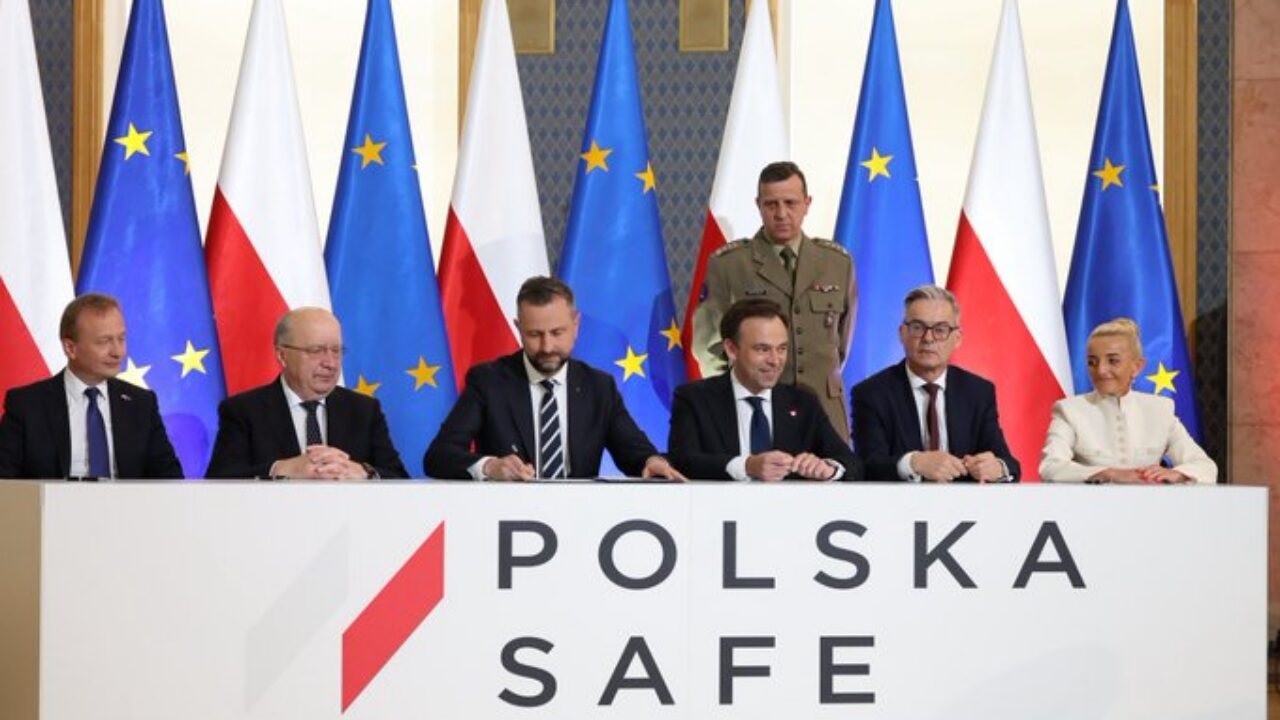
WARSAW — May 9, 2026 : Poland has officially signed a €43.7 billion low-interest defence loan agreement with the European Union under the bloc’s Security Action for Europe (SAFE) programme, securing the largest allocation awarded to any participating member state.
The agreement was signed on Friday during a ceremony attended by Deputy Prime Minister and Defence Minister Władysław Kosiniak-Kamysz, Finance Minister Andrzej Domański, representatives of state development bank BGK, European Commission officials including Commissioners Piotr Serafin and Andrius Kubilius, and Prime Minister Donald Tusk.
Poland became the first of 19 participating European Union member states to finalize funding under the SAFE programme, while Lithuania is expected to be the next country to complete the process.
SAFE Programme and Funding Structure
The SAFE programme is a €150 billion European Union defence financing initiative established to strengthen military readiness and accelerate defence procurement across Europe following security concerns linked to Russia’s ongoing war against Ukraine.
The mechanism places strong emphasis on European defence manufacturing, requiring at least 65 percent of funded procurement to be sourced domestically or from European partner countries.
Under the agreement, Poland will receive an initial advance payment of approximately €6.5 billion, representing 15 percent of the total allocation, with the first transfer expected as early as May. The financing is structured as a 45-year low-interest loan backed by the European Union’s credit rating, while the remaining funds will be distributed in twice-yearly tranches through 2030.
Officials stated that nearly 89 percent of the financing will support Poland’s domestic defence industry and military modernization programmes over the next four years.
Political Dispute Over Financing Mechanism
The finalization of the agreement followed internal political disputes regarding the structure of the financing arrangement.
President Karol Nawrocki vetoed legislation connected to the SAFE mechanism, arguing that the European Union could potentially suspend financing under the 45-year arrangement for political reasons. He also raised concerns that European procurement quotas could limit Poland’s defence purchasing flexibility and affect existing defence cooperation with suppliers from the United States and South Korea.
To proceed with the agreement, Prime Minister Donald Tusk’s government approved a resolution authorizing state development bank BGK to secure the SAFE financing and transfer the funds through the Armed Forces Support Fund, a domestic mechanism established in 2022 to finance military procurement.
Government officials stated that the revised arrangement would allow most major weapons programmes to continue according to schedule, although some projects originally included in the investment proposal may lose funding. Approximately 7 billion zlotys previously planned for the border guard and police will not be released under the new structure.
Defence Priorities and Procurement Plans
SAFE financing is expected to support several of Poland’s key defence priorities, including the East Shield border fortification programme along the borders with Russia and Belarus.
The project combines physical defensive barriers with electronic warfare systems, drone detection technology, surveillance infrastructure and anti-drone capabilities. Additional funding will be directed toward air defence systems, artillery, armored vehicles and large-scale ammunition production.
Polish officials expect approximately 40 arms procurement contracts financed through SAFE funding to be finalized by the end of May.
Domestic Defence Industry Beneficiaries
A major share of the allocation is expected to strengthen Poland’s domestic defence industry, with the state-owned Polish Armaments Group projected to be the largest overall beneficiary through its subsidiaries.
Among the companies expected to receive SAFE-backed contracts is MESKO, which manufactures ammunition and missile systems including the Piorun air-defence system.
Fabryka Broni Łucznik is also expected to benefit through contracts linked to the production of Grot rifles, Beryl rifles and VIS 100 pistols.
Additional expected beneficiaries include Huta Stalowa Wola, producer of the Krab howitzer, Rak mortar and Borsuk infantry fighting vehicle, and Wojskowe Zakłady Elektroniczne, which develops radar, electronic warfare and air-defence components.
Other companies expected to receive SAFE-supported orders include WZL No. 1, which services military aircraft and helicopters, Zakłady Mechaniczne Tarnów, producer of machine guns, sniper rifles, grenade launchers and anti-aircraft systems, ammunition manufacturer Dezamet, and CENZIN, which specializes in arms trade, equipment supplies and modernization services.
The SAFE programme also supports Poland’s broader military modernization strategy, including plans to allocate 4.8 percent of GDP to defence spending in 2026.
——— End of Article ———